In the serious, sedate, forlorn field of Music Theory, it will probably seem unforgivably
misplaced to inject a touch of humor, especially if it has the slightest erotic connotation.
If this lapse into frivolity seems unduly offensive, it will immediately be retracted
and removed.
Sextending the Basic Orbit Chain
The birth ofNatural Canonsis to be found in the3-2-1-0 OrbitChain, resulting from the use of Voice-Leading A, which evidently produces a 4-voice canon, usually presented as 0-3-2-1, so as to end onOrbit 1. However, in the DOMINANT/TONIC resolution in theDiatonic Major Mode, we had found 2 other Voice-Leading Lines, as we resolved fron Tetrad to Triad
of rest, 1-1(PROPER TONEtoPROPER TONE), and0-0(COMMON TONEtoCOMMON TONE), which can be incorporated into our original3-2-1-0line, extending it into a 6-voice Orbit line composed of3-2-1-1-0-0, suggesting our choice of title. For the most appropriate canonic entries, the orbit chain has been set to 1-0-0-3-2-1, so as to start, and end, onOrbit 1.
Performance The examples have been scored for a 6-voice choir, composed of - Soprano 1 and Soprano 2 (S1, S2) in treble clef on the first staff, Alto (A) in treble clef on the second staff, Tenor (T) in bass clef on the third staff, and Bass 1 and Bass 2 (B1, B2) in bass clef on the fourth staff.
Swing Examples
These swing examples are all on the chromatic swing (with chordsFm6 and C7) but could just as well be on any other swing.
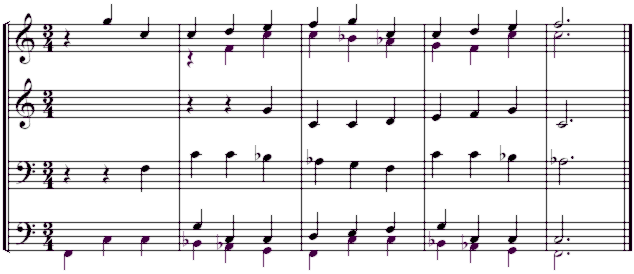
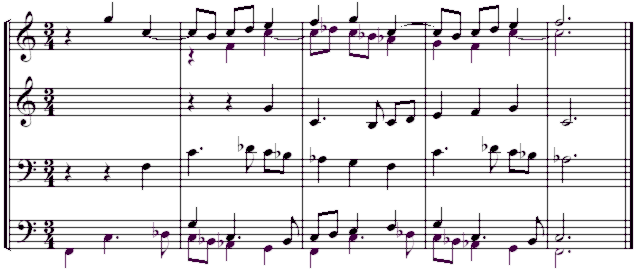
Basic Canon The canonic entries (B2, S1, T, B1, S2, A) were chosen to produce the most satisfactory disposition for the final cadence, with - S1 and S2 sharing the top octave, A and T sharing the central octave, and B1 and B2 sharing the bottom octave, B2, T, and S2 using the lower section of each octave, which rises and
descends, alternating entries with B1, A, and S1 using the higher section of each octave, which descends
and rises. The 4-part canon required a 2 octave range and this 6-part canon requires a 3 octave range. The 6 entries occur in bars 1 and 2, and the complete 6-voice canon evolves in bars 3 and 4.
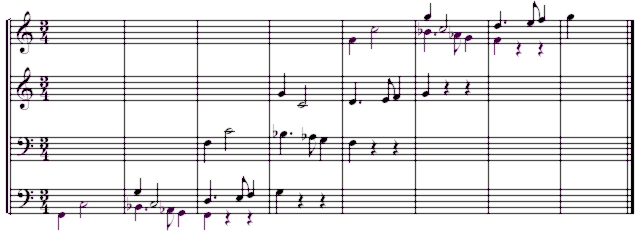
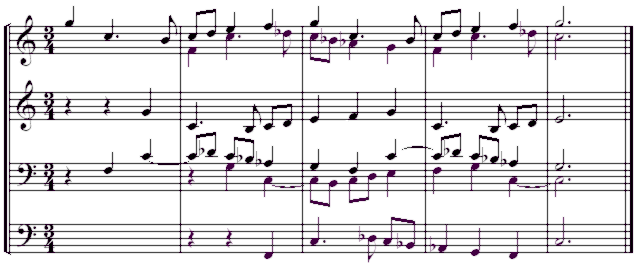
2 Voices Rising This example is in 2 voices only, with entries at a 3-note interval, at the beginning of each 3/4 bar, evolving from the lower to the upper voices, B2, B1, T, A, S2, S1.
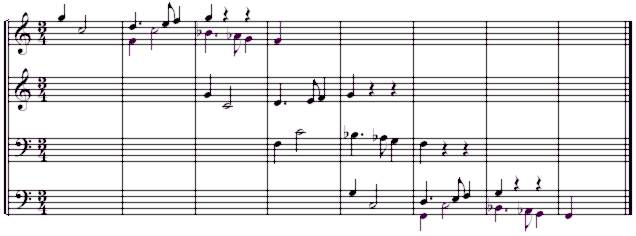
2 Voices Descending This is the inversion of the preceding example evolving from the upper to the lower voices, S1, S2, A, T, B1, B2.
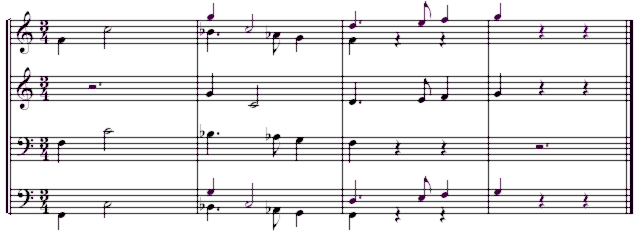
2 Voices Tutti This is a tutti version of the preceding examples, with B2, T and S2 together, answered by B1, A, S1. The inverse order would, evidently, also be possible.
Bach Fugue Theme Using the disposition of the first example, we see how easily it can be transformed into the subject of Bach's Fugue in Ebm
- by dotting note 2, by embroideringOrbit 0with a superior (or inferior) semi-tone on the following(ighth-note), by placing a partial () substitution0(3)byOrbit 0on note 4 (Orbit 3). Once this gets going, there will be constant friction on the Off-Beats, between B and Bb, and between D and Db, with impeccable Voice-Leading in both cases.
Inversus This is the inversion of the previous example. Once again, the order of the canonic entries was chosen to achieve the best possible disposition at the final cadence.
Circle Examples
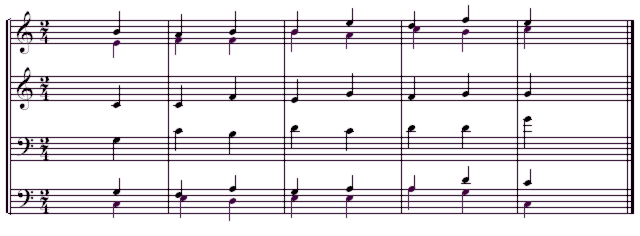
Sextending the Basic Orbit Chain The operation is not as simple in the Circle as it was in the Swing because each1is transformed into10 and each0is transformed into01 byMetamorphosis 1, producing the 6-Voice Orbit Chain3-2-10-01-01-10, with the Voice-Leading (3-2), (2-1), (0-0), (1-0), (1-1), and the procuration (0-3), rather than the original (3-2), (2-1), (1-1), (1-0), (0-0), and the procuration (0-3), of the Swing.
Basic Lines Chord Pattern -C+7 - F+7 - Bm7-5 - Em7 - Am7 - Dm7 - G7 - C The S1 keeps the original3-2-10-01-01-10Orbit Line with3-2added at the end to complete the 8-chord circle. The S2 uses the next2-10-01-01-10-3Orbit Line with2-10added at the end. The A uses the next10-01-01-10-3-2Orbit Line with10-01added at the end. The T uses the next01-01-10-3-2-10Orbit Line with01-01added at the end. The B1 uses the next01-10-3-2-10-01Orbit Line with01-10added at the end. The B2 uses the next10-3-2-10-01-01Orbit Line with, theoretically,10-3added at the end, preferably changed to theFundamentalBass in order to cadence. NOTE the striking similarity of this Circle Sextension, with the 3-voiceCircle with Voice-Leading A, Orbit Chain3-2-10. In the 3-voice circle, we had an Orbit Chain of3-2-10-3-2-10-3-2, with notes B, A, B, D, C, D, F, E. In the 6-voice circle, we had an Orbit Chain of3-2-10-01-01-10-3-2, with notes B, A, B, B, E, D, F, E. Only the fourth and fifth notes were changed, but that was enough to produce 3 more canonic lines.
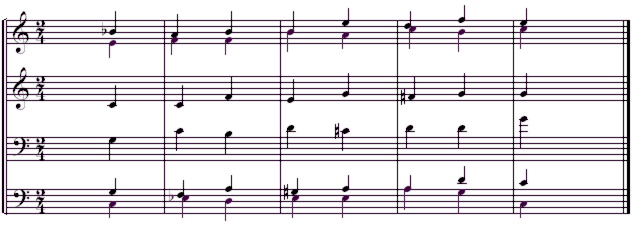
Dominantized This is the same as the previous example with each chordDominantized- on chord 1 withOrbit 3Bb in the S1, on chord 2 withOrbit 3Eb in the B2, chord 3, theBUCKLEchord, is left diatonic because it already has a Dominant sound, on chord 4 withOrbit 2G# in the B1, on chord 5 withOrbit 2C# in the T, on chord 6 withOrbit 2F# in the A, chord 7, is left diatonic because it is the original DOMINANT. NOTE that this process of Dominantization could be applied to any of these forms of circles, with 2-, 3-, 4-, or 6-voice canons.
These basic lines could be used for various canonic variations, as was the case with the swing which was previously seen.