Possibilities There is less choice than one might think in the possibilities of voice-leading: -Orbit 3always resolves toOrbit 2(of the next chord); -Orbit 2normally resolves toOrbit 1(of the next chord).
Resolution Resolution is, above all, a question of lowering thetension by one notch (to the next smaller orbit).
-Orbit 1andOrbit 0are relatively free to go to each other.
More possibilities The principal choice in Voice-lerading lies in what we call the "procuration ofOrbit 3" when we progress from one complete tetrad to another and this is exactly the kind of complete harmony in which we will indulge
for a while.
There are 3 possibilities of procuringOrbit 3(theMOTRIX): -A.fromOrbit 0, with the voice-leading0-3, the most natural; -B.fromOrbit 1, with the voice-leading1-3, more difficult to handle; -C.fromOrbit 2, with the voice-leading2-3, the most convenient, interrupting the normal resolution2-1.
Natural Canons We will examine these forms of Voice-leading by starting at the Basic Level of Tetrads
in the Window and developing a form of "Musical Tapestry", a kind of "Fashion Show"
of musical events, in which the music actually composes itself without any human intervention.
This Musical Tapestry might seem a little unusual and in reality it is. We are here
in the Window delimiting the 7 diatonic notes, but where there is no RHYTHM, no beginning,
no end, no points of rest, no breaths, just continual movement with complete Tetrads;
there is no Fundamental Bass, just the 4 lines of Voice-leading.
We call this form of music "Natural Canons" for reasons which will soon be obvious. For now, these tapestries will be in the
TONIC-DOMINANT swing of C major but would be the same in any other key or in any other
swing.
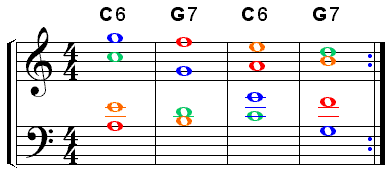
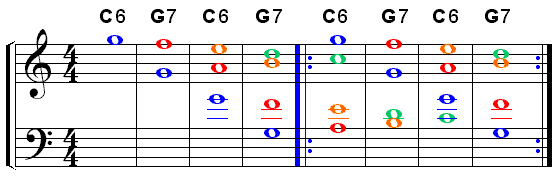
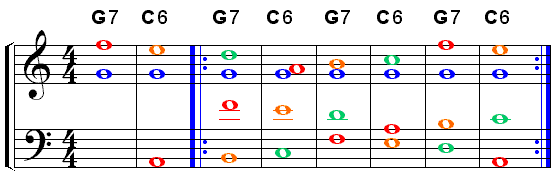
Voice-leading A - Procuration 0-3
The Procuration0-3will produce an orbit chain0-3-2-1which can repeat itself indefinitely.
-Note the Orbit colors of the members of each chord: On the first chord (TONIC - C6) : Orbit 0(theCOMMON TONE) is G; Orbit 1(thePROPER TONE) is C; Orbit 2(theMEDIAN) is E; Orbit 3(theMOTRIX) is A. On the second chord (DOMINANT - G7) : Orbit 0(theCOMMON TONE) is still G; Orbit 1(thePROPER TONE) is now D; Orbit 2(theMEDIAN) is B; Orbit 3(theMOTRIX) is F. The third chord is like the first and the fourth chord is like the second.
Orbit Chains If we verify the orbit colors in each line, voice by voice, we will find0-3-2-1everywhere. This is why we use the term "Natural Canons".
-If each voice starts on the same orbit (sayOrbit 0), the canon is much more obvious, and so is the fact that - the Sopranos and Tenors have descending lines and the Altos and Basses have ascending lines. With the two chords of the swing operating in opposite directions, this should not come as any surprise. NOTE - 1. the 2 descending (or ascending) lines should not be placed in adjacent voices because theycross, and 2. a descending line will produce aFRAMEInversion if it is placed in the Bass Voice. Remaining in this "Primary Disposition" (with an ascending line in the Bass Voice) severely limits the possibilities of disposing the Voice-leading A
Swing - one can only invert the Soprano and Tenor, or the Alto and Bass, not both, because that brings us back to the original disposition. Naming our chord dispositions in ascending order as usual (starting with the Bass
voice) - the disposition we have here, in the fifth chord, is3,2,1,0 (2,1,0,3, 1,0,3,2,and0,3,2,1, in the following chords, would be considered the same disposition). the only other possible disposition is0,1,2,3 (3,0,1,2, 2,3,0,1,and1,2,3,0, would be considered the same disposition). 3or1of the sharpening (ascending) chord (in this case, C6) must be in the Bass voice.
-This one might ring a bell - let's call itBell-1for future reference !
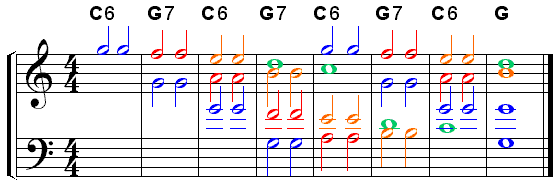
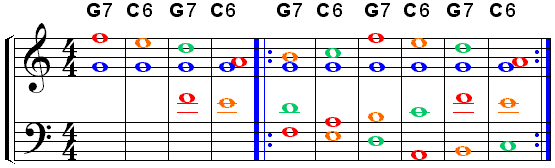
The procuration1-3will produce an orbit chain1-3-2which can repeat itself indefinitely.
V-shape Notice the "V-shape" of this1-3-2movement withOrbit 3at the apex of the "V". This bouncing back ofOrbit 3is most important when one jumps to it (a movement of third or more).
If we wish to complete the harmony,Orbit 0, which does not appear in the chain, will be held in another voice (the Alto for the best disposition of the voices), because the three canonic linescross. There is an unusualspreadbetween the Tenor and Bass voices, but that is the best place for it.
-We do not have 2 descending and 2 ascending lines here, but rather 3 lines which are each successively ascending and descending. This is the result of the conflict between the odd number of orbits in the chain and the even number of chords in the swing. There is no serious objection to theFRAMEinversionin the first chord of the Bass voice - theMOTRIXis present (in the Soprano voice), and theCOMMON TONE, held as a pedal tone throughout, does not attract attention. NOTE - 1. The 3 canonic lines should not, in principle, be placed in adjacent voices because theycross, but it is possible tospreadthem between the Tenor ans Bass voices. 2. TheOrbit 0line should be placed in the Alto Voice to avoid crossing the three top voices. This severely limits the possibilities of disposing the Voice-leading B Swing
- one can only invert any 2 of the 3 canonic lines. Naming our chord dispositions in ascending order as usual (starting with the Bass
voice) - the disposition we have here, in the first chord, is1,2,0,3(simplified1,2,3) (3,1,2and2,3,1, in the following chords, would be considered the same disposition), the only other possible disposition is3,2,1 (2,1,3and1-3-2would be considered the same disposition). The 3 canonic lines, being the same, present no problem of choice for the Bass
voice.
Canons Canons can be produced in contrary motion by entering at the distance of 1 chord, as we did for Voice-leading A, (starting arbitrarily onOrbit 3).
Canons can also be produced in similar motion by entering at the distance of 2 chords.
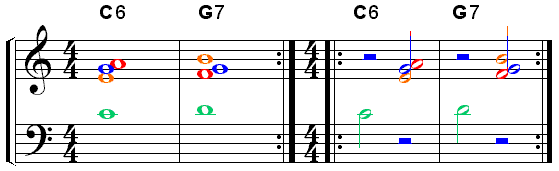
Voice-leading C - Procuration 2-3
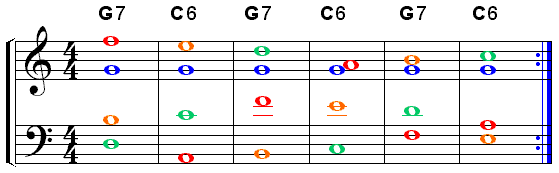
The procuration2-3will produce the orbit chain2-3which can repeat itself indefinitely (Orbit 3returning immediately toOrbit 2). If we wish to complete the harmony,Orbit 1andOrbit 0, which do not appear in the chain, can be maintained in the other two voices. This swing is less interesting than the other two, with far less movement, but has
considerable advantages - 1. The four orbit lines may be present with or without the Fundamental Bass. 2. Any of the four orbit lines can be placed in theBass voice. 3. None of the four orbit lines cross, permitting any choice ofdisposition. Voice-leading C was used exclusively in the examples of themajor mode, both for the swings and for the circle.
-Who knows, it might strike a bell (Bell-2) if presented as a Beat-Off-beat accompaniment, especially if it isdominantized.
Moreover, with various forms ofIncompletenessandNon-chordal tones Voice-leading C has been used extensively in just about all styles of music.