The most fundamental form of chromaticism is that of dominantization, strengthening a weak chord by chromatically turning it into a strong, Dominant-type
chord, one which has the interval of diminished fifth (augmented fourth) between its secondary notes (theMEDIANand theMOTRIX), commonly known as a "Dominant Seventh" or "Minor Sixth" chord depending on its direction.
Dominantizing Swings
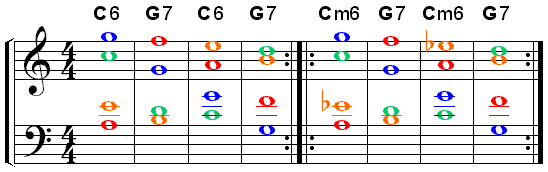
Swing with Voice-leading A -In the swing withVoice-leading A the only chord we can dominantize is the TONIC Chord because the DOMINANT Chord already has that shape and strength. The dominantized TONIC Chord is now Cm6, with a chromaticMEDIANEb.
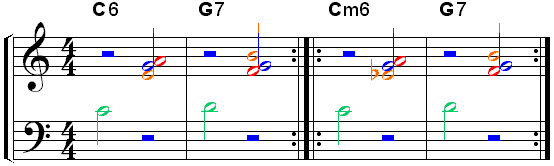
Swing with Voice-leading C -In the swing withVoice-leading C we can also dominantize the TONIC Chord (Cm6 withOrbit 2, Eb). Here is the complete version of ourBell-2- it should ring now!
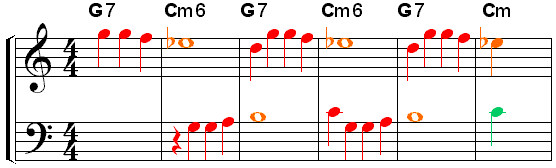
Substitutions -Using the same swing withVoice-leading C withsubstitutionsof theMOTRIX1(3) and 0(3) and with dominantization of the TONIC Chord, here is the complete version of ourBell-3- it should also ring now! You might wish to hear the versionwithoutthe dominantization to compare.
Dominantizing with Metamorphoses
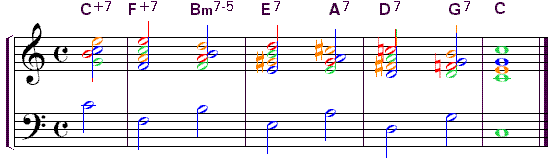
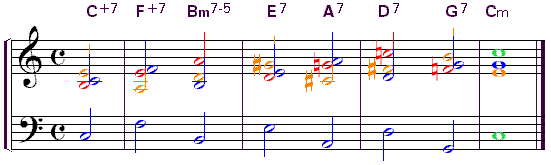
Circle with Voice-leading C -In the circle produced byMetamorphosis 1with Voice-leading C, it is not easy to find a way to dominantize the first three chords. However, starting with theAnte-3at the top of the window, each chord may be dominantized (E7, A7, D7).
Note that each chromatic note is followed by the diatonic note in the same voice, creating a descending chromatic scale.
You might wish to hear the versionwithoutthe dominantisation to compare.
Circle with Voice-leading A -In the circle produced by Metamorphosis 1 with Voice-leading A, the same difficulty exists concerning the dominantization of the first three
chords. No problem if we start with the Ante-3 at the top of the window.
Note that, in this case, each chromatic note is followed by the diatonic note in another voice, creating more elegant, melodic lines.
You might wish to hear the versionwithoutthe dominantisation to compare.
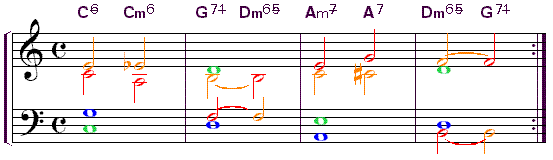
Metamorphosis 2 -In this example ofmetamorphosis 2 the chords of C6 and Am7 were presented as Real Triads to differentiate them from each other. Their respective identities are all the more clearly defined if we dominantize the chord at the point where theMOTRIXappears, Cm6 and A7. You might wish to hear the versionwithoutthe dominantisation to compare.
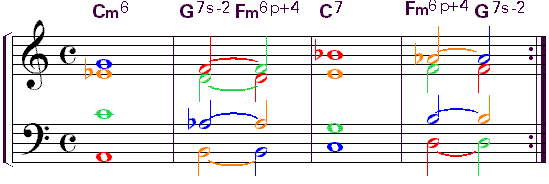
Metamorphosis 3 -In this example ofmetamorphosis 3 the chords of C6 and C+7 were originally presented with theirMOTRIX to differentiate them from each other. Their respective identities are all the more clearly defined if we dominantize them, Cm6 (Eb) and C7 (Bb), as well as the COUNTER, Fm6
(Ab). You might wish to hear the versionwithoutthe dominantisation to compare.
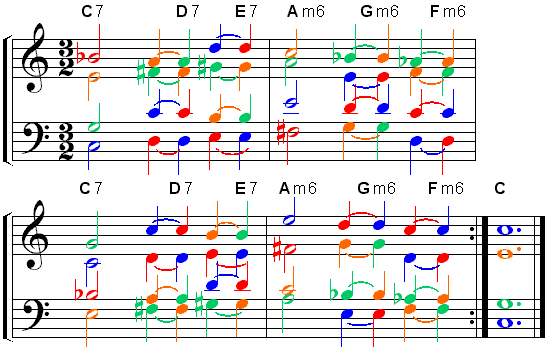
Metamorphosis 4 -In this example of 2 consecutive applications ofmetamorphosis 4 the chords at the beginning of the bars (C+7, Am-6) had no metamorphosis, but the others did (F6Dm7, G6Em7, Em7G6, Dm7F6). As we dominantize each chord, the second function of the metamorphosed chords will be affected, so that C+7 - F6Dm7 - G6Em7- Am-6 - Em7G6 - Dm7F6 will become C7 - D7 - E7 - Am6 - Gm6 - Fm6 all powerful Dominant-shape chords! You might wish to hear the versionwithoutthe dominantisation to compare.