|
Voice-leadingfixes the joint (the "mortar") between any 2 chords.
Three of these Transformations,Incompleteness,
Chromaticism,andNon-chordal Tones,are fairly superficial transfigurations, changing mostly the surface sound of a chord
without altering its function.
TheMetamorphoses, on the other hand, change mostly the function of a chord, without appreciably altering
its sound, sometimes not at all.
Examples will be given in the fundamental, diatonic C MAJOR mode
but they could just as well be transposed into any other key
by simply moving the Window.
seeTHE USE OF COLOR
ORBITS
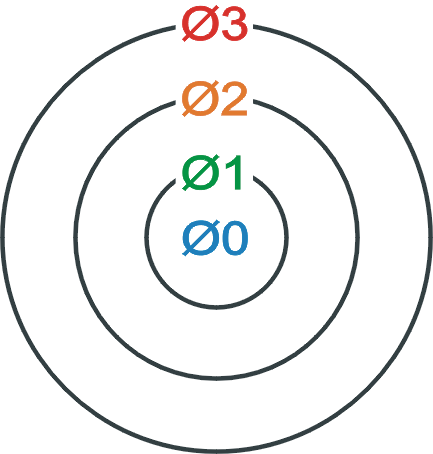
We will now present a terminology which we call the "Orbits of a Chord", numbered
from 0 to 3 (possibly 4, as we will later see) in which the parts of a chord are placed
in order of tension:
|
- theCOMMON TONE,
in the center,
with no tension at all,
is calledOrbit 0;
- thePROPER TONE,
with very little tension,
is calledOrbit 1;
- theMEDIAN(third),
with considerably
more tension,
is calledOrbit 2;
- theMOTRIX
(sixth or seventh),
with the greatest tension,
is calledOrbit 3.
|
Orbit Lines
The natural resolution of Orbits will produce a horizontal sequence that we call "Orbit
Lines".
We know that theMOTRIX,Orbit 3, resolves to theMEDIAN,Orbit 2,
which, in turn, resolves to thePROPER TONE,Orbit 1,
producing the Orbit Line3-2-1.
We have also seen lines which remain on thePROPER TONE,1-1-1,
and lines which remain on theCOMMON TONE,0-0-0.
These Orbit Lines are an essential part of Harmony, as important as the vertical chords
themselves.
Voice Disposition
The Orbit Lines (fundamental generations of Resolution, especially that of the Secondary
Notes) will be disposed in what we call "Voices" to fix what we might call a "Performance
Format" (such as the Soprano, Alto, Tenor, Bass voices of the choral format). This
disposition is of a secondary order of importance because it does not change the lines
themselves, only their position with respect to each other. We will be seeing a great
deal of both, the Orbit Lines and the Performance Voices, in the following pages,
and it is important never to confuse the two, always starting with the lines themselves
and then proceeding to their disposition in the voices.
The Bass Voice
Reducing the fundamental 5-voice presentation of Harmony (the 4 Orbit lines and the
Fundamental Bass) to a 4-voice presentation (which is the norm of choral writing)
requires special treatment of the Bass Voice (the other 3 voices, Soprano, Alto, and
Tenor, remaining unaffected by this reduction). We will offer here a few guide-lines
which assure proper respect for the particular role of the Bass Voice as "pedestal"
for the harmonic "statue".
The Fundamental Bass
TheFundamentalBass line, as we know, consists of the root of each chord
which gives the harmony its most solid footing.
In 4-voice writing, it will be used mostly for phrase endings (traditionally
called "cadences").
When it is used, one of the 4 Orbit-lines must be omitted,
usually1-1or0-0, to preserve the important secondary-note lines,3-2and2-1.
More precision and details are furnished inClass 1 of the Fugue course.
The Orbit Lines
When the Fundamental Bass line is not used (at the beginning of phrases)
the Bass Voice will use (one might even say "borrow") one of the 4 Orbit lines.
The3-2line, composed uniquely of Secondary Notes, is always a good choice,
there being no danger of inversing theFRAME.
Inversion of the Frame
It is dangerous (but not impossible) to place the fifth of the chord in the Bass Voice
below the root of the chord (placed in one of the upper voices),
thus inversing the normal disposition of theFRAME(where the fifth is placed above the root).
Note that this only applies to the fifth in the Bass Voice, not in the other voices.
We will see the different possibilities as we go along, as well as the most appropriate
solutions.
Choral Disposition
The conventional restrictions of Choral Disposition have very little to do with the
fundamertal structure of the musical language. They are far more a part of the performance
of musical material. Since most of our examples are meant for choral performance,
this might be as good a place as any to set the habitual norms for this medium. We
will constantly be referring to Choral Disposition in the examples as well as in the
exercises.
Range of Voices
Each choral voice (Soprano, Alto, Tenor, and Bass) has a range of an octave and a
half,
which must not be confused with the range of solo voices which is considerably
larger.
Now, let's see the "G" rule of thumb -
the upper limit of the upper voices (Soprano and Tenor) is the note "G", and
the lower limit of the lower voices (Alto and Bass) is also the note "G".
The other limit of the four voices is thus either C or D.
Crossing
Crossing is evidently defined as having a lower voice sounding above a higher voice.
In "Harmonic" choral writing, where all the voices have the same note-values
and the same words,
crossing is usually avoided because it is not clearly perceived -
the notes which the Alto voice sings above the Soprano voice
sound as if they were sung by the Soprano voice.
In "Polyphonic" choral writing, where each voice has specific note-values and
words (as in a fugue),
crossing is occasionaly employed because it is clearly perceived -
the notes which the Alto voice sings above the Soprano voice
sound as if they were sung by the Alto voice.
Spread
Neighboring voices can be placed in unisson (for one note)
and can be up to an octave apart.
The spread between Tenor and Bass voices can be considerably larger.
The four voices can thus be quite close together (in ascendng order, G-B-D-F),
quite far apart (F-D-B-G), or
anywhere in between (G-D-B-F or G-D-F-B).
Those on a Guided Tour should click on in the Navigation Bar below. in the Navigation Bar below.
Those browsing might wish to see the transformation ofVoice-Leading
|
