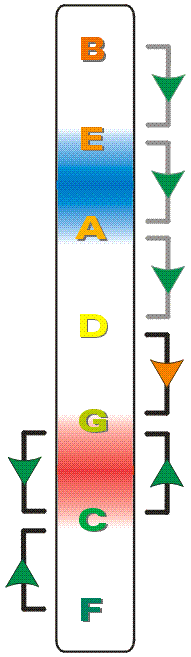
Tetrads will be constructed in the series of fifths, in theWindowof the natural diatonic system (no sharps or flats).
A - This mode consists of a nucleus (at the bottom of the Window) composed of 3 major chords, in theFRAMEs F-C, C-G, and G-D.
The progressions in this nucleus are bidirectional both sharpening ("upward") and flattening ("downward") because the centralTONICchord (in theFRAMEC-G, colored red) can progress in either direction.
The strong (orange) and weak (green) progressions have arrows which are colored accordingly.
B - In this mode we also have a tail (at the top of the Window) composed of 3 minor chords, in theFRAMEs D-A, A-E, and E-B.
The progressions in this tail are unidirectional, all flattening ("downward") because they are attracted to the TONIC chord, passing through the strong DOMINANT chord (in theFRAMEG-D).
A - The nucleus
D
B
G F
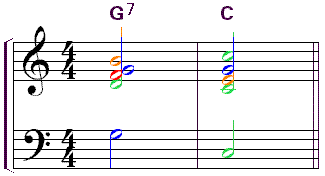
1. The most typical and best-known Tetrad is the DOMINANT Seventh, - the chord ofV, in this case, G7, producing a flattening progression ("downward") - with aFRAMEcomposed of two members of the Series of Fifths, G (theCOMMON TONE) and D (thePROPER TONE) - thePrimary Notes; - with a Major Third, B (theMEDIAN), and a Seventh, F (theMOTRIX), - theSecondary Notes.
-Resolution of the Secondary Notes of the DOMINANT chord of G7: - The Seventh (MOTRIXF), pushed by theCOMMON TONEG (which remains in place), resolves down to the Third (MEDIANE) of the TONIC Chord of C (I). - The Third (MEDIANB) resolves in the opposite direction, up to thePROPER TONEC of the TONIC chord. - The Fifth,PROPER TONED, is free to resolve to either Primary Note, but usually resolves to thePROPER TONEC of the TONIC Chord. The TONIC chord, being in a position of rest, on theBeat, is preferably presented without aMOTRIX. - The "Fundamental Bass", G-C, consists of the root of each chord. - We will have 5 voices in all these examples: the 4 chordal tones and the Fundamental
Bass.
These 5 voices are often used for rudimentary accompaniments but, for more elegant writing, 4 voices are judiciously chosen among them.
A G
E
C
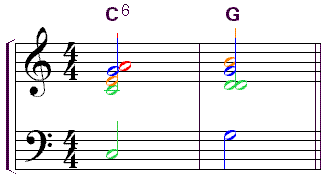
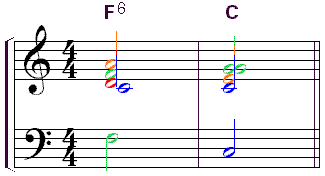
2. What happens to the TONIC Chord of Iwhen it resolves to the DOMINANT? - in this case the chord of C6, producing a sharpening progression (it has a sixth asMOTRIXA, because it resolves "upward" a fifth) - with aFRAMEcomposed of G (theCOMMON TONE) and C (thePROPER TONE) - the Primary Notes; - with a Major Third, E (theMEDIAN), and a Sixth, A (theMOTRIX) - the Secondary Notes.
-Resolution of the Secondary Notes of the TONIC Chord of C6: - The Sixth (MOTRIXA), pushed by theCOMMON TONEG (which remains in place) resolves up to the Third (MEDIANB) of the DOMINANT Chord of G. - The Third (MEDIANE), resolves in the opposite direction, down to thePROPER TONED of the DOMINANT Chord. - The Root,PROPER TONEC, is free to resolve to either Primary Note, but usually resolves to thePROPER TONED of the DOMINANT Chord. The Dominant chord, being in a position of rest, on theBeat, is presented without aMOTRIX. - the "Fundamental Bass", C-G, consists of the root of each chord. Notice the inverse symmetry with the G7-C, DOMINANT-TONIC, progression.
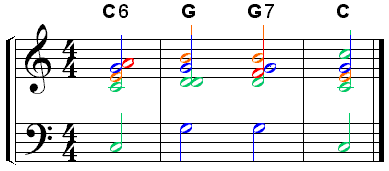
Swings This alternating between the two same chords is what we call a "Swing". This Swing has the note G asCOMMON TONE.
Terminology of the IV chord For reasons which will become increasingly clear as we progress, the use of the term
"Sub-Dominant" to denote the chord ofIV, which is situated (on the degree of the scale) just below the DOMINANT Chord, would
be misleading and imprecise. We prefer to see it in the Window, on the other side
of the TONIC chord and to call it the "COUNTER-DOMINANT" ("COUNTER" for short) and
hope that you will eventually find that this change was worth while.
D C
A
F
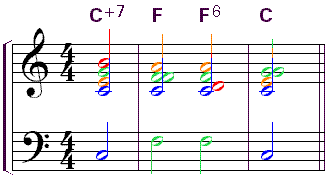
3. The COUNTER-DOMINANT Chord (IV)also resolves to the TONIC Chord (I). - in this case the chord of F6, producing a sharpening progression (it also has a sixth asMOTRIXD, because it resolves "upward" a fifth) - with aFRAMEcomposed of C (theCOMMON TONE) and F (thePROPER TONE) - the Primary Notes - with a Major Third, A (theMEDIAN), and a sixth, D (theMOTRIX) - the Secondary Notes.
-Resolution of the Secondary Notes of the COUNTER Chord of F6: - The Sixth (MOTRIXD), pushed by theCOMMON TONEC (which remains in place), resolves up to the Third (MEDIANE) of the TONIC Chord of C. - The Third (MEDIANA) resolves in the opposite direction, down to thePROPER TONEG of the TONIC chord. - The Root,PROPER TONEF, is free to resolve to either Primary Note, but usually resolves to thePROPER TONEG of the TONIC Chord. The TONIC Chord, being in a position of rest, on theBeat, is presented without aMOTRIX. - the "Fundamental Bass", F-C, consists of the root of each chord. This progression is identical to the TONIC-DOMINANT progression.
G
E
C B
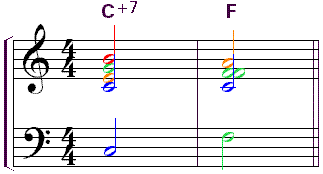
4. Now, what happens to the TONIC Chord (I)when it resolves to the COUNTER? - in this case the chord of C+7, producing a flattening progression (it has a seventh asMOTRIXB, because it resolves "downward" a fifth) - with aFRAMEcomposed of C (theCOMMON TONE) and G (thePROPER TONE) - the Primary Notes - with a Major Third, E (theMEDIAN), and a Major Seventh, B (theMOTRIX) - the Secondary Notes.
-Resolution of the Secondary Notes of the TONIC Chord of C+7: - The Seventh (MOTRIXB), pushed by theCOMMON TONEC (which remains in place), resolves down to the Third (MEDIANA) of the COUNTER Chord of F. - the Third (MEDIANE) resolves in the opposite direction, up to thePROPER TONEF of the COUNTER Chord. - The Fifth,PROPER TONEG, is free to resolve to either Primary Note, but usually resolves to thePROPER TONEF of the COUNTER Chord. The COUNTER Chord, being in a position of rest, on theBeat, is presented without aMOTRIX. - the "Fundamental Bass", C-F, consists of the root of each chord. This progression is very similar to the DOMINANT-TONIC progression.
Another "Swing", this one withCOMMON TONEC
Beware of triads! In each Tetrad, two Triads are "hidden" - the real Triad, in which theMOTRIXis missing, but theFRAMEremains, (the last chord in all the preceding examples) and - a deceptive Triad, in which theCOMMON TONEis missing, and in which the two secondary notes could easily be mistaken for aFRAME. In the G7Tetrad, we have - the real Triad ofV(G, B, D) - the deceptive Triad ofVII(B, D, F). In the C6Tetrad, we have - the real Triad ofI(C, E, G) - the deceptive Triad ofVI(A, C, E). In the F6Tetrad, we have - the real Triad ofIV(F, A, C) - the deceptive Triad ofII(D, F. A). In the C+7Tetrad, we have - the real Triad ofI(C, E, G) - the deceptive Triad ofIII(E, G, B)
It is interesting to note that we have here every diatonic triad available within the nucleus of the major mode. The three major triads are, evidently, all real triads, but the three minor triads, as well as the diminished triad (with 2 minor thirds)
are deceptive. These deceptive triads are incomplete major tetrads (without theCOMMON TONE), and should never be confused with the real minor triads of the Tail in the top of
the Window.
B - The tail
B
G
E D
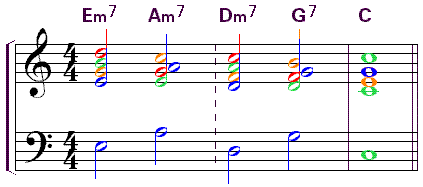
Progressions are all flattening ("downward") , from Em7, the chord ofIII,
E
C
A G
"down" to Am7, the chord ofVI
A
F
D C
"down" to Dm7, the chord ofII, "down" to the DOMINANT Chord, G7(V), which in turn resolves "down" to the TONIC Chord, C (I).
Notice how theCOMMON TONE becomes thePROPER TONEof the next chord - (E- E, A- A ...)
The ANTECEDENTS These are the ANTECEDENTS to the DOMINANT and we give them the following names - "III", Em7- the ANTE-3; - "VI", Am7- the ANTE-2; - "II", Dm7- the ANTE-1.
The Circle Were we to continue indefinitely in the same direction, we would come back to our
original chord and have produced what we call a "circle" (in this case a flattening
circle).
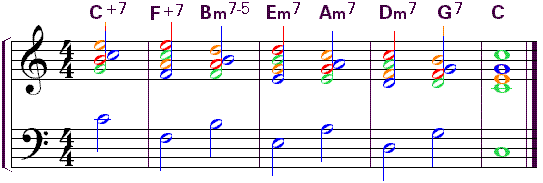
-In this example, we start on the TONIC Chord C+7, then progress "down" to the COUNTER Chord, F+7, then progress "down" to the ANTE-4 Chord, the "BUCKLE*" chord, Bm7-5, then progress "down" to the ANTE-3 Chord, Em7, then progress "down" to the ANTE-2 Chord, Am7, then progress "down" to the ANTE-1 Chord, Dm7, then progress "down" to the DOMINANT Chord, G7, then finally progress "down" to the TONIC Chord of rest, C, withoutMOTRIX.
* This "BUCKLE" chord acts as a link between one extremity of the window and the other. It has the sharpest note (B) as its root and the flattest (F) as its fifth. One should not be surprised of its unusual shape (a "hunch-back"FRAME) and instability. It is almost impossible to treat it as a chord of rest.
Those on a Guided tour should click onin the Navigation Bar below.