Thesix preceding pagesdealt with a very specific form of Natural Canon, a Voice-leading A Swing, in which
: (a) there were no metamorphoses within the canon (only possibly to paste in the
assembling) and (b) there was no Rhythmic structure whatever in the original canon,
no beginning, no end, only vague Binary Groupings because a fundamental Metamorphosis
0 Swing consists of only 2 chords, one in each direction. This canon became more and
more musical (and melodic) as the Rhythmic structure asserted itself. TheCircle, on the other hand, (a) makes constant use ofMetamorphosis 1, and (b) possesses a definite Rhythmic structure, with beginning and end, with a
fixed length of 8 chords. However, these 8 chords can be grouped in 3 very different
ways with varied and interesting results. Each chord of the Circle will be written as a full Bar. This will offer us an opportunity to see that Bars behave, among themselves, exactly
the same way that beats of a bar do and that Rhythm has the sameAlternationof Beats and Off-beats at all levels, large as well as small.
Cell-size, Voice-leading, and Direction If thecell is Binary, with 2 chords (bars), 1 on the Off-beat and 1 on the Beat, Voice-leading Cwill be used, with its binary Orbit Chain (3-2), and the voices will descend a second at each cell. If thecell is Ternary, with 3 chords (bars), 2 on the Off-beat and 1 on the Beat, Voice-leading Awill be used, with its ternary Orbit Chain (3-2-10), and the voices will ascend a third at each cell.
The Binary Circle
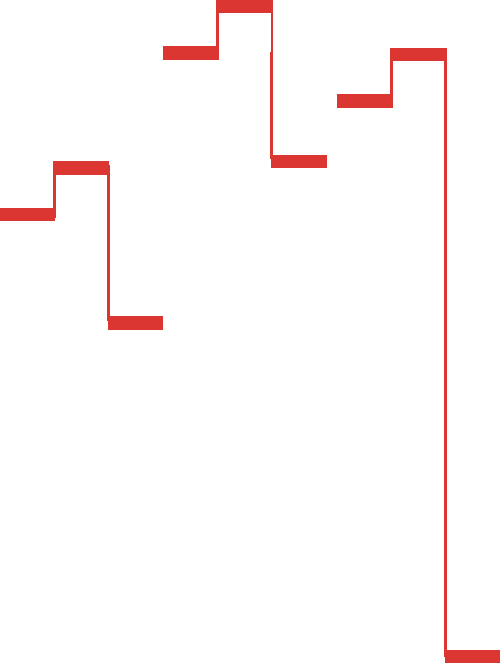
Shape The Binary Circle, with its 4 cells, is in the fundamentalaA / cA, aC / cCshape, abasic binary formwithout any transformation of ablation.
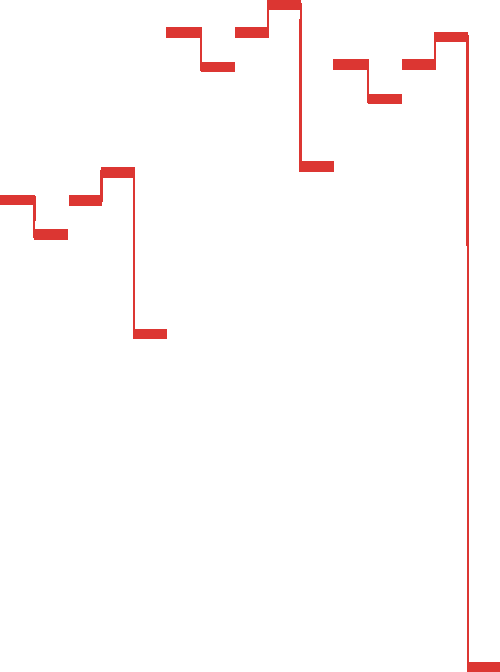
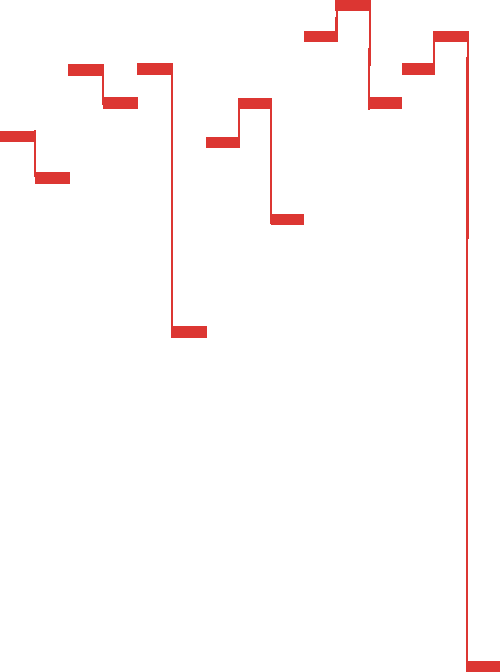
This is what the Rhythm Graphics look like for all the binary Circles, whatever the number ofEntities.
One Entity
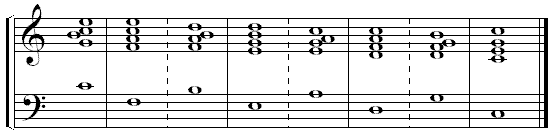
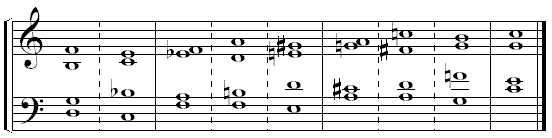
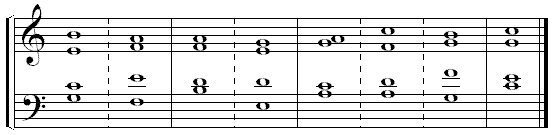
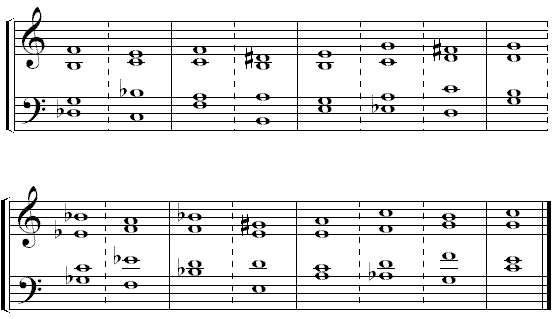
The beginning The very first circle we saw was in theDiatonic Major Mode. C+7/ F+7, Bm7-5/ Em7, Am7/ Dm7, G7/ C We have here one large diatonic 4-cell entity, with aMOTRIXon each chord except the last.
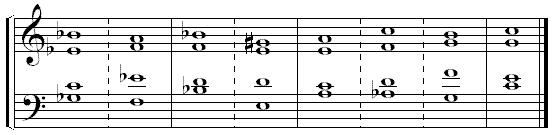
Dominantized C7/ F7, Bm7-5/ E7, A7/ D7, G7/ C We still have only one large 4-cell entity, with aMOTRIXon each chord except the last, but here each chord except the BUCKLE (in Bar 3) has beendominantized.
Two Entities
There are 2 ways of dividing the complete large entity into 2 equal smaller entities, in both cases by having aReal Triadin Bar 4 - 1. with a Real Triad of E (major), part of an Ante-1/Dominant temporary cadence (Bm7-5/ E) in A minor, and 2. with a Real Triad of E minor, part of a Dominant/Tonic temporary cadence (B7/ Em) in E minor.
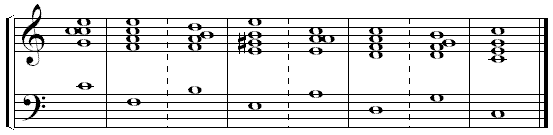
Temporary Dominant in the Middle Only the E major Real Triad is dominantized, all the other chords are diatonic. C / F+7, Bm7-5/ E, Am / Dm7, G7/ C NOTE that theMOTRIXs of Bar 1 and Bar 5 have been removed by a1(3)substitution, leavingMOTRIXs only atLevel +1, in Bars 2, 3, 6, and 7, to avoid re-diatonicizing the G# to G with a weak Inward Chord (Am7), and allowing theMEDIANG# to resolve naturally to A.
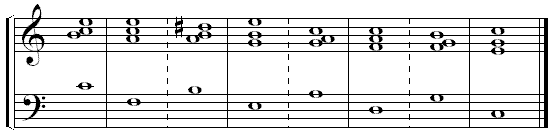
Temporary Tonic in the Middle Only the Buckle is dominantized, actually by borrowing the B-F#FRAMEabove the Window, all the other chords remaining diatonic. C+7/ F+7, B7/ Em, Am7/ Dm7, G7/ C NOTE that we have aNeapolitan Sixthprogression here, between F+7and B7, in which it preferable to leave out theCOMMON TONEline, which starts on G.
Four Entities
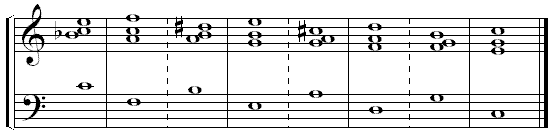
Temporary Tonics in each Cell Each Off-beat (odd-numbered) Bar will be dominantized (Bar 7 is already dominantized in its diatonic state), each Beat (even-numbered) Bar being a Diatonic Real Triad, producing Dominant/Tonic temporary cadences in F, Em, Dm, C. C7/ F, B7/ Em, A7/ Dm, G7/ C NOTE that we still have the Neapolitan Sixth progression here, and that theCOMMON TONEline has been left out.
The Ternary Circle
In order to have Ternary grouping in the 8-chord circle, we must evidently add 1 bar.
This doubly-ternary group of 9 bars is the result of 2 ablations in the binary group
of 16 bars by (a) ablation of bars 1-4 to produce TernaryLevel +2+3and (b) ablation of bars 5, 9, and 13 to produce TernaryLevel 0+1(in other words, removal of the first quarter of the whole 16-bar group, and then
removal of the first quarter of each of the 3 remaining large quarters). The 9 bars
left are the original Bars 6-7-8, 10-11-12, 14-15-16. They will henceforth below be
numbered Bars 1-9.
One Entity
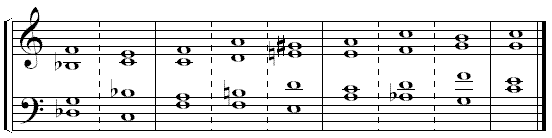
The originalVoice-leading A Circlehad only 8 chords, but it was evidently in Ternary Groups. In order to make it completely Ternary, it will be necessary to add another chord. 1. This can be achieved by adding another TONIC chord at the end - C+7/ F+7, Bm7-5, Em7/ Am7, Dm7, G7/ C, (C) 2. It can also be achieved by adding another chord at the beginning, in this case a DOMINANT chord, which gives it a much clearer Ternary form. G7, C7/ F7, Bm7-5, E7/ A7, D7, G7/ C NOTE that all the chords (except the BUCKLE) have been dominantized, to avoid the over-powering effect of the opening DOMINANT when all the other diatonic chords are weak. NOTE also how effective the diatonic BUCKLE is in this specific rhythmic
position, especially with its flat fifth in the Bass Voice.
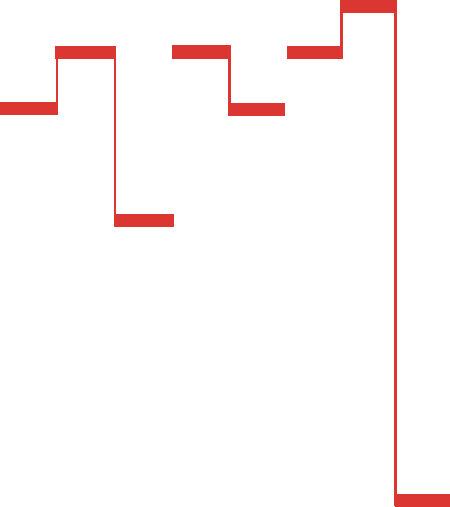
Shape The Ternary Circle has been transformed from the fundamentalaA / cA, aC / cCshape, into acA, aC / cCby the ablation of the first quarter, with 3 bars in each ternary cell.
This is what the Rhythm Graphics look like, for the Ternary Circle, whatever the number of Entities.
Three Entities
Temporary Tonics in each Cell Instead of binary Dominant/Tonic temporary cadences, we will now have ternary Ante-1, Dominant/Tonic temporary cadences, in F, Am,
C. Gm7-5, C7/ F, Bm7-5, E7/ Am, Dm7-5, G7/ C, with the flat fifth in the Bass Voice. NOTE that each Temporary Ante-1 has a minor7-5shape/sound, typical of the diatonic BUCKLE. We may possibly have found the "ideal" Ante-1 sound - The diatonic BUCKLE, once considered the "ugly ducking" of the diatonic circle, might very well be a lovely swan when used as an Ante-1 (temporary or not). Why ? Because the ANTE-1 (Bm7-5in A minor), is the shadow of the Sharpening DOMINANT (Dm6) and contains the SecondLeading Toneof the TONIC (the F), the first Leading Tone (the G#) being in the Flattening DOMINANT
(E7).
The Fibonacci 8 Circle
In the Ternary Circle, we had produced TernaryLevel 0+1and TernaryLevel +2+3. In the Fibonacci 8 Circle, the 4 Levels are fused together, creating one singleLevel 0+1+2+3. Of the 9 bars left in the Ternary Circle (6-7-8, 10-11-12, 14-15-16), one more will
be removed (Bar 10) leaving only the original Bars 6-7-8, 11-12, 14-15-16. They will
henceforth below be numbered Bars 1-8.
Shape The Fiboncci 8 Circle is also in the ternarycA, aC / cC3-cell shape, with only 2 bars in the centralaCcell.
This is what the Rhythm Graphics look like, for the Fibonacci 8 Circle, whatever the number of Entities.
One Entity
C+7, F+7/ Bm7-5, Em7/ Am7, Dm7, G7/ C We have here one large diatonic 3-cell entity, with aMOTRIXon each chord except the last.
Three Entities
Cm7-5, F7/ Bb, E7/ Am, Dm7-5, G7/ C
We have here three 1-cell entities, with aMOTRIXon chords 1-2, 4, and 6-7, and Real Triads with substitution 1(3) on chords 3, 5, and 8. NOTE that - in ternary cell 1 (cA, Bars 1-2-3) and in ternary cell 3 (cC, Bars 6-7-8), we have Ante-1, Dominant / Tonic entities, in Bb and C, but in binary cell 2 (aC, Bars 4-5), we have a shorter Dominant / Tonic entity in Am, thus 3 entities in Bb, Am, C. NOTE also that - in ternary cell 1 (cA, Bars 1-2-3) and in ternary cell 3 (cC, Bars 6-7-8), Voice-leading A is used and the voices rise a third, but in binary cell 2 (aC, Bars 4-5), Voice-leading C is used and the voices drop a second.
Two Circles
It is merely by chance that the Circle falls into a Binary form. There are only 7
chords in the Window, but a Circle requires repetition of the initial TONIC chord
at the very end, giving us a total of the convenient binary 8. Progressing through
2 circles would thus produce 15 chords (2x7+1) which could conveniently be divided
either into 3 groups of 5 or 5 groups of 3 (both Fibonacci numbers).
Three Groups of Fibonacci 5
Shape These 3x5 Circles will also have a ternarycA, aC / cCshape, with 5 bars (chords) in each section, 6 entities (cadences) in all.
This is what the Rhythm Graphics look like for these 3x5 Circles.
C7/ F, Bm7-5, E7/ Am, D7/ G, Cm7-5, F7/ Bb, E7/ Am, Dm7-5, G7/ C We have here 6 entities, in 3 groups of binary-ternary, in temporary keys Am, Bb, C, with descending Voice-leading C in each binary cell, and ascending Voice-leading A in each ternary cell.
Five Groups of Fibonacci 3
Shape These 5x3 Circles will also have a ternarycA, aC / cCshape, with 6 bars (2 cells) in the first and third sections and 3 bars (1 cell) in the second, 5 entities (cells) in all. However, the first section has been transformed from 2 ternary cells to 3 binary cells, producing 6 entities (cells) in all, from the original 5, see below.
This is what the Rhythm Graphics look like for these 5x3 Circles.
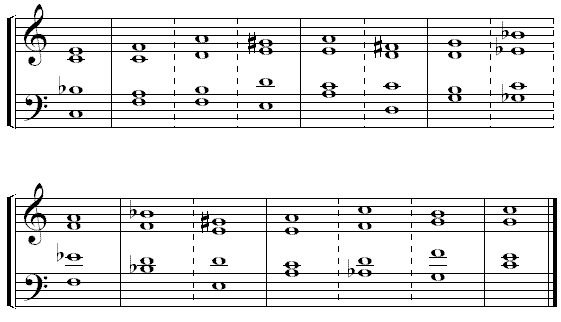
C7/ F, B7/ Em, A7/ Dm, Gm7-5, C7/ F, / Bm7-5, E7/ Am, Dm7-5, G7/ C NOTE the cheating at the beginning, in thecA- instead of being 2 groups of 3 bars, it is 3 groups of 2 bars, a large hemiole, to facilitate the range for a vocal performance, by having 3 Voice-leading C descending cells, instead of 2 Voice-leading A ascending cells. Instead of 6 entities, there would have been 5 without the hemiole cheating. NOTE also that - the first 3 binary cells are the same as the first 3 cells of theBinary Circle in Four Entities(an octave lower), and the following 3 ternary cells are the same as the complete Ternary Circle in Three Entities.
Two Fibonacci 8 Circles
Two Fibonacci 8 Circles will produce 16 chords (bars) and it will be necessary to
add a chord at the beginning as we did for the Ternary Circle of 9 chords.
Shape These 2x8 Circles will have a complete binaryaA / cA, aC / cCshape, with 3 bars in the first (aA) and third (aC) sections and 5 bars in the second (cA) and fourth (cC), 6 entities (cadences) in all. Each Fibonacci 8 circle will have the sameshapeas when we had only one.
Gm7-5, C7/ F, B7/ Em, Am7-5, D7/ G, Cm7-5, F7/ Bb, E7/ Am, Dm7-5, G7/ C NOTE that the first circle is in the DOMINANT key (in G), and the second circle in the TONIC key (in C), as it was in theFiconacci 8 Circle in Three Entities.