We very seldom stop to observe and evaluate the advantages and disadvantages
of Diatonicism. It is a thing which we take so much for granted, like gravity, and
that we know so little about, that this kind of meditation seems useless or at least
premature. However certain elements of Diatonicism can be quite enlightening, and
we will attempt to expose some of them. With or without Diatonicism, certain glorious elements of Music are often totally
disregarded and certainly unappreciated. One of the most important is the presence
of preferential distances (in this case, the octave, the perfect fifth, and the major
third) which do not exist in other cosmic manifestations. The size of the electron
might be the only preferential distance in the physical universe. We are also aware
of other preferential sizes in Music like that of the complete chord (at four notes
and not three as was long thought to be the case) and the size of a diatonic system
(at seven notes, whether in the vertical form of a string of fifths in the Window,
or in the horizontal form of a scale). It would be quite simple to elaborate valid
and convincing proofs for all of these preferential sizes. For the present it will
suffice to examine and appreciate them. InChrominicismandJust Intonation, we examined the nature of individual notes, but we will now examine the nature of
complete chords.
The Window
Rhythmic considerations aside, theWindowis what differentiates Free Harmony from Melodic Harmony. In Free harmony, all chords have the sameDominant shape, while in Melodic Harmony, chords in the Window have several different shapes. In Free harmony, there is no difference between "diatonic" and "chromatic", while in Melodic Harmony, one is inside the Window and the other outside. In Free harmony, there is no Tonic preferential position of rest, while in Melodic Harmony, there are 2 Tonic preferential positions in the Window. We will examine these differences more closely.
2 Levels of Direction
How far can you go in the wood ? Only half-way, after that you're coming out.
The Window level of Direction Very much the same way that individual notes have2 levels of Tendency, individual Tetrads have 2 levels of Direction - 1. Thelarger levelof the entire series of fifths, in which theMOTRIXchoice determines the direction, a flattening direction with a seventh asMOTRIX and sharpening direction with a sixth asMOTRIX, placed in columns (below). 2. The smaller level of the Window (which acts as the proverbial wood), with Inward chords directed toward the center, and Outward chords directed
toward the edge. placed in rows (below). TheBUCKLE chord(both flattening and sharpening) has been placed in the top of the table, being, technically, an Inward chord. All examples (chord symbols) are in the Natural Window.
DIRECTIONS
DIRECTIONS
Flattening
Flattening
Sharpening
Sharpening
BUCKLE
BUCKLE
2-3-3 Sonority Heptatonic span Bm7-5
2-3-3 Sonority Heptatonic span Bm7-5
3-3-2 Sonority Heptatonic span Bm-6-5
3-3-2 Sonority Heptatonic span Bm-6-5
Inward
Inward
3-2-3 Sonority Pentatonic span Em7-Am7-Dm7
3-2-3 Sonority Pentatonic span Em7-Am7-Dm7
3-2-3 Sonority Pentatonic span F6-C6-G6
3-2-3 Sonority Pentatonic span F6-C6-G6
Outward
Outward
3-3-2 Sonority Heptatonic span G7
1-4-3 Sonority Hexatonic span C+7-F+7
3-3-2 Sonority Heptatonic span G7
1-4-3 Sonority Hexatonic span C+7-F+7
2-3-3 Sonority Heptatonic span Dm6
1-4-3 Sonority Hexatonic span Am-6-Em-6
2-3-3 Sonority Heptatonic span Dm6
1-4-3 Sonority Hexatonic span Am-6-Em-6
Diversity of Chord Shape/Sound
In both flattening and sharpening directions , we find 7 chords (the BUCKLE and 6
in the Window). In the first row, The BUCKLE chord (both flattening and sharpening, Bm7-5and Bm-6-5) has a Heptatonic span (B-F) between its PrimaryFRAMENotes which destabilizes it completely and prevents it from being a chord
of rest. In the second row, 3 of the Window chords will resolve Inward, toward the center
of the Window, with a Pentatonic span between thePROPER TONEand the weakMEDIAN, and will have a totally homogeneous3-2-3 Sonority of minor seventh chords (Em7, Am7, Dm7) or sixth chords (F6, C6, G6), depending on the large-level direction (flattening or sharpening). In the third row, 3 of the Window chords will resolve Outward, toward the edge
of the Window, and divide in 2 very distinct categories (a really mixed bag) - 1. ADominant-shapechord, the only one left from Free Harmony, is an Outward chord in position only, without the slightest intention of ever leaving the Window, with a Heptatonic span (B-F) between its strong Secondary Notes, producing the cadential DOMINANT / TONIC progression essential to the
Strong Modes, G7/ C in DiatonicMajorand Dm6/ Am in DiatonicMinor. This powerful, climaxing, cadence brings musical phrases to an end and seems to have considerable influence on the remaining chords
of the Window. We have left the unidirectional (Circle) terrain of theTail and are now in the bidirectional (Swing) terrain of theNucleus. 2. We find here 2 considerably complex chords, with a Hexatonic span between theCOMMON TONEand the weakMOTRIX, major seventh chords(C+7, F+7) or minor flat sixth chords (Am-6, Em-6), depending on the large-level direction (flattening or sharpening).
Degrees of Diatonicism
1. The Inward chords, with their pentatonic span, are the most diatonic of all the
Window chords, never involved with the notes on the edge of the Window (if they are placed in
the center, of course). 2. The Outward chords, with their hexatonic span, are less diatonic than the Inward
chords, using one of the notes on the edge of the Window, either asCOMMON TONEor asMOTRIX. 3. The DOMINANT chords with their heptatonic span, are even less diatonic than either the Inward or Outward chords, using both notes on the edge of the Window, asMEDIANand asMOTRIX. 4. The BUCKLE chords with their heptatonic span, are also less diatonic than either the Inward or Outward chords.
Metamorphosis 4 We will define aMetamorphosis 4association between 2 chords as one in which both chords are composed of the same notes with inversion of the Primary and Secondary functions. This Metamorphosis 4 association exists between - the 2 groups of Inward chords (F6Dm7, C6Am7, G6Em7), the 2 groups of Outward chords (F+7Am-6, C+7Em-6), the DOMINANT and BUCKLE chords (G7Bm-6-5, Dm6Bm7-5).
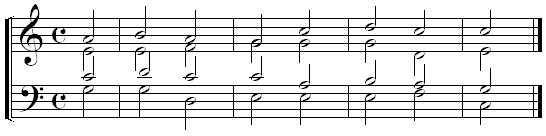
The homogeneous Inward sound It would be possible to use the nucleus chords (eitherMajororMinor) without using the DOMINANT and thus maintain a soft homogeneous sound with only weak Inward chords. We have here, in C major, the chord pattern C6/ G6, Dm7F6/ C twice, with a cadential disposition the second time. There is aMetamorphosis 1on the first 2 chords and a Metamorphosis 4 on the third chord. We have here, in A minor, the chord pattern Am7/ Dm7, G6Em7/ Am twice, with a cadential disposition the second time (same Metamorphoses). Traveling through both modes, we have here the chord pattern Dm7F6/ C6/ G6Em7/ Am7, which can be repeated indefinitely. There is a Metamorphosis 1 on each chord, followed by a Metamorphosis 4 on the
first and third chords. The same traveling through both modes, but with Diminution applied to the end of each
chord Dm7F6, F+6+1/ C6, C+6+1/ G6Em7, Em-7-5/ Am7, Am-7-5, which can be repeated indefinitely (same Metamorphoses).
Tonality
The concept of Tonality evidently comes from the presence of the 2 remaining Dominant
shape chords. Fortunately, each DOMINANT resolves to aTONICwhich is centrally placed in its own mode, with its COUNTER(DOMINANT) on the outside, at the very extremity of the Window, and its DOMINANT on the inside, near the center of the Window, ready to receive its series of unidirectionalANTEs.
Traveling between modes Each diatonic mode (MajorandMinor) has its Nucleus at one end of the Window, and its Tail at the other. Thehalf circleof each mode starts on the TONIC of the other mode - theMajorhalf circle (Am7/ Dm7, G7/ C) starts on theMinorTONIC (Am), and theMinorhalf circle (C6/ G6, Dm6/ Am) starts on theMajorTONIC (C). One could even include a foray into the COUNTER Swing, before taking off on the journey to the other mode - fromMajortoMinor(C+7/ F6, C6/ G6, Dm6/ Am), and fromMinortoMajor(Am-6/ Em7, Am7/ Dm7, G7/ C). In all of this traveling, one could indulge in copiousdominantization, without shaking the solidity of the Window in the least, enjoying the sound of Free Harmony without losing the security of Tonality, such as Dominantizing each Off-beat (C7/ F, Cm6/ G, Dm6/ Am, Am6/ Em, A7/ Dm, G7/ C), or Dominantizing every chord except the last (C7/ Fm6, Cm6/ Gm6, Dm6/ Am, Am6/ E7, A7/ D7, G7/ C).
What about the price ? As long as we travel within the Window, there is no appreciable price to pay for Tonality, and the advantages are considerable. However, even the innocuous (complete) diatonic circle leads us into perilous terrain which we will now explore.
The Buckle Chord
In the complete circle, the link from one end of the Window to the other cannot be
other than difficult, with the considerable difference of Chrominicism between the 2 ends. We end up with the distorted, deformed, mis-shapen, hunchbackedBuckle Chord whoseFRAMEconsists of the sharpest note of the Window (B,) acting as root of the chord, and the flattest note of the Window (F) acting as fifth of the chord, both inTrunk Tuning. It is impossible to use the diatonic Buckle Chord as a (temporary) Tonic of any kind, but it is possible to use it as a (temporary) Dominant chord (with a flat
fifth).
The Neapolitan Sixth
In circles In theMajorcircle, it will be preferable to use the chord below the Window (Bb), when we need a temporary Tonic chord of rest, and it will be preferable to use the chord above the Window (B7), when we need a temporary Dominant chord of motion. NOTE that we are using the very first notes of Primary Chromaticism (Bb and F#) for theFRAMEs of these "extension chords" which seem to be attached to the Window even if they are outside of
it, a little like a balcony or porch is to a house. Linking this together will bring us to what is traditionally called the "Neapolitan
Sixth", which is essentially no more than a simple major triad, whose distinction lies in the fact that it precedes a Dominant Seventh chord, placed a diminished fifth below it (in flattening progressions). It would therefore seem preferable to speak of a "Neapolitan Sixth progression" which includes the following chord, rather than of an isolated "Neapolitan Sixth chord". A few examples of flattening circles with each Off-beat dominantized - 1. Traveling from TONIC to TONIC, we would have C7- F - B7- Em - A7- Dm - G7- C. 2. Traveling from DOMINANT to DOMINANT, we would have G7- C - F7- Bb - E7- Am - D7- G. NOTE that in both examples, from F to B7, and from Bb to E7, we find the Neapolitan Sixth progression, in which there is noCOMMON TONE, and in which the Voice-leading is specific and delicate. 3. In theInterlaced Circles, after C - E7- Am - C7and F - A7- Dm - F7, we find Bb - D7- G - B7, in which both extension chords Bb (of rest) and B7(of movement) appear.
In the m74 Chord Pattern (I-IV-V-I) We have here the generation of the traditional Neapolitan Sixth (chord/progression)
- (a) first with A - A - G# - A in the Soprano, Orbit chain0 - 03 - 2 - 1, with Metamorphosis 4 on the second chord, and Metamorphosis 1 on the third
chord, (b) then, A - Bb, A - G# - A, with a temporary chromatic superior Non-chordal
Tone on the second A, (c) and finally, A - Bb - G# - A, in which the Non-chordal Tone is permanent. This (c) is what the traditional Neapolitan Sixth looks/sounds like. The tuning is a comma higher (Bb+, D, F+) than it was for the extension Bb triad (Bb,
D-, F) being higher in the Window (in theMinorsection). This process is completely inside the Window and does not cause any kind of problem.