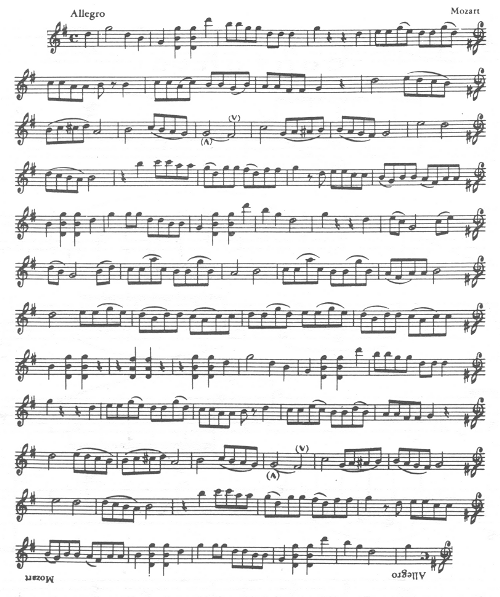
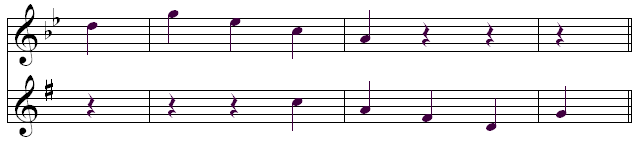
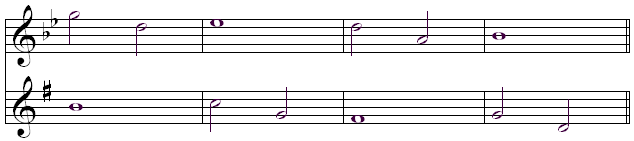
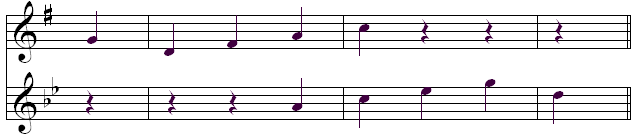
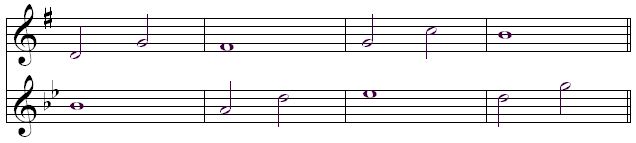
The "Face to Face Duet" in which two performers read the same sheet of music in opposite
directions, is, tecnically speaking, aretrograd inversecanon transposed to the proper key. Although Bach composed a large number of canons,
none of them were of this specific type. The only example we are aware of is a duet
by Mozart for two violins, presented here as edited and abridged by Livingston Gearhart.
This presentation of the Mozart Face to Face Canon (with the clefs and key signatures at both ends of each line) is what is called the "Enigma" from which the two performers read the work. It is evidently quite difficult to acurately assess the result of the canon from this
disposition. For this reason, we will present most of ourexamplesin the "score" form (with the retrograde line, written in its forward direction, below the first
line, the original Enigma) and see what we call the "Upside" and the "Downside" at the same time.
Theory
Since Face to Face Canons are both Retrograde (in Time) and Inverse (in Pitch), the
all-important aspect of Pivots will be equally important in the Rhythm of the Canon,
on one hand, as well as in the Harmony and Melody of the Canon, on the other.
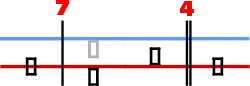
In Each Bar Rhythmic Pivots will exist at different levels of the Canon, from the largest level in the very center, around which all must be symmetrical, possibly to intermediate levels in the center of sections, and even to individual bars, which will ensure the same result backward
as well as forward, and which is strongly recommended for the beginner. This is quite similar to starting the Footsies at the smallest possible
level.
Bars of 4/4 - left intact, with 1 note - would evidently be a,, divided into 2 notes - would evidently be 2,, divided into 3 notes - would normally be 2with abetween them,, or possibly 2tied to the extremes,__, (a syncopated Latin Melo-rhythm, written with ties because dots are
not "retrogradable") divided into 4 notes - would normally be 4s,, or possibly 2s tied to the extremes with 2 others in the middle,__, (the "dot-snap" Melo-rhythm ofComin' Through the Rye) divided into 5 notes - could be 2s on each side of a,, or 4s in the middlle of 2s with the 2 middles tied,_, (another favorite syncopated Latin Melo-rhythm, also used in theFrailach) It is preferable not to write the 2 tieds as a syncopated to avoid the individual flags of the other 2s which are not as "retrogradable" as the beams. or possibly 3s in the middlle of 2s all syncopated, Latin style (the individual flags are inevitable), divided into 6 notes - could be 2s on each side of 2s,, or aon each side of 4s,, divided into 7 notes - would be 8s with the middle 2 tied,_. More complex Melo-rhythmic patterns could be devised usings (See 3/4).
Bars of 3/4 - left intact, with 1 note - would evidently be 3 tieds,__(remember that dots are not retrogradable), divided into 2 notes - would evidently be 2s in the middle tied to the outsides,__, divided into 3 notes - would evidently be 3s,, divided into 4 notes - would be 2s between 2s,, or possibly 2s between 2s,, all syncopated, Latin style (the individual beams are inevitable), divided into 5 notes - could normally be 2s on each side of a,, or possibly aon each side of 2with anbetween them,. We will certainly find other symmetrical possibilities as we go along.
At Larger Levels We will examine the rhythmic pivots of larger levels as we proceed in thepracticeof writing these Face to Face Canons.
In Pitch
1. TONIC Frame as Pivot
Melo-harmony - Chord Patterns With theFRAMEof the TONIC chord acting as Pivot, this TONIC chord evidently corresponds to itself, and the DOMINANT and COUNTER(dominant) chords, on each side of the TONIC, correspond to each other.
The most natural Melo-harmonic chord pattern will obviously be the74pattern, shown here inDiatonic Major, but also possible in the4 Strong Modes. NOTE the symmetry between the COUNTER (below the TONIC line) and the DOMINANT (above the TONIC line). The most basic Melo-line on this pattern would be the1-1Orbit line, the notes A,G at the end, on the4pattern, and the notes D, C at the beginning, on the7pattern, producing the Melo-line D, C, A, G, consisting uniquely ofOrbit 1.
If we add the missing, central, note B in this D, C, A, G Melo-line, we have the D, C, B, A, G line (which we affectionately call "the winner"), and the "cadential 64 chord" would normally be placed on the new note B, producing the64chord patternon the last 4 notes.
The rhythmic symmetry of this64chord pattern will be achieved by shortening the final TONIC chord and placing the second half as a pick-up at the beginning (shown here in black), (TONIC for a, COUNTER for a, TONIC for a, DOMINANT for a, and TONIC for a), with the "cadential 64 chord" in the center. Remember that the74chord pattern consists of (TONIC for a, COUNTER for a, DOMINANT for a, and TONIC for a). We will see how useful both of these patterns can be when creating Melo-lines.
Melo-lines - Clefs and Keys With theFRAMEof the TONIC chord placed in the center, theMEDIANof the TONIC chord will be placed on the center line of the staff - the note B in Treble Clef, placing us in the Key of G (major or minor), the note D in Bass Clef, placing us in the Key of B or Bb (major or minor), the note G in C Clef first line, placing us in the Key of E or Eb (major
or minor), the note E in C Clef second line, placing us in the Key of C (major or minor), the note C in C Clef third line, placing us in the Key of A (major or minor), the note A in C Clef fourth line, placing us in the Key of F or F# (major
or minor), the note F in C Clef fifth line, placing us in the Key of D (major or minor). We have listed the 7 possibilities despite the fact that few of the C Clefs are still in use. InPractice, we will see that the Retrograde (Downside) need not necessarily be in the same Clef as the Forward (Upside), and the mean between the two acts as pivot for the canon. Example - with Treble Clef at one end of each line (center B), and Bass
Clef at the other (center D), the note C (as in the C Clef third line) would act as melodic pivot. NOTE that the choice of Clef(s) (and Key) in no way affects the Chord Pattern of the
Harmonic Symmetry, which is determined solely by the Harmonic Pivot, in this case the TONICFRAME.
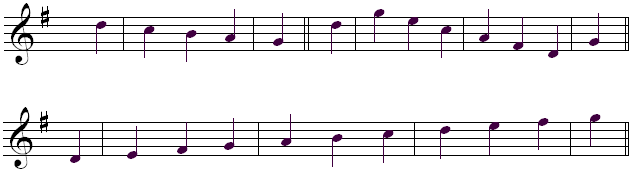
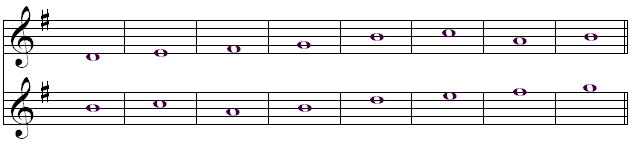
We have here 3 examples - the first a descending scale from D to G (our "winner"), the second a descending arpeggio through the COUNTER and DOMINANT triads,
and the third an ascending scale from D to G which covers the whole staff. These 3 examples sound exactly the same in both voices (directions), producing
unison passages (the Upside and the Downside being identical). The first 4 notes of the third example (as well as the last 4 notes, in each
case, D, E, F#, G) would have the Downside at the octave of the Upside, on each side of the
center of the staff, as we will later see. These examples are written in the simplest possible note-values, all. More complex and interesting Melo-rhythm could eventually be contrived.
Pitch Specifics
The following variables of Modes, Intervals, and Counter-melodies, evidently apply only to Pitch and not to Time.
Modes
Diatonic Major As we did in theHarmonyVolume, all examples are given in theDiatonic MajorMode. They can subsequently be tranformed into the otherStrong Modes.
Diatonic Minor Transposition from Diatonic Major toDiatonic Minoris simply one of Inversion around the melodic Pivot of the canon.
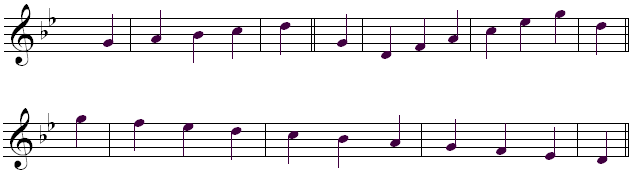
We have here the 3examplespresented in the "Tonic Frame as Pivot", with the Key Signature changed to Gm (2 flats), and all the notes inverted around the center of the Treble Clef staff (the note B,
in this case Bb). All previous comments (in the Diatonic Major Mode) also apply here.
Chromatic Minor If we compare the Diatonic Major andChromatic Minormodes, in this situation using the convenient Keys ofG majorandG minor, we see that - thenucleusFRAMEnotes, C, G, D, A, are common to both keys, but that theMEDIANs are divided - Eb (of the COUNTER) and Bb (of the TONIC) are in the Key of G minor,
and F# (of the DOMINANT)) and B (of thedominantizedTONIC) are in the Key of G major. The dominantized TONIC at the beginning of them74pattern is obligatory to preserve the harmonic symmetry ofmajor,minor,major,minor(G, Cm, D, Gm). The main task here will be to "spread theMEDIANs around" between the 2 lines.
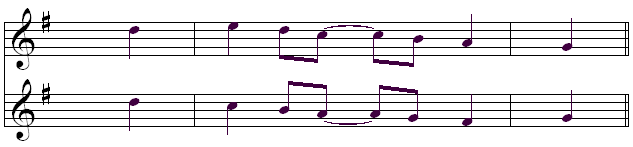
The secondexamplepresented in "Tonic Frame as Pivot" could easily be transposed to Chromatic Minor by cutting the phrase in 2 and giving each player half of it. This is achieved by simply placing rests at the end - The Upside (Gm) player plays the first half (with the Eb) while the
other player counts rests, the Downside (G) player plays the second half (with the F#), and they both play the 2 notes in the middle (C and A) for rhythmic stability.
It is also possible to write complete, independant Melo-lines by placing theMEDIANs first (here ins) - Eb and Bb in the Upside (Gm) line (in bars 2 and 4), and B and F# in the Downside (G) line (in bars 1 and 3). NOTE that the B and the Bb conveniently correspond to each other (as
do the Eb and the F#) . The 2FRAMEnotes of each chord will now be placed (ins) in the appropriate available spots, in such a way as to always surround eachMEDIANby conjunct motion withPROPER TONEs (a D on each side of the Eb, and a G on each side of the F#) to assure Retrograde resolution. NOTE that we are encroaching on the concept ofCounter-melodywhich we will see shortly.
Chromatic Major Transposition from Chromatic Minor toChromatic Majoris also one of Inversion around the melodic Pivot of the canon, as it was for the Diatonic Modes. The Upside line will now be in G major (1 sharp), and the Downside line will now be in G minor (2 flats). The Downside line is now higher than the Upside line.
Here is the first example, with the 2 lines sharing the melody.
Here is the second example with complete, independant Melo-lines.
Intervals
Unisons - Octaves The 3examplespresented in the Tonic Frame as Pivot, all produced unisons, because they were all symmetrical around the center of
the staff. In this specific form of Pivot, the Tonic Frame (in this case, a fifth from D down
to G) is right in the center but the "Inter-Frame" (a fourth from D up to G) is off-center and by itself, produces octaves.
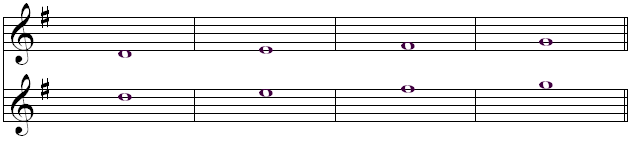
We have here, in the Upside, the four notes D, E, F#, G in the lower half of the staff,
and they will be answered, in the Downside, by the same four notes in the upper half
of the staff, an octave higher.
Thirds - Sixths To produce thirds, we must shift the Pivot of the Upside from the central B to the
neighboring C, thus shifting the Pivot of the Downside to the corresponding A, and automatically (almost magically) producing thirds.
We have here (in the complete central bar of the Upside) thefivenotes E, D, C, B, A, centered on the C, which will be answered in the Downside by the notes C, B, A, G, F#, centered
on the A, a third lower than the original Upside.
Counter-melodies
To produce canonic counter-melodies, we must place them end-to-end, (either on the same line, or on 2 different lines) and they will automatically sound together..
We have here (in the Upside) - first the notes D, E, F#, G, which we already saw in theexample on octaves, followed by notes B, C, A, B, which not only answer at the unison, but also act as a suitable Counter-melody to the original Melody. The Downside will first present the Counter-melody (while the original Melody is in the Upside), then the original Melody, an octave higher, (while the Counter-melody is in the
Upside). Both the original Melody and the Counter-melody are presented here on the same line, but it would be necessary to place them on individual lines if we wanted to insert additional material between them. NOTE that this is not exactly the same process as the one we had inChromatic Minor, where the Counter-melody evolved directly, almost miraculously, from the original
Melody.
Practice
Exercise 1 Pivot 1, only 1 Line, Unisons and Octaves, in the 2 Diatonic Modes, in Treble and Bass Clefs
Let's start with somerthing simple.
1. Using, as models, the threeexamplesin the Clefs and Keys section (with Pivot 1, treble clef in G major), make a line of your own. 2. You may use as aharmonic chord patterneither theM74pattern, with a complete TONIC bar at each end, or theM64pattern with a TONIC half-bar at each end and a complete TONIC bar in the middle. In either case, the bars at the ends may be shortened and given a pick-up
shape, as was the case in theexamples. 3. The Melo-line may be either ascending or descending, in either scale or arpeggio form. NOTE that the ascending arpeggio form was not used in theexamples, and you might feel up to trying it. 4. Count the notes in the bars and refer to the options in theRhythmic Pivots. 5. Verify that you have produced perfect Retrograde unisons or octaves. 6. You now have the Diatonic Major version with Pivot 1, treble clef in G major (with
1 sharp). 7. There are now several possibilities of transformation which you may undertake in the order you please - (a) change mode, in this case to theDiatonic Minor, and (b) change clefs, in this case either by - using theBass Clefat both ends, or possibly using 2 different clefs, Treble at one end and Bass at the other. You could thus end up with 6 different versions in 6 different Keys (G, Gm, D,
Dm, C, Cm). 8. Enjoy !And let us know if you have any problems.
Exercise 2 Pivot 1, only 1 Line in canon, Unisons and Octaves, in the 2 Diatonic Modes, in Treble and Bass Clefs
This shouldn't be too difficult either.
1. Let's start with either of 2 scale passages from D to G ins (with Pivot 1, treble clef in G major), (a) the descending Tonic Intra-frame "winner" (D, C, B, A, G) all .inside theFRAME, or (b) the ascending Inter-frame (D, E, F#, G) passing from oneFRAMEto another, from which you will make a line of your own which will be in canon with itself, in other words, a 2-partRound Canonwithin a Face to Face Canon. 2. This is achieved by - repeating the line (at least once, to have it twice), and adding rests at the end of the Upside to make the Downside start at the right distance (in time) from the Upside. In the case of the Intra-frame Winner, which has 5 notes, the bars at the ends should preferably be shortened tos to give the phrase a 4-bar structure. 3. Verify that you have produced perfect Retrograde unisons or octaves. 4. Here again, each of these 1-line "Round-Face" Canons (the Intra-frame Winner and
the Inter-frame) in the Diatonic Major version with Pivot 1, treble clef in G major (with
1 sharp). can be transformed to produce 6 versions (in G, Gm, D, Dm, C, Cm) by (a) changing mode, in this case to theDiatonic Minor, and (b) changing clefs, in this case either by - using theBass Clefat both ends, or possibly using 2 different clefs, Treble at one end and Bass at the other. 5. We strongly recommend that you do BOTH the Intra-frame Winner and the Inter-frame
! Let us know if you have any problems.
Exercise 3 Pivot 1, only 1 Line in 2 canons, Unisons and Octaves, in the 4 Modes, in Treble and Bass Clefs
Let's see if we can arrange the 2 preceding Round-Face Canons to make a complete 4-part
canon. They are both part of theNatural Canon SwingwithVoice-leading A. In the Intra-frame Winner we have the Soprano and Tenor Voices, at the same octave, with the G at the end aSubstitutionofOrbit 0byOrbit 1, and in the Inter-frame we have the Alto and Bass Voices, in the required octaves. More on this later (In 5.).
1. The operation is relatively simple, just playing both lines together. Repeat the lines at least once, to hear them twice, (one line could be repeated an extra time, to both start and end the entire
4-part canon). 2. Now, add rests - not only at the end of the Upside of one Round-Face Canon to make the Downside start where it should, but also at the beginning and at the end of the other Round-Face Canon, to make both the Upside and the Downside start where they should. 3. There should be no problem with perfect Retrograde unisons or octaves, but check all the entries carefully. 4. Lots of transformation possibilities here ! We evidently start from the Diatonic Major version (with Pivot 1, treble clef in Gmajor, with 1 sharp), which we have just completed with both the descending Intra-frame Winner and the ascending Inter-frame Round-Face Canons. Then we can change mode - first to theDiatonic Minor by inverting the lines and changing the Key Signature tominorin both lines, in this case Gm (2 flats), second to theChromatic Minor by placing the descending Intra-frame Winner inminor and the ascending Inter-frame inmajor, in this case Gm (2 flats) and G (1 sharp) respectively, third to theChromatic Major by placing the ascending Intra-frame Winner inmajor and the descending Inter-frame inminor, in this case G (1 sharp) and Gm (2 flats) respectively. For any of the above, we can also change clefs (and Keys) either by - using theBass Clefat both ends (in B, or Bb, major or minor), or possibly using 2 different clefs, Treble at one end and Bass at the other (in
A major or minor). 5. In performance, if the Upside (or Downside) of the Intra-frame Winner is played
by a piccolo, which sounds an octave higher than written, and the other 3 parts are performed by flutes, which sound at the written octave, the result would be very much like that in theVoice-leading ASwing. Let us know if you have any problems.