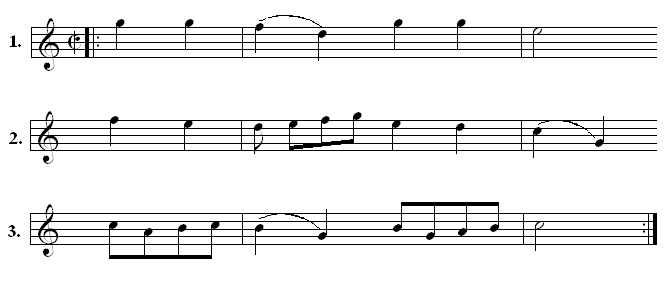
Rounds, otherwise known as "perpetual canons", are no more than theVoice-leadinglines of aMelo-harmonicchord pattern. Unfortunately, this has not been the case in their historical development,
and a great number of them, including the much revered but poorly conceivedFrère Jacques, do not adequately measure up to this minimal exigency of harmonic structure because
they were conceived as being purely and uniquely melodic. Any of these traditional
round canons would be appropriate material forAnalysis.
The M4 Pattern
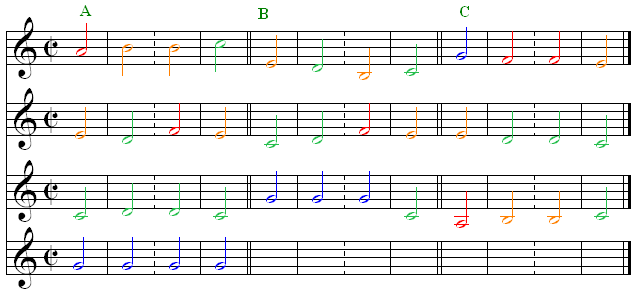
Let's start by seeing what we can produce with the basic DOMINANT / TONIC pattern TheOrbit Voice-leading Linesare - Orbit 3/Orbit 2, the notes F / E, Orbit 2/Orbit 1, the notes B / C, Orbit 1/Orbit 1, the notes D / C, and Orbit 0/Orbit 0, the notes G / G.
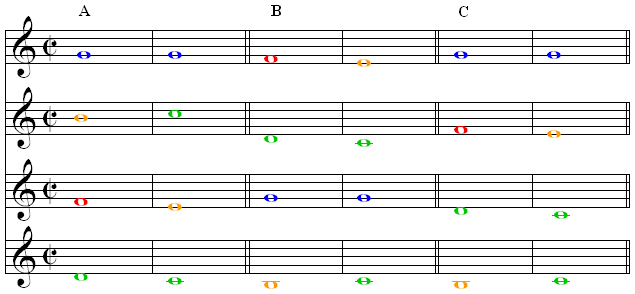
Canonic Disposition of the Orbit Lines These Orbit Voice-leading lines can be distributed in various ways - (A)0 / 0 , 2 / 1 , 3 / 2 , 1 / 1 ,will be developed below, and proved to be a great success. (B) 3 / 2 , 1 / 1 , 0 / 0 , 2 / 1 ,has placed the last 2 Orbit Lines at the beginning, and can serve as aCounter-Melodyfor the (A) version. (C)0 / 0 , 3 / 2 , 1 / 1 , 2 / 1 ,has a nice smooth, melodic, descending scale, the disposition we recommend inSingAlotfor learning this chord pattern, and which is the basis for the ever-popularChopsticks.
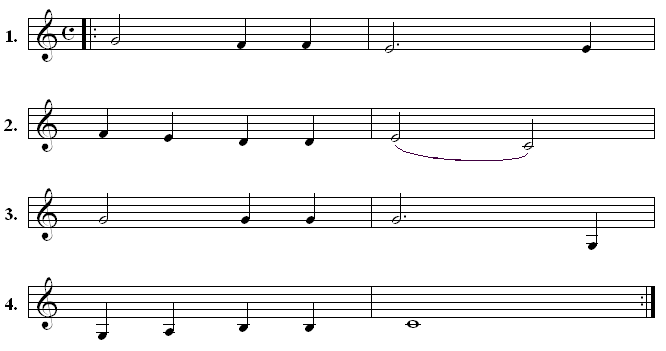
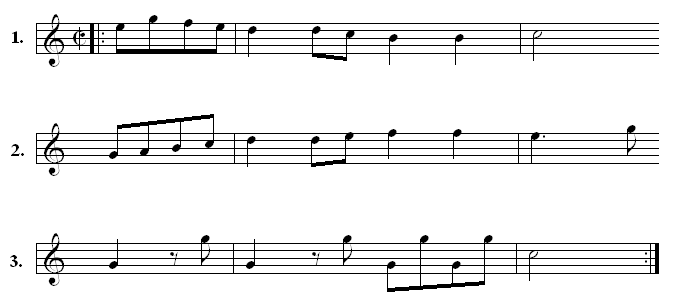
(A) Embelishing Orbit Lines into Canonic Melody
Processes There are 2 processes of embelishment in this canon : Melo-rhythmic subdivision and
Embroideries. In Canonic Line 1, we find a Feminine Rhyme, with an important superior Embroidery,
A, to improve the sonority with the Masculine Rhyme of Canonic Line 2,
C, followed by a superior and then a (chromatic) inferior Embroidery at the
end. In Canonic Line 2, we find an inferior Embroidery just before the Masculine Rhyme. The second half of Canonic Line 2 acts as a pick-up to Canonic Line 3, placing the second half of the canon at a smaller Rhythmic Level. In this pick-up we find a (chromatic) inferior and then a superior Embroidery before the Feminine Rhyme of Line 3. In Canonic Line 3, after the Feminine Rhyme, we repeat the whole process twice, into the Feminine Rhyme of Line 4 In Canonic Line 4, after the Feminine Rhyme, we repeat the whole process into the Masculine Rhyme at the end. It is a good idea to fill in the last 3s, to get back to the large level of the beginning and not start the repeat
too soon. One could clap hands or simply say "two, three, four".
The Melo-rhythmic subdivision of Line 1 was repeated in Line 2, and the second half of the Melo-rhythmic subdivision of Line 1 was used for Lines 3 and 4.
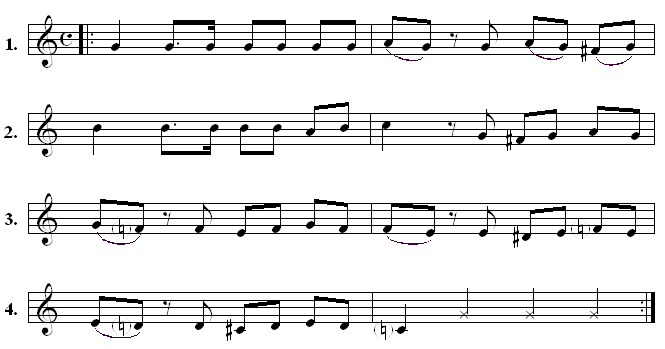
(B) Producing a Counter-Melody Canon
Producing aCounter-Melodyis quite similar to producing a Round Canon, maintaining the same Melo-harmonic Chord PatternM4, and distributing the Orbit Voice-leading Lines wisely, especially the resolutions of the Secondary Notes (Orbit 3andOrbit 2), while constantly seeking satisfactory sonorities between the 2 melodies. The processes of embelishment in this canon are : Melo-rhythmic subdivision, use of 2 lines, Substitution ofOrbit 3, and Non-Chordal Tones (including a Passing Tone). In Canonic Line 1, we find a substitution0(3), GF / E. In Canonic Line 2, we find double and single Non-Chordal Tones ofOrbit 1, FED / EC, the only Feminine Rhyme. In Canonic Line 3, there is nothing butOrbit 3, G. In Canonic Line 4, we find 2 Orbit Lines,0 / 1, G / C (the Fundamental Bass), and2 / 1, B / C, with a Passing Tone between them, GAB. Orbit 0, which can "resolve" anywhere, is often used as a supplementary Orbit Line to create more melodic
variety.
The Melo-rhythmic subdivision is much simpler in this canon, / for Lines 1 and 3, and \ / for Lines 2 and 4, with the Feminine Rhymein Line 2. The canon remains at the same (large) Rhythmic Level throughout.
These 2 Counter-Melody Rounds are very popular in Quebec with French words. We hope to have English words for them shortly, and include them in theSingAlotrepertoire. They should be sung a little higher, preferably in Eb.
(C) Chopsticks
Canonic possibilities The well-knownChopsticks, which very young children play with their two index fingers, makes a very ingenious use of these 4 Orbit Voice-leading Lines - Orbit 0/Orbit 0, G / G, andOrbit 3/Orbit 2, F / E, are presented together, then Orbit 2/Orbit 1, B / C, andOrbit 1/Orbit 1, D / C, are presented together. It is surprising that no one seems to have realized that the 2 phrases could be played
simutaneously, and that a second child, playing an octave lower, could start when the first
reaches the second phrase, the 2 phrases complementing each other perfectly to give a complete DOMINANT / TONIC progression.
It is also possible to organize the middle section ofChopsticksto form another canon, but we will see this in theEvolving Canons.
(D) Answering Machine
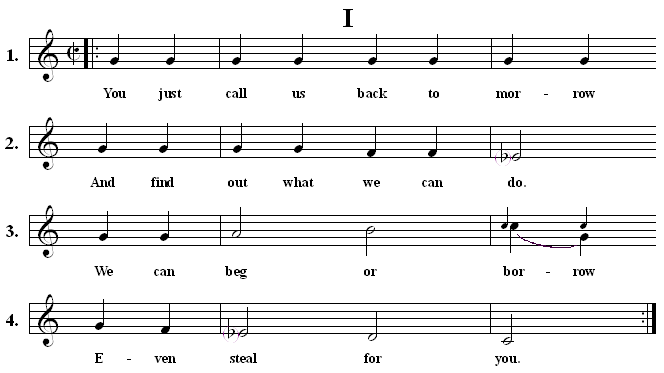
A new invertible 4-voice round canon Here is another ingenious use of the 4 Orbit Voice-leading Lines in theM44chord pattern - Orbit 0/Orbit 0, G / G,Orbit 3/Orbit 2, F / E,Orbit 2/Orbit 1, B / C, andOrbit 1/Orbit 1, D / C. The 4 lines all start onOrbit 0, G - Line 1 remains there for all of its 8s. Line 2 leaves it at the second DOMINANT chord forOrbit 3, F, (the Procuration ofVoice-leading A), which resolves toOrbit 2, F / E. Line 3 leaves it at the first TONIC chord forOrbit 3, A, (also the Procuration of Voice-leading A), and closes with theOrbit 2/Orbit 1line, B / C, (the small notes are for the ending only). Line 4 leaves it in the first DOMINANT chord forOrbit 3, G-F, (Substitution 0(3)), and closes with theOrbit 1/Orbit 1line, D / C. The lines spread out in a fan-like pattern, with Line 3 ascending and with Lines 2
and 4 descending.
In other modes WITHOUT the optional Eb (indicated "(b)" in Lines 2 and 4) and singing the original
E natural, this version is in theDiatonic Major Modein the Key of C major. WITH the optional Eb (indicated "(b)" in Lines 2 and 4) this version is in theChromatic Minor Modein the Key of C minor.
The inversion
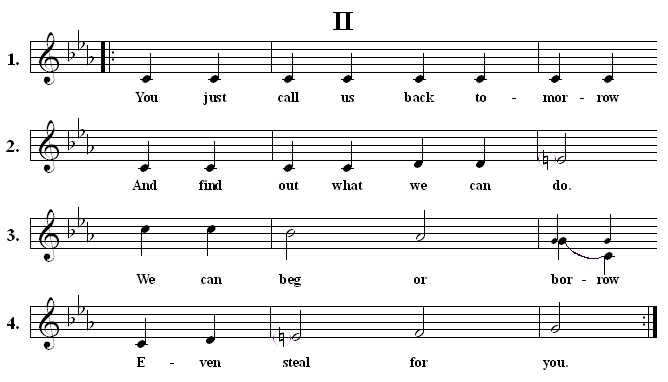
The inversion is not around the central note D of the Window but rather around theFRAMEC-G and uses the correspondingw44chord pattern in C minor (Fm6/ Cm, Fm6/ Cm) rather than in A minor (Dm6/ Am, Dm6/ Am), with the 4 Orbit Voice-leading Lines - Orbit 0/Orbit 0, C / C,Orbit 3/Orbit 2, D / Eb,Orbit 2/Orbit 1, Ab / G, andOrbit 1/Orbit 1, F / G. Here again, the 4 lines all start onOrbit 0, C - Line 1 remains there for all of its 8s. Line 2 leaves it at the second DOMINANT chord forOrbit 3, D, (the Procuration ofVoice-leading A), which resolves toOrbit 2, D / Eb. Line 3 leaves it at the first TONIC chord forOrbit 3, Bb, (also the Procuration of Voice-leading A), is placed an octave higher to remain within the C-C octave range, and closes with theOrbit 2/Orbit 1line, Ab / G, (the small notes are for the ending only). Line 4 leaves it in the first DOMINANT chord forOrbit 3, C-D, (Substitution 0(3)), and closes with theOrbit 1/Orbit 1line, F / G. With Line 3 placed an octave higher we no longer have a fan-like pattern, but we still have 1 line descending (Line 3) and 2 lines ascending (Lines 2 and
4).
In other modes WITHOUT the optional E natural (in Lines 2 and 4) and singing the original Eb, this version is in theDiatonic Minor Modein the Key of C minor. WITH the optional E natural (in Lines 2 and 4) this version is in theChromatic Major Modein the Key of C major.
Traveling between the modes With the inversion around theFRAMEC-G rather than around the central note D of the Window, the 4 versions of this canon are all in the Key of C, either C major or C minor, making it very convenient to travel from one mode to another, all combinations being possible. For combining the 4 versions, we recommend the following order to get the best possible
balance - The Diatonic Minor Mode, versionII, singing the original Eb, The Chromatic Minor Mode, versionI, singing the optional Eb, The Chromatic Major Mode, versionII, singing the optional E natural, and The Diatonic Major Mode, versionI, singing the original E natural. The 2 minor modes are placed first, the 2 major modes last. The sharpening (ascending) modes alternate with the flattening (descending)
modes. The diatonic modes are placed first and last, the chromatic modes in the
middle.
Performance 1. For a mixed-voice choir it is preferable to have M-F-F-M entries to have the best disposition at the end of the first entry. 2. It's a good idea to sing the canon through in unison before the canonic performance. 3. A satisfactory, short performance could consist of 8 bars of unison and 8 bars
of canon, with a fermata at the end. 4. Don't hesitate to travel between different modes and try out all the combinations. 5. You will probably prefer to sing it a tone higher, in D (minor and major).
Lyrics The words are, of course, pure nonsense, what you might hear on the answering machine of a loan-shark, based on the old "beg, borrow, or steal" saying. In the French version, the lyrics are far more poetic and sentimental, praising the joys of friendship, as inAuld Lang Syne. You might feel like writing some lyrics of your own.
The M34 Pattern
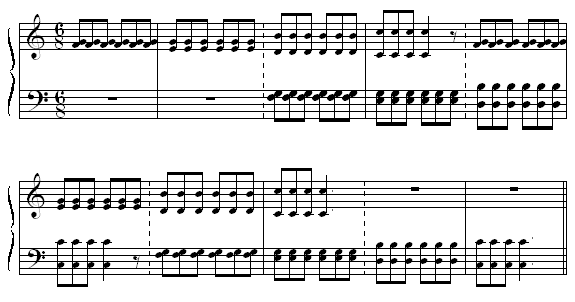
Let's look at this 2-cell TONIC / DOMINANT , DOMINANT / TONIC pattern TheOrbit Voice-leading Linesare - Orbit 3/Orbit 2,Orbit 2/Orbit 1, the notes A / B, B / C, Orbit 2/Orbit 1,Orbit 3/Orbit 2, the notes E / D, F / E, Orbit 1/Orbit 1,Orbit 1/Orbit 1, the notes C / D, D / C, and Orbit 0/Orbit 0,Orbit 0/Orbit 0, the notes G / G, G / G.
Canonic Disposition of the Orbit Lines Since this chord pattern consists of 2 cells, with a breath between the two (at the
dashed bar-line), the Canonic Lines can jump from one Orbit Voice-leading line to another
- (A) 3 / 2 , 2 / 1 // 2 / 1 , 3 / 2 // 1 / 1 , 1 / 1 // 0 / 0 , 0 / 0 are the 4 "normal" lines exposed above with the same Orbit on both DOMINANT
chords. (B)2 / 1 , 2 / 1 // 1 / 1 , 3 / 2 // 0 / 0 , 0 / 1, with aFundamentalBass in the third line, are the choice of Orbit Lines made for a first 3-voice canon. (C)0 / 3 , 3 / 2 // 2 / 1 , 1 / 1 // 3 / 2 , 2 / 1 are the choice of Orbit Lines made for a second 3-voice canon which can serve as aCounter-Melodyfor the (B) version.
(B) Embelishing Orbit Lines into Canonic Melody The processes of embelishment in this 3-voice canon are : Melo-rhythmic subdivision, use of 2 Orbit Lines, and Non-chordal Tones (Embroideries
and Passing Tones), The 3 Canonic Lines have Masculine Rhymes, and the first two have the same Melo-rhythmic subdivision. In Canonic Line 1, we find 2 Orbit Lines,0 / 1, G / D and2 / 1, E / D, with a superior Embroidery , F, which is also a Passing Tone from the
G. There is also a Passing Tone, C, as we change Orbit Line. In Canonic Line 2, we find 2 Orbit Lines,0 / 1, G / D and1 / 1, C / D, with 2 Passing Tones, A and B, between G and C. There is also a Passing Tone, E, as we change Orbit Line. Here again,Orbit 0, which can "resolve" anywhere, is used as a supplementary Orbit Line to create more melodic variety. In Canonic Line 3, we have a different Melo-rhythmic subdivision, without any Foreign Tones whatsoever. A series of 5 octave "sneezes" with theFBat the end, GG, GG, GGGGGC.
(C) Producing a Counter-Melody Canon Here again, for thisCounter-Melody, we will maintain the same Melo-harmonic Chord PatternM34, and distribute the Orbit Voice-leading Lines wisely, especially the resolutions of the Secondary Notes (Orbit 3andOrbit 2), while constantly seeking satisfactory sonorities between the 2 melodies. The processes of embelishment in this canon are : Melo-rhythmic subdivision, use of 2 Orbit Lines, Substitution ofOrbit 3, and a variety of Non-Chordal Tones. In Canonic Line 1, we find the Voice-Leading A procuration, G / F, Substitutions1(3)and0(3), DGG / E. In Canonic Line 2, we find : unprepared Non-Chordal Tones ofOrbit 2andOrbit 1, FE / D and ED / C as well as the insertion ofOrbit 0, G, with the Passing Tones E and F. the only Feminine Rhyme, with anotherOrbit 0, the low G. In Canonic Line 3, we find Substitution1(3)with Passing Tone B, insertion ofOrbit 0, G, with Passing Tone A.
These 2 Counter-Melody Rounds are very popular in Quebec with 5- and 6-yearolds. We hope to have English words for them shortly, and include them in theSingAlotrepertoire. They should be sung lower, preferably in G.