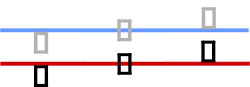
There are 4 principal processes of Chord Pattern Transformation - 1. Opening, 2. Tenant Chords, 3. Shadows, and 4. Pasting.
1. Opening
Once
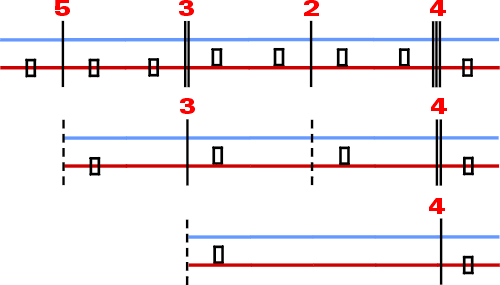
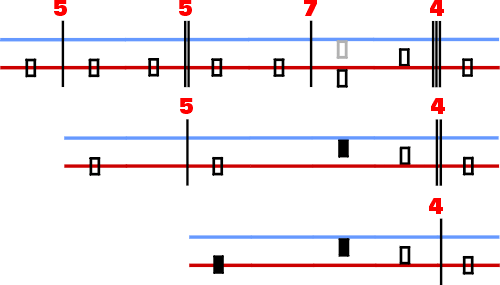
1a.Opening consists of repeating each chord - DOMINANT, DOMINANT / TONIC, TONIC - and then placing the last (TONIC) chord, as an anacrusis, at the beginning, producing a smaller rhythmic level - TONIC / DOMINANT DOMINANT // TONIC.
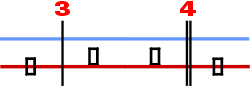
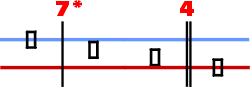
Chord Pattern34 (a swing between the two same chords, C6 / G G7 // C)
Antecedent-Consequent The first cell3(C6 / G) is the antecedent which opens the harmony. The second cell4(G7 // C) is the consequent which closes the harmony. The DOMINANT chord on the Beat of the first cell (G) is a form ofLanger Hinge.
Symmetry Note the inverse symmetry between the 2 cells (the antecedent and the consequent), one progression sharpening, and one progression flattening, the essence of theSwing.
Note the single bar-line in the3, where there is only the “drop” ofLevel 0, and the double bar-line in the4, where there are the “drops” ofLevel 0andLevel +1. (By “drop” we evidently mean the passing from the Off-beat to the Beat.)
Examples This chord pattern is extremely popular, and the astute listener will find it everywhere, from Neapolitan songs Carnival of Venice-3434, to Mexican tunes La Raspa-3434, Folkloric staples Down In The Valley-34 Oh Where, Oh Where-3434, as well as A great variety of classical music.
Twice
1b.Opening again would produce, at a still smaller rhythmic level - TONIC / TONIC TONIC // DOMINANT DOMINANT / DOMINANT DOMINANT /// TONIC.
Chord Pattern5324, with an antecedent composed of 53(C / C C6 // G), and a consequent composed of 24(G / G G7 /// C). The DOMINANT chordLanger Hingeis now on the Beat of the second cell.
Note the triple bar-line at the end, forLevel +2.
Examples Another big favorite - Laura's Theme(from Dr. Ghivago) -5324, Polly Wolly Doodle-5324 5324, La Raspa-5324, La Cucaracha-5324, Mexican Hat Dance-5324, Rudolf, The Red-Nose Reindeer-5324. Rossini couldn’t live without the5324pattern. In hisOvertures, at least one of the two themes, sometimes both are on this Chord Pattern. Not to forget a lot of Waltzes.
The same pattern
1c. It is quite evident that these three patterns are the same at different levels.
Starting from the bottom and working up will enable you to perceive the process of
opening. This clearly indicates that all the levels meet at the end and not at the beginning.
2. Tenant Chords
Placing a Tenant Chord consists of - Replacing the first part of a subdivided chord by another chord, immediately sharper (superior) or flatter (inferior) than the original in
the Window, which resolves to the "true chord" on the second part. This is the harmonic equivalent of the Non-chordal Tones in Harmony - Transformations. By placing a Tenant Chord, it is possible to transform the fundamental34chord pattern, in which the 2 DOMINANT chords (in the middle) occupy the complete Off-beat of the4at the large level.
A sharper Tenant
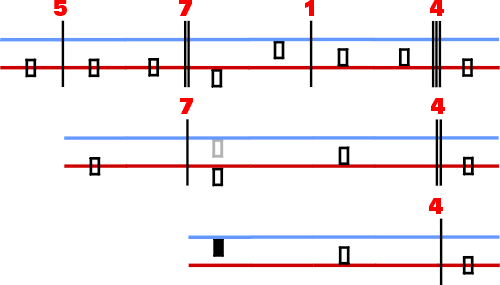
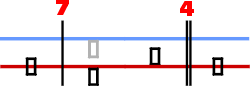
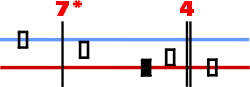
The 74 Pattern 2a. If the tenant chord on Chord Pattern34is sharper (superior), the first DOMINANTchord will be replaced by an ANTE-1 (formerly a COUNTER transformed by a Metamorphosis 4) TONIC / COUNTER (ANTE-1) DOMINANT // TONIC
and this will produce Chord Pattern74, (C+7 / F6Dm7 G7 // C)
with an antecedent composed of Progression7(C+7 / F6Dm7), and a consequent composed of Progression4(G7 // C). In the sound file, Voice-leading C is used between tetrads. The COUNTER chord on the Beat of the first cell (F6) is now theLanger Hinge.
Symmetry Note the direct symmetry between the 2 cells (the antecedent and the consequent), two flattening progressions, three with the ANTE-1 / DOMINANT progression between the cells, the essence of theCircle.
Examples This is another very popular chord pattern (the traditionalI-IV-V-I), a folkloric staple - Little Brown Jug-7474 The chorus ofMy Bonnie-7474 Aura Lee-74 Certainly one of BACH’s favorites.
Opening The 74
2a1. Opening Chord Pattern74will produce, at a smaller rhythmic level - TONIC / TONIC TONIC // COUNTER ANTE-1 / DOMINANT DOMINANT // TONIC. There is an openMetamorphosis 4in the center.
Chord Pattern 5714 with an antecedent composed of Chord Pattern57(C / C C+7 // F6 ), and a consequent composed of Chord Pattern14(Dm7 / G G7 /// C). Here again we see, at three rhythmic levels, the generation of5714from the original4, where the Tenant Chord is indicated in solid black.
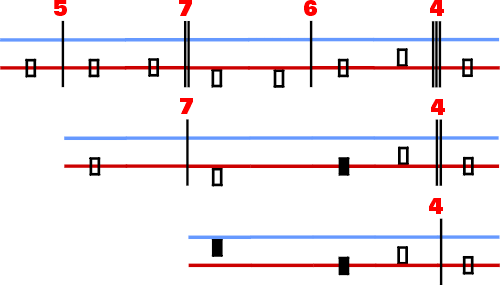
Another Tenant 2a1a. Placing a flatter (inferior) tenant chord, on the first DOMINANT of5714will produce TONIC / TONIC TONIC // COUNTER COUNTER / TONIC DOMINANT /// TONIC. There is no more Metamorphosis 4.
Chord Pattern 5764 with the same antecedent composed of Chord Pattern57(C / C C+7 // F6 ), but with a new consequent composed of Chord Pattern64(F6 / C G7 /// C). You will notice, in the sound file, that, on Chord 6, the Fundamental Bass is that of the original DOMINANT proprietor (G) and not that of the TONIC tenant (C) to clearly distinguish it from the
last TONIC of rest at the end. This is commonly called the "cadential 64 chord", with notes a sixth and a fourth above the bass note.
Here again we see, at three rhythmic levels, the generation of the5764 from the original4where both Tenant Chords (one sharper and one flatter) are indicated in solid black (one Tenant Chord is even indicated in the74).
Examples This5764pattern is used far more often than the original5714. Over The Waves-5324 5764 Bill Bailey-5324 5764
A Flatter Tenant
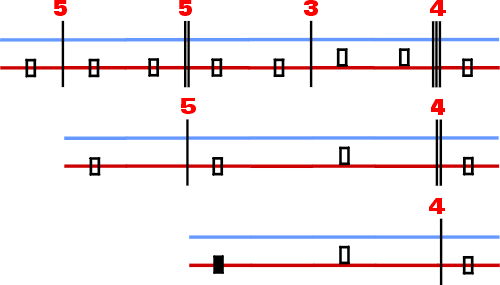
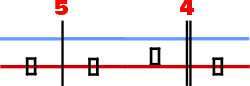
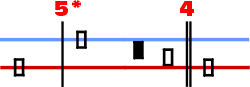
The 54 Pattern 2b. If the tenant chord on Chord Pattern34is flatter (inferior), the first DOMINANT chord will be replaced by a TONIC chord TONIC / TONIC DOMINANT // TONIC
and this will produce Chord Pattern54, (C / C6 G7 // C)
with an antecedent composed of Progression5(C / C6), and a consequent composed of Progression4(G7 // C). The TONIC chord on the Beat of the first cell is now theLanger Hinge.
Examples Mary Had A Little Lamb-5454 Tarara-Boom-Diay-5454 London Bridge-5454
Chord Pattern 5534 with an antecedent composed of Chord pattern55(C / C C // C), and a consequent composed of Chord pattern34(C6 / G G7 /// C). Here again we see, at three rhythmic levels, the generation of the5534 from the original4where the Tenant Chord is indicated in solid black.
Another Tenant 2b1a. Placing a sharper (superior) tenant chord, on the first DOMINANT of5534will produce TONIC / TONIC TONIC // TONIC TONIC / COUNTER(ANTE-1) DOMINANT /// TONIC.
Chord Pattern 5574 with the same antecedent composed of Chord Pattern55(C / C C // C), but with a new consequent composed of Chord Pattern74(C+7 / F6Dm7 G7 /// C). Here again we see, at three rhythmic levels, the development of the5574 from the original 4 where both Tenant Chords (one flatter and one sharper) are indicated in solid black (one Tenant Chord is even indicated in the54).
This5574pattern is used more often than the original5534.
Those on a Guided Tour should click onin the Navigation Bar below.
We have presented, in detail, the generation of the most fundamental and popular 4-cell Chord Patterns. You might enjoy seeing for yourself how the others are generated.
Table Of 4-Cell Patterns
5494
5594
5694
3384
5384
7384
3774
5774
7774
5474
5574
5674
3394
5394
7394
3784
5784
7784
5484
5584
5684
3374
5374
7374
3794
5794
7794
5424
5524
5624
3314
5314
7314
3734
5734
7734
5434
5534
5634
3324
5324
7324
3714
5714
7714
5414
5514
5614
3334
5334
7334
3724
5724
7724
5444
5544
5644
3364
5364
7364
3754
5754
7754
5454
5554
5654
3344
5344
7344
3764
5764
7764
5464
5564
5664
3354
5354
7354
3744
5744
7744
Map 1. The basic fundamental5324pattern is placed dead center. the5534is placed in the center of the left section and the5714is placed in the center of the right section.
2. Each of the three sections evolves from its center. the sharper (superior) tenant of the sixth chord (of the pattern) is placed above surrounded (above and below) by the tenants of the fifth chord, and the flatter (inferior) tenant of the sixth chord is placed below, also surrounded (above and below) by the tenants of the fifth chord. To all of these are added the tenants of the second (or third) chord on the sides.
3. The patterns indicated in bold script on yellow are all recommended having antecedents which do not overwhelm the consequent. The patterns indicated without bold script on green are not recommended because the antecedent is more complex than the consequent. The patterns indicated in red script on grey are not recommended because the antecedent is more powerful than the consequent. The patterns indicated in red script on green are not recommended because the antecedent is both more complex and more powerful than the consequent.
The antecedent must never overwhelm the consequent. otherwise, all sensation of 'build-up" is destroyed.
Two Dimensions There are two dimensions to consider here - First, the strength of a progression - Chord Pattern4is the only strong one, Chord Patterns1, 3, 6, 7, 9,are weak, Chord Patterns2, 5, 8,have no strength at all, being merely repetitions of the same chord. Second, the complexity of a pattern - This is a question of tenant chords, which make a pattern more complex than it originally was.
Antecedents-Consequents By applying the various possibilities of tenant chords, - we have nine possible antecedents - Those starting with5are weak, and cause no problems -53, 54, 55, 56, 57 they can be coupled with a consequent of any strength. The four others are stronger and care must be taken -33, 73, 37, 77 they should not be coupled with a weak consequent. - we also have nine possible consequents - The three starting with2, 5, 8, 24, 54, 84are weak and they should not be coupled with a stronger antecedent -33, 73, 37, 77. The three starting with1, 2, 3, 14, 24, 34are not complex (having no tenant chord on the DOMINANT) and they should not be coupled with an antecedent which does -54, 56, 33, 73, 37, 77. The four others are sufficiently strong and complex -44, 64, 74, 94 they can be coupled with any antecedent.
Examples Amor, Amor -5384 Bye, Bye, Blackbird(beginning) -5384 Comin' Round The Mountain-5374 Oh When The Saints-5374 Red River Valley-5374 Old Folks At Home-7374 Clementine-5364
This should give us a fairly comprehensive view of the 4-cell Chord Patterns which remain within the Nucleus of theMajor Mode.
3. Shadows
As we have seen inMetamorphosis 4, the 3minorchords, in the top of the Window, and the 3majorchords, in the bottom of the Window, are remarkably similar, especially in Tetrad form when they possess aMOTRIXdirected "inward" (toward the center of the Window), a seventh for theminorchords and a sixth for themajorchords.
TheANTESof the Tail serve as “shadows” for the chords of the Nucleus.
The COUNTER-DOMINANT (F6) and the ANTE-1 (Dm7) possess the same notes, The TONIC (C6) and the ANTE-2 (Am7) possess the same notes, The DOMINANT, when it ascends, (G6) and the ANTE-3 (Em7) possess the same notes.
Parts of chord patterns (progressions) can be displaced into the shadows (these are frequently called "substitute chords").
In 74
3a. In Chord Pattern74, the first cell TONIC / COUNTER (Cmaj7 / F6) Chord Progression7, can be transported into the shadows to ANTE-2 / ANTE-1 (Am7 / Dm7) Chord Progression7*(“*” for shadow), especially if we are not at the very beginning of the piece. The voice-leading is remarkably similar to that of the original Chord Pattern74.
Chord Pattern7*4composed of ANTE-2 / ANTE-1 DOMINANT // TONIC (Am7 / Dm7 G7 // C)
With tenant Chord 3a1. In Chord Pattern7*4, which already has a sharpening Tenant Chord on the first half of the DOMINANT, one frequently sees a shorter flattening Tenant Chord on the third quarter
of the DOMINANT. ANTE-2 / ANTE-1 TONIC-DOMINANT // TONIC, (See2a1a, Chord Pattern5764)
Chord Pattern7*4-t composed of antecedent ANTE-2 / ANTE-1 and consequent TONIC, DOMINANT // TONIC
In a case like this, the ANTE-1 seems to progress directly to the DOMINANT with the TONIC acting like twoNon-chordal Tones(s4 and s6) placed on the DOMINANT.
In 54
3b In Chord Pattern54, the second half of the first cell, the TONIC (C) on the Beat (after the bar-line) is often transported into the shadows to the ANTE-2 (Am7) producing TONIC / ANTE-2 ANTE-1-DOMINANT // TONIC with an openMetamorphosis 4in the first cell.
Chord Pattern5*4+t (C / Am7 Dm7-G7 // C) This is possible even at the very beginning of a piece.
In this Chord Pattern5*4+t one has no choice but to place a sharpening tenant chord on what is left of the DOMINANT. The ANTE-2 (Am7) is frequentlydominantized(A7). The ANTE-1 (Dm7) is occasionally dominantized. (D7).
Examples Bye, Bye, Blackbird(end)5*4+t
4. Pasting
Many longer patterns are the result of pasting shorter patterns together. The pasting can be done (a) with complete patterns or (b) with incomplete patterns.
4a Complete Patterns
Same Patterns
4a1. Let's start with the process of repetition, the safest and simplest of them all. Using the Fundamental Progression, Chord Pattern4 The verse ofNever On Sunday-M4444 The "A" sections ofQuando, Quando-M4444 and the three 2-cell patterns, Chord Pattern34 Down In The Valley-M3434 Carnival Of Venice-M3434 Oh Where, Oh Where-M3434 Chord Pattern74 The chorus ofMy Bonnie-M7474 The "A" sections ofLove Me Tender-M7474 Chord Pattern54 London Bridge is Falling Down-M5454 Ta-ra-ra Boom Di-ay-M5454 Mary Had A Little Lamb- M5454 All of these patterns can be repeated without any problem whatsoever.
Different Patterns
4a2. Pasting different patterns together, is a more delicate task, in which one must remember that the pasting of two patterns will always give the role of antecedent to the first , and the role of consequent to the second. As we saw in the section on Tenant Chords, the antecedent must never overwhelm the consequent otherwise, all sensation of 'build-up" is destroyed.
Definition of Strength and Complexity Let’s review the two dimensions involved here - First, the strength of a progression - Chord Pattern4is the only strong one, Chord Patterns1, 3, 6, 7, 9,are weak, Chord Patterns2, 5, 8,have no strength at all, being merely repetitions of the same chord. Second, the complexity of a pattern - This is a question of tenant chords, which make a pattern more complex than it originally was.
Incompatibility If we now look carefully at the three 2-cell Chord Patterns34, 74, 54, We note that - 34is less complex than the two others, having no tenant chord, 54is weaker than the two others, having no strength at all in its first cell. Conclusion - 34and54seem to be incompatible.
Examples of Strength and Complexity The repertoire seems to confirm this incompatibility - M34-74(inHappy Birthday) and M54-74(inFor He's A Jolly Good Fellow) are fine because the sections are placed in that order, 74being more complex than34and stronger than54.
Longer Patterns The pasting of longer (already opened) patterns is occasionally the same as the opening of shorter (already pasted) combinations. For instance - pasting together Chord PatternsM5324-5764 gives the same result as opening the already pasted Chord PatternsM34-74 (and adding the inferior tenant chord, the TONIC, on the last DOMINANT) Over The Waves-M5324-5764 Bill Bailey-M5324-5764
Those on a Guided Tour should click onin the Navigation Bar below.
4b. Incomplete Patterns
By pasting "incomplete" patterns together, we evidently mean pasting antecedents and consequents that were not originally meant to co-exist in the same Chord Pattern. We have already seen this in theTable Of 4-Cell Patterns in the section on Tenant Chords.
4c. Other Possibilities
Only Consequent Some songs are built of only a consequent, no antecedent. We have already seen some of this in the Fundamental ProgressionM4 but some songs use more complex consequents - On Top Of Old Smokey- M6464 This Land Is Your Land-M6464
Major and Minor Some songs are in the ChromaticMinorMode, Miami Beach Rhumba-m3434 and others alternate between the DiatonicMajorand ChromaticMinor, the two flattening modes, Carioca-m3434M3434. We will use the appropriate prefixes and colors (Mandm) to differentiate them.
Only In Minor Some songs have patterns that seem possible only in the chromaticminormode wherem6is as strong asm4. Dark Eyes-m4464 La Cumparsita-m4464
Minor Circle The complete circle is also usually seen in the chromaticminormode identified here as two half-circles, one inmajor, the other inminor- The chorus ofAutumn Leaves-M7*4-m7*4 Tres Palabras(Without You) -M7*4-m7*4