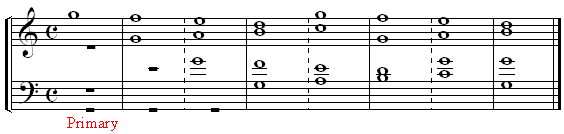
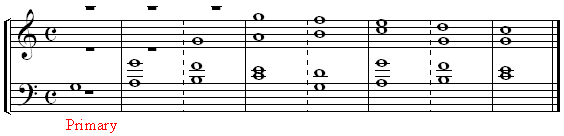
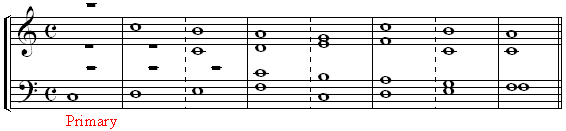
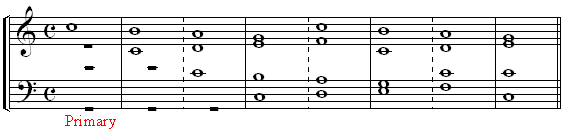
All the preceding examples were in Primary Disposition (with an ascending Orbit Line
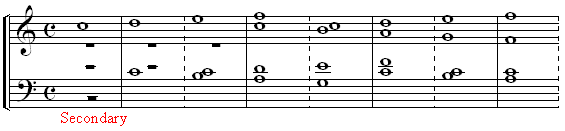
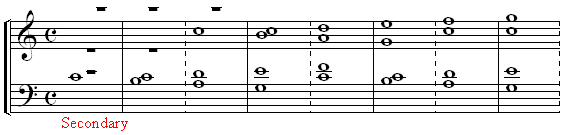
in the Bass Voice). However, in order to change to a neighboring swing, in this case from the TONIC/COUNTERSwing to the DOMINANT/TONIC Swing, and possibly back, it will be necessary to use the Secondary Disposition (with a descending Orbit
Line in the Bass Voice) on one of the swings, to have the 4 Performance Voices remain in the same
range. This will mean accepting the inconvenience ofFRAMEinversion which seems quite acceptable under these circumstances in this polyphonic
style of music. Rather than present complete 32-chord examples ready-made, it seemed preferable to offer the choice of building them from the basic 8-chord segments, disposed in the appropriatetablesbelow.
First, an individual presentation of these 8-chord segments, starting with a review
of those already seen.
M3333P Thefirst example presentedwasM3333P,C6/G7, C6/G7, C6/G7, C6/G, theantecedent from the DOMINANT/TONIC Swing, in Primary Disposition, in a high range.
M4444P Then weaddedtheconsequentM4444Pfrom the same DOMINANT/TONIC Swing to produce a 16-barentity,ac, also in Primary Disposition, in a high range. One could produce the sameacby performing these two 8-chord sections one after the other.
The Secondary Disposition From now on, new material will be developed. The first step is to transform the 2 existing examples from the Primary Disposition
to the Secondary Disposition (with a descending line in the Bass Voice) by inverting the Soprano and Bass voices, and inverting the Alto and Tenor
voices, thereby displacing the example to another range, from high to medium
or from medium to high.
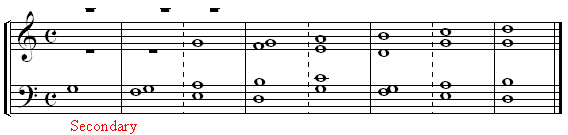
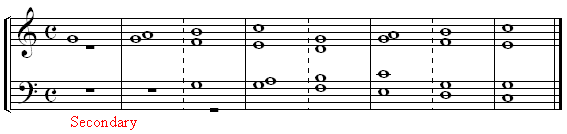
M3333S M3333Phas been transformed intoM3333S, placing it in a lower (medium) range. NOTE the last note in the Soprano Voice, which is D instead of G,Orbit 1instead ofOrbit 0, to achieve a more melodic ending, and the substitution0(3), G instead of F, in the Alto Voice.
M4444S M4444Phas been transformed intoM4444S, placing it in a lower (medium) range. NOTE the last note in the Bass Voice, which is C instead of G,Orbit 1instead ofOrbit 0, and the substitution0(3), G instead of F, in the Tenor Voice.
A neighboring Swing The TONIC/COUNTER Swing is quite similar to the DOMINANT/TONIC Swing, a diatonic fifth
lower.
M7777P M7777Pis similar toM4444P, but placed a fifth lower, in the same medium range asM4444S, rather than in the high range ofM4444P. NOTE the last note in the Tenor Voice, which is F instead of C,Orbit 1instead ofOrbit 0, and the substitution0(3), C instead of D, in the Alto Voice.
M6666P M6666Pis similar toM3333Pbut placed a fifth lower, in the same medium range asM3333S, rather than in the high range ofM3333P. NOTE the substitution0(3), C instead of B, in the Tenor Voice. TheOrbit 1toOrbit 0line has been preserved, acting asFundamentalBass, as was the case inM3333P.
M7777S M7777Phas been transformed intoM7777S, placing it in the higher range withM4444P. NOTE the last note in the Alto Voice, which is F instead of C,Orbit 1instead ofOrbit 0, and the substitution0(3), C instead of D, in the Tenor Voice.
M6666S M6666Phas been transformed intoM6666S, placing it in the higher range withM3333P. NOTE the last note in the Soprano Voice, which is G instead of C,Orbit 1instead ofOrbit 0, and the substitution0(3), C instead of B, in the Alto Voice.
A RECAP of the changes made to the last chord - 1. the substitution0(3)ofOrbit 3byOrbit 0in all cases, to remove the tension of the chord, and 2. the change of theOrbit 1toOrbit 0line intoOrbit 1toOrbit 1 except when it acts asFundamentalBass in a sharpening progression (inM3333Pand inM6666P), to produce a more final melodic line.