It is possible to place, one after the other, both the Real Triad and the deceptive
triad of the same seventh Tetrad, in root position, giving the impression of a progression
by ascending third. This is the normal order, the Real Triad first, without the seventh,
followed by the deceptive triad, with the seventh. However, cadential priorities will
at times favor the opposite order, to produce the Fundamental Bass. The two basic
Tetrads involved will be that ofI+7with its Real Triad ofIand its deceptive triad ofiiiproducing the(I-iii)-IVchord pattern and that ofV7with its Real Triad ofVand its deceptive triad ofviiproducing the(V-vii)-Ichord pattern (the two triads have been placed in parentheses to show that they belong
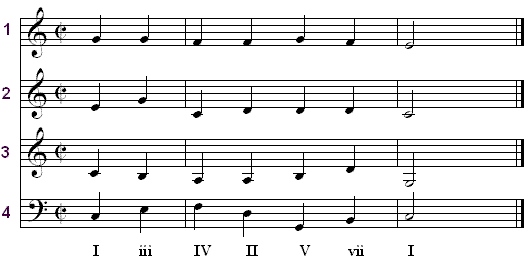
to the same Tetrad and that there is no progression involved). The(IV-II)-Vpattern which we saw inClass 4will act as a link to establish a complete pattern(I-iii)-(IV-II)-(V-vii)-I, from the basic TetradsI+7-IV6II7-V7-I.
I-iii-IV and V-vii-I
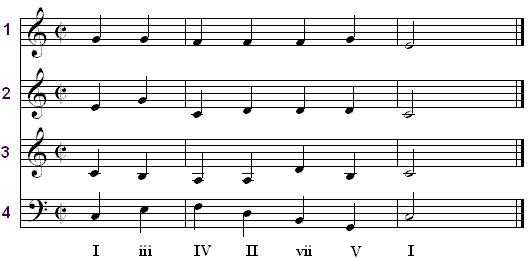
Doubling and Voice-leading Lines The four VLLs have been written ins to clearly indicate that they belong to the same basic Tetrad and that there is no veritable progression between them. The(I-iii)-(IV-II)-(V-vii)-Ichord pattern - NOTE, in(I-iii), the EG in VLL 2 which prevents doubling the E of VLL 4 and doubles the G of VLL 1, while VLL 3 "passes" the seventh ofI+7. NOTE, in(V-vii), the BD in VLL 3 which prevents doubling the B of VLL 4 and doubles the D of VLL 2, while VLL 1 "passes" the seventh ofV7GF. Thevii-Icadence is weaker than theV-Icadence because it does not have theFB(GC) in VLL 4. The(I-iii)-(IV-II)-(vii-V)-Ichord pattern, with theFB(GC) in VLL 4, by inversing the position ofVandvii- NOTE that - II-vii, by descending third, is a true progression, part ofII7-V7, but (vii-V), also by descending third, is not a true progression, only parts ofV7. NOTE, in(vii-V), the DB in VLL 3 which replaces the lost B of VLL 4, while VLL 1 loses the seventh ofV7substituting the root FG, which resolves to E as the seventh F would have done. This second example has a stronger cadence than the first one.
V-iii-IV
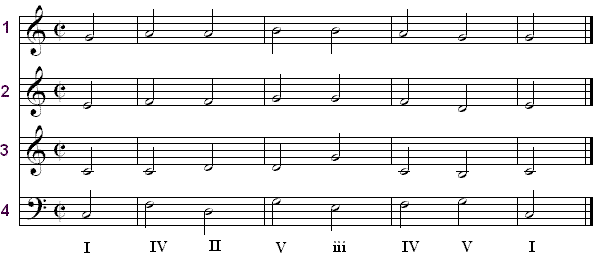
Doubling and Voice-leading Lines Here is another interesting example of a true progression by descending third, this one based on two Tetrad progressions by descending fifthV7-I+7-IV, theiiibeing a deceptive triad ofI+7. TheI-(IV-II)-V-iii-IV-V-Ichord pattern - NOTE the ascending lines in the first half, and the descending lines in the second half. The note G in VLL 3 may be an octave higher, but the crossing with VLL 1 will impose disposition in the soprano and tenor voices. True progressions by descending third (likeV-iii) will be common practice in the circle when Real Triads and deceptive triads alternate.
Melody More interesting and fruitful VLLs here.
Exercises
Exercise 1 With the(I-iii)-(IV-II)-(V-vii)-Ichord pattern asa and the(I-iii)-(IV-II)-(vii-V)-Ichord pattern asc, and with line 4 in the bass voice (CEFDGBC CEFDBGC), any version of either pattern may be used. NOTE that thecends with the Fundamental Bass (GC) producing a stronger cadence. In the soprano voice, a VLL which does not end on the note C will be placed in the antecedent (a), and a VLL which ends on the note C will be placed in the consequent (c), for a stronger cadence. In the alto and tenor voices, the remaining VLLs will be placed. Transposition may be required for vocal performance.
Exercise 2 With theI-(IV-II)-V-iii-IV-V-Ichord pattern twice as bothaandc, line 4 will, as usual, be placed in the bass voice (CFDG EFGC). In the soprano voice, a VLL which does not end on the note C will be placed in the antecedent (a), and a VLL which ends on the note C will be placed in the consequent (c), for a stronger cadence. In the alto and tenor voices, the remaining VLLs will be placed. Transposition may be required for vocal performance.