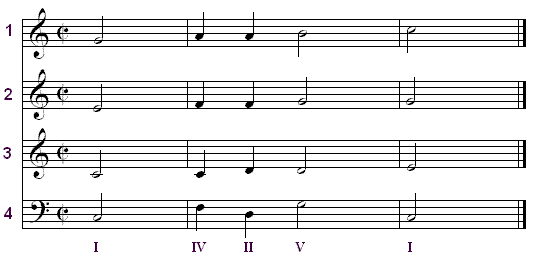
Doubling and Voice-leading Lines In this class, we will see theI-(IV-II)-V-Ichord pattern, in which both theIVand theIIappear, one after the other, between theIand theV. We now have three progressions by descending fifth (I-IV,II-V, andV-I), as well as what seems to be a progression by descending third (IV-II), in reality, two Real Triads from the TetradsIV6andII7, composed of the four same notes (FACD and DFAC), IVbeing the Real Triad ofIV6andIIbeing the Real Triad ofII7. IVandIIhave been rhythmically disposed ass within the same because they are basically the same chord (IV6II7). NOTE how the three VLLs end up higher than they started even if the voice-leading in the three progressions by fifth is exactly as it
was before, with the resolutions of the thirds, and the preservation of the common tone,
respected, inI-IV, E-F (in VLL 2) and C-C (in VLL 3), inII-V, F-G (in VLL 2) and D-D (in VLL 3), inV-I, B-C (in VLL 1) and G-G (in VLL 2) It is the presence of theIV-IIdisplacement which pushes all the VLLs to a higher position. Here again the Root of each Triad in line 4 (the FB) produces the doubling in each Triad (with VLL 3, VLL 2, VLL 3, VLL 2, and VLL
1).
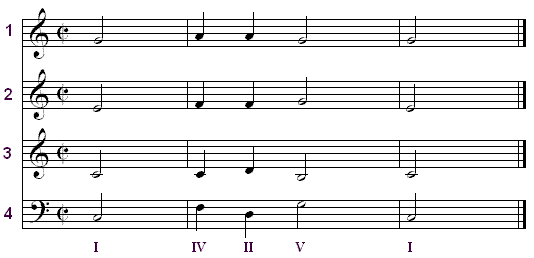
Preventing the rise of the VLLs The use of adiadonVwill brings the VLLs down, so that they end on the same note they started. NOTE onII, the Fifth A descending to the Root G (VLL 1) and the Root D descending to the Third B (VLL 3), while the Third F resolves normally to the Root G (VLL 2). OnV, the Third B resolves normally to the Root C (VLL 3), the common tone (the Root G) remains in place (VLL 1), and the other Root G descends to the Third E (VLL 2), preventing the rise of the lines. But it is by no means obligatory if one wishes the VLLs to ascend. The diad could also have been placed onI.
Melody The diads do not merely prevent the rise of the VLLs, they also offer new VLL possibilities.
Exercises
Exercise 1 With theI-(IV-II)-V-Ichord pattern presented twice, first asaand then asc, and with the FB (line 4) in the bass voice both times (C-FD-G-C, C-FD-G-C) - use the diad onVin eitheraorcand not on the other. In the soprano voice, a VLL which does not end on the note C will be placed in the antecedent (a) for a weak cadence , and a VLL which ends on the note C will be placed in the consequent (c), for a strong cadence. In the alto and tenor voices, the remaining VLLs will be placed, in either open or close position. Transposition to a more appropriate key may be required for vocal performance.