There is very little new here. The second half of the circle was seen inClass 5and the use of diads to control the rising VLLs was also seen there. With a complete
circle, there will be more possibilities of disposing these diads, even in a large
ternary form.
I-IV-VII-III-VI-II-V-I
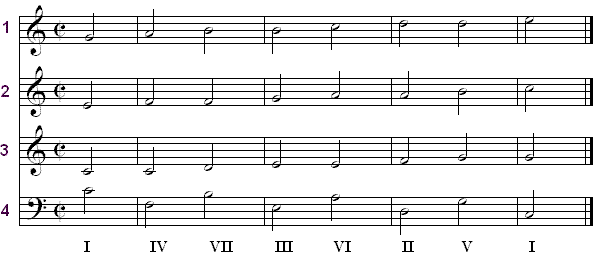
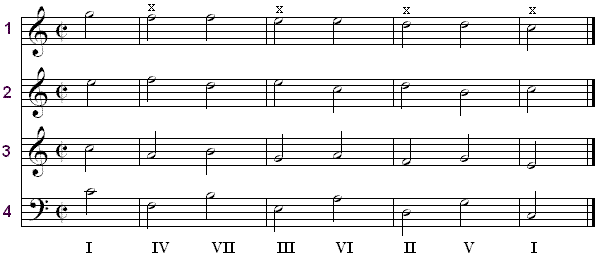
Doubling and Voice-leading Lines Here the four VLLs are exactly as they were in theVI-II-V-Ipattern, with VLLs 1, 2, 3 ascending constantly (two positions) as VLL 4, a Fundamental Bass with the root of each chord, descends. Here diads have been placed on each even-numbered chord (numbers 2, 4, 6, and 8), with VLLs 1, 2, 3 now descending two positions with the four diads. VLL 2 seems to descend only one position, but that is without its resolution
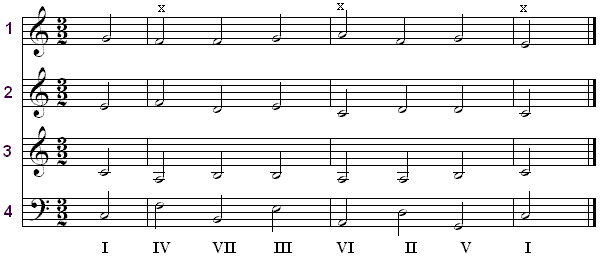
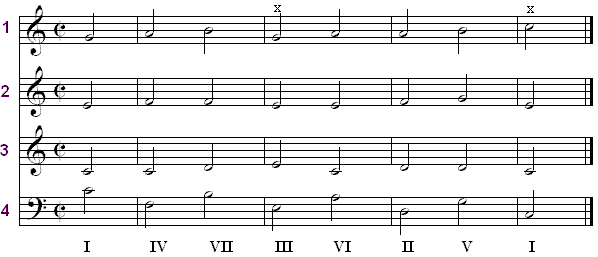
toIV. Here diads have been placed on each third chord (numbers 2, 5, and 8), in a ternary grouping (with 3/2 bars), with VLLs 1, 2, 3 now descending only one position with the three diads. VLL 3 seems to remain in place, but that is without its resolution toIV. Here diads have been placed on each fourth chord (numbers 4 and 8), back in binary grouping (with 2/2 bars), with VLLs 1, 2, 3 remaining in place with the two diads. VLL 1 seems to ascend, but that is without its resolution toIV.
Melody Lots of movement by descending third here, with all these diads.
Exercises
Exercise 1 There will only be one exercise here but the diads, which control the movement of the lines, can be disposed at will, on condition that there are not two diads in a row. With theI-IV-VII-III-VI-II-V-Ichord pattern, line 4 will, as usual, be placed in the bass voice (CFBE ADGC). In the soprano voice, a VLL which ends on the note C will be placed to produce a strong cadence. In the alto and tenor voices, the remaining VLLs will be placed. Transposition may be required for vocal performance.