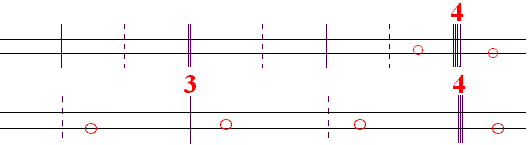
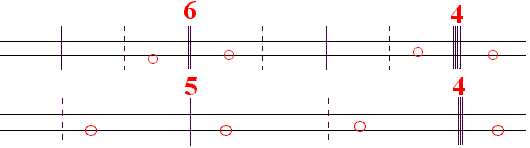
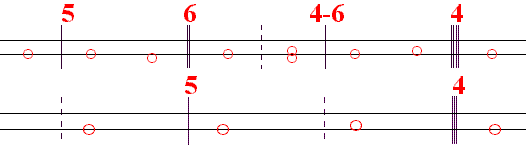
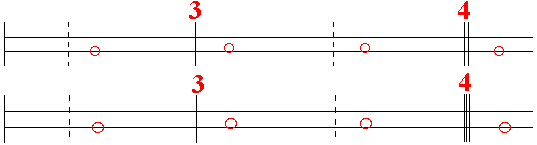
There will be two classes of Procedures in this Method of Analysis - two Procedures of Analysis itself, one for the Melo-rhythm, and one for the Melo-harmony (the Chord Patterns),
followed by two Procedures of Observation, one for the Entities, and one for the Symmetries.
Analysis of the Melo-rhythm Melody is rhythmically structured as verse, not as prose, and should therefore be disposed on paper as verse, not as prose. Passing from one staff-line to another should correspond to the breaths, and not when one runs out of space.
1. The first step of analysis will be to disregard whatever musical text we have before
us, and establish ALL the rhythmic levels withFootsies. This will enable us to verify the position of bar-lines, especially atLevel 0. 2. You may then wish to look at theGraphicsagain to refresh your memory concerning the "look" of the Rhythm. 3. Another look at theMelo-rhythm boxesmight also be useful. 4. Placing bar lines of different "intensity" (dashed, single, double, triple, ...
) helps to situate the larger Rhythmic Levels. 5. One must place the same number ofLevel 0cells on each staff-line, only 1 cell if it is very subdivided, 2 cells is the most common number, but there may be 4 cells if there are few subdivisions (notes).
Analysis of the Melo-harmony Now that we have a well-disposed copy of our song, we can proceed to the genealogical process of retracing its harmonic origins. In a generative approach, one does not harmonize a melody, one seeks the Chord Pattern whose Voice-leading Lines produced the Melody, and the Melo-linesTable, presented in the Preface, will enable us to retrace the Chord Pattern which generated the Melody.
Observation of the Entities A simple matter, since Entities have been clearly defined in each of Melody's components
- Melo-rhythm, Melo-harmony, and Melo-lines. The more variety in the size (length) of these Entities, the better.
Observation of the Symmetries Also, a fairly simple matter. Here, moderation is the ideal - avoiding scarcity and excess as much as possible.
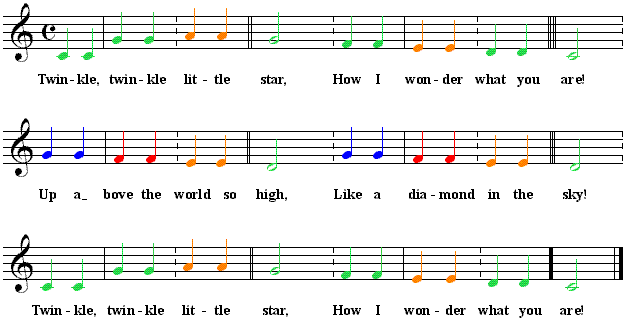
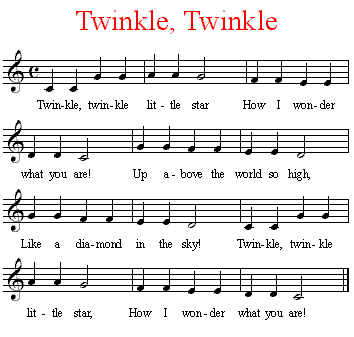
Twinkle, Twinkle, Little Star
Analysis of the Melo-rhythm
Beware ! You might very well find the song looking like this -
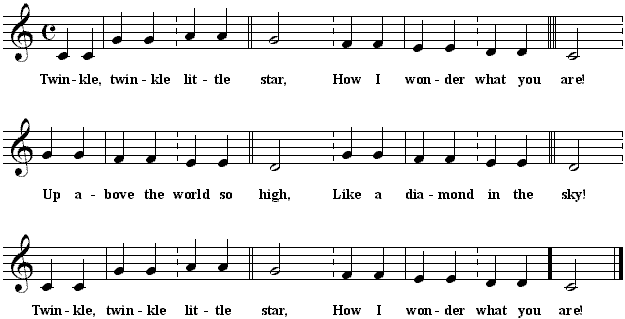
The first thing to do is to verify the "grammar" and "spelling" of this example. The best way is to forget it completely and start all over. How ?Back to the footsies ! Singing the song with the footsies at all the levels will remind us - thatLevel 0is at 0 + 2 (no pick-up and 2 notes in the first Off-beat) and that bar-lines atLevel 0will occur just before the Right Foot strikes, (the first bar-line will be just before the third note of the song). All the bar-lines of the original copy are misplaced. Remember that theCellsofLevel 0always have a Bar-line in their center between the Off-beat and the Beat. You might also want to check, and review, theGraphicsand the Melo-rhythmicboxesof this song.
Now concerning the disposition of the staff-lines, which should not be of any arbitrary
length - Place the right number of cells (no more, no less) on each staff-line, the same
number on each line.
Note - 1. There are 4 cells in each of the 3 staff-lines. 2. The first and third staff-lines are what are called "A" sections, Entities
in the three components. The second staff-line is what is called a "B" section, the "Bridge" of this
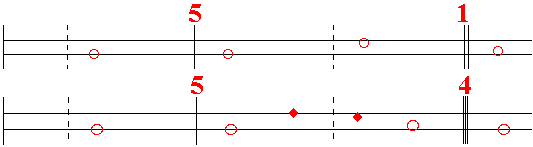
song, which is not an Entity in the Melo-harmony (ending on a DOMINANT chord). The complete song has what is called an "ABA" form which is an "AABA" with the first "A" removed. The bar-lines - atLevel -1, the bar-lines are dashed, atLevel 0, the bar-lines are solid (single), atLevel +1, the bar-lines are double, atLevel +2, the bar-line is triple (end of the second staff-line), atLevel +3, the bar-line is quadruple (end of the first staff-line), atLevel +4, the bar-line is quintuple (a heavy line, end of the third staff-line). Note the bar-lines of the first staff-line - single, dashed, double, dashed, single, dashed, quadruple, the last bar-line is NOT triple as one would expect. That would have happened in the first staff-line (had it remained in
the song). We now have a reliable rhythmical analysis of the song.
Analysis of the Melo-harmony
The A sections 1. In theMelody, we will start with the last cell (end of the third staff-line), in which the notes
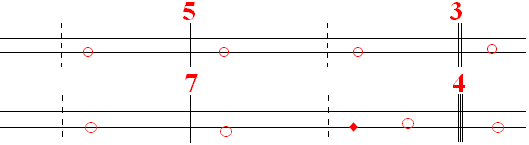
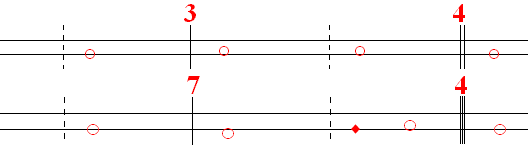
are D / C. In thetable, we see that the notes D / C are the lineOrbit 1toOrbit 1 in the ChordPatternM4, DOMINANT / TONIC. When this Chord Pattern isopened(on the bottom harmonic staff), it will becomeM34atLevel +1 with a long DOMINANT chord which will occupy the space of the fourth, fifth, sixth, and seventh chords of the top harmonic staff.
2. In theMelody, we will now look at the center of the pattern, the second cell, in which the notes
are A / G. In thetable, we see that the notes A / G are the lineOrbit 2toOrbit 1 in the Chord PatternM6, COUNTER / TONIC. We now have a TONIC as fourth chord (on the top harmonic staff), and theM34becomes anM54atLevel +1 with a TONICtenantchord on the first half of the DOMINANT chord (on the bottom harmonic staff).
3. In theMelody, we will now look at the two remaining cells - In the first cell, in which the notes are C / G, we evidently have the Chord PatternM5, TONIC / TONIC both notesOrbit 1(on account of the Metamorphosis 1 at the bar-line). However, in the third cell, in which the notes are F / E, we could find in thetableeither - the lineOrbit 3toOrbit 2, in the Chord PatternM4, DOMINANT / TONIC, or the lineOrbit 1toOrbit 2, in the Chord PatternM6, COUNTER / TONIC.
4. We are clearly dealing with the consequent of the Harmony (the last two cells), and we must find a "consequent-oriented" solution in thetable. The notes F / E are placed farther right (on the "consequent" side) in theM6, COUNTER / TONIC pattern than in theM4pattern. The complete Chord Pattern is thus - M5664, TONIC / TONIC \ COUNTER / TONIC \ COUNTER / TONIC \ DOMINANT / TONIC. We now have all the information we need to place the Orbit colors on the musical text
of the "A" sections.
The B section 1. In theMelody, we will start with the last cell (end of the second staff-line), in which the notes
are E / D, In thetable, we see that the notes E / D are the lineOrbit 2toOrbit 1 in the Chord PatternM3, TONIC / DOMINANT. 2. The same will apply to the second cell, in the center, in which the notes in the
Melody are also E / D, because the Bridge consists of two identical 2-cell sections.
3. Because, being parts of aBridge, they are both "antecedent-oriented", the first and third cells will also be Chord PatternM3, TONIC / DOMINANT with theOrbit 0toOrbit 3line, (on the left in thetable), producing the lineOrbit 0toOrbit 3, andOrbit 2toOrbit 1in each of the 2 sections, which we saw in theVoice-leading A Swing.
Complete Analysis All the Rhythmical analysis is in the bar-lines and disposition, all the Harmonic analysis is on the Harmonic Staves, and the Voice-leading is in the Orbit colors.
Observation of the Entities
In the A sections In the Melo-rhythm, we have two identical 2-cell entities2x (H1F H1M). In the Melo-harmony, we have one 4-cell entityM5664. In the Melo-lines, we have two 2-cell entities Orbit 1toOrbit 1,Orbit 2toOrbit 1, and Orbit 1toOrbit 2,Orbit 1toOrbit 1. A reasonable variety, with the Melo-harmonic entity longer than those of the
two other components.
In the B section In the Melo-rhythm, again we have the two same 2-cell entities2x (H1F H1M). In the Melo-harmony, we have no true entities because we have no strongM4pattern. however, we do have four identical, weakM3patterns. In the Melo-lines, we have two identical 2-cell entities 2x (Orbit 0toOrbit 3,Orbit 2toOrbit 1) Here again, a reasonable variety.
Observation of the Symmetries
In the A sections In the Melo-rhythm, the exact symmetry between the two 2-cell entities is not in itself
excessive. In the Melo-harmony, there is no appreciable symmetry within its single 4-cell entity only the repeat in the second "A" at the end, which is very welcome. In the Melo-lines, there is no appreciable contour, melodic symmetry between the 2-cell
entities.
In the B section In the Melo-rhythm, having exactly the same entities (H1F H1M) as in the "A" sections is truly excessive six times in all, without the slightest variation. The French version (Ah, vous dirai-je, maman) has Feminine Rhymes on the second and fourth cells of the Bridge which relieve the excessive repetition of theH1F H1Mpattern. We might consider suggestions of improvement when we are ready forAnalysis. In the Melo-harmony, the repeat of theM3pattern is hardly excessive, being a weak progression. In the Melo-lines, the orbit chain 0-3-2-1 lends itself to rich, polyphonic treatment,
with itsnatural canon.
Between the A and B sections The symmetry here is truly remarkable, between the last half of the "A" section and
the Bridge. The repeat of the notes F-F / E-E \ D-D / C, in the last half of the "A" section, a diatonic second higher as G-G / F-F \ E-E / D, in the Bridge, creates considerable unity between the "A" and "B" sections. A process which should certainly be used more often.
If you already know howGenerationworks, you might like to see it forthis song.
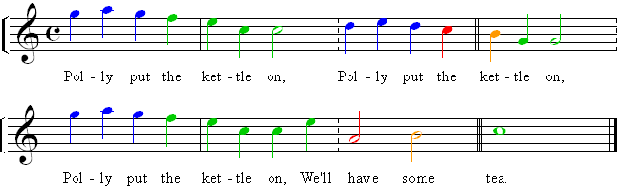
Polly, Put The Kettle On
Analysis of the Melo-rhythm
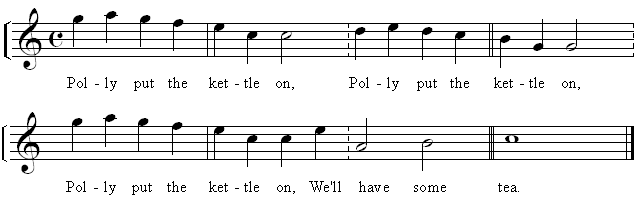
This song is usually well-written withLevel -1bars of 2/4 or 2/2 time. You can confirm this by singing it and relying on thefootsies !to findLevel 0 with no pick-up and 4 notes in the first Off-beat (the first bar ofLevel -1). You might also want to check, and review, theGraphicsand the Melo-rhythmicboxesof this song.
This 2-line disposition is very useful to spot the Symmetry of the Masculine and Feminine
Rhymes. There are 2 cells in each of the 2 staff-lines. The bar-lines - atLevel -1(at the center of each staff-line), the bar-lines are dashed, atLevel 0(at the beginning of each staff-line), the bar-lines are solid (single), atLevel +1(at the end of the first staff-line), the bar-line is double, atLevel +2(at the end of the second staff-line), the bar-line is triple, We now have a reliable rhythmical analysis of the song.
Analysis of the Melo-harmony
This song is a little more complicated. We will maintain the same order of the steps.
1. We start with the very last cell (at the end of the second staff-line) - In theMelody, we find the notes B / C (surrounding the bar-line). In thetable, we see that the notes B / C are theOrbit 2toOrbit 1line in theM4Chord Pattern, DOMINANT / TONIC. (See "5." for analysis of the other notes in this cell.) 2. Next we look at the second cell (in the center of the song, at the end of the first
staff-line) - In theMelody, we find the notes C / B (surrounding the bar-line) In thetable, we see that the notes C / B are theOrbit 1toOrbit 2line in theM3Chord Pattern, TONIC / DOMINANT, but we also find the note D (with a non-chordal tone E) in the Off-beat of the
cell which lead us to believe that the ANTE-1 (probably dominantized) is involved, and that we are dealing with theOrbit 3toOrbit 2line in theM1Chord Pattern, ANTE-1 / DOMINANT. 3. Next we look at the first cell (at the beginning of the first staff-line) - In theMelody, we find the notes G / E, C , theM5Chord Pattern, TONIC / TONIC. (there are no Orbit Voice-leading lines when we remain on the same
chord). The A and F are evidently Non-chordal Tones and the E is, in all probability, a double Non-chordal Tone of the C. 4. Finally, the third cell (at the beginning of the second staff-line) - is identical to the first cell, theM5Chord Pattern, TONIC / TONIC. 5. On the Off-beat of the fourth cell, we also find the note A which indicates an
ANTE-1tenantchord, in which the note A isOrbit 1substituting forOrbit 3, resolving to the note BOrbit 2of the DOMINANT. In such a case, it is recommended to have another tenant chord (an ANTE-2) at the end of the Beat of the previous (third) cell. It might seem surprising to see this bar (E, C, C, E) all onOrbit 1, the E is, as we already know, a double Non-chordal Tone of the C, on the
chord of C, and the following C is also a double Non-chordal Tone of the E, on the chord
of Am. We now have all the information we need to place the Orbit colors on the musical text
of the song.
Observation of the Entities
In the Melo-rhythm, we have one 4-cell entityK2F= K2F= K2F= pK1M. In the Melo-harmony, we have one 4-cell entityM5154. In the Melo-lines, we have four 1-cell entities, a reasonable variety.
Observation of the Symmetries
In the Melo-rhythm, there is - exact symmetry between the first three cells3x (K2F=), which makes the abrupt change of the fourth cell imperative (pK1M). In the Melo-harmony, there is exact symmetry between the first and thid cellsM5154. In the Melo-lines, there is exact melodic symmetry in the first three cells. The symmetry is almost excessive in the Melo-rhythm and Melo-lines.
If you already know howGenerationworks, you might like to see it forthis song.
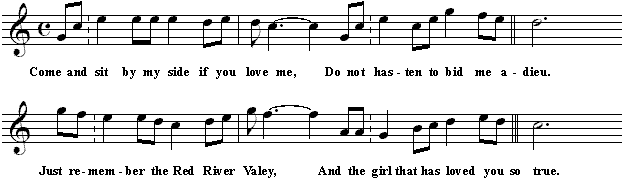
Red River Valley
Analysis of the Melo-rhythm
Beware of these old "folk-songs" ! We have seen this one written with very small bars,
atLevel -2. You are far better to sing it and rely on thefootsiesto findLevel 0 with 2 notes pick-up and 6 notes in the first Off-beat (the first bar ofLevel -1). Write your own version, with bars ofatLevel -1. You might also want to check, and review, theGraphicsand the Melo-rhythmicboxesof this song.
This 2-line disposition is very useful to spot the Symmetry of the Masculine and Feminine
Rhymes. There are 2 cells in each of the 2 staff-lines. The bar-lines - atLevel -1, the bar-lines are dashed, atLevel 0(at the center of each staff-line), the bar-lines are solid (single), atLevel +1(at the end of the first staff-line), the bar-line is double, atLevel +2(at the end of the second staff-line), the bar-line is triple, We now have a reliable rhythmical analysis of the song.
Analysis of the Melo-harmony
This is a simple song to analyse harmonically. The important thing is to remember
the order of the steps.
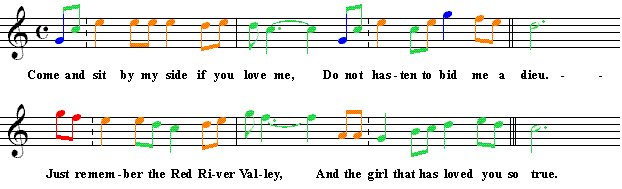
1. We start with the very last cell (at the end of the second staff-line) - In theMelody, we find the notes D / C (surrounding the bar-line). In thetable, we see that the notes D / C are theOrbit 1toOrbit 1line in theM4Chord Pattern, DOMINANT / TONIC. (See "5." for analysis of the other notes in this cell.) 2. Next we look at the second cell (in the center of the song, at the end of the first
staff-line) - In theMelody, we find the notes E / D (surrounding the bar-line) In thetable, we see that the notes E / D are theOrbit 2toOrbit 1line in theM3Chord Pattern, TONIC / DOMINANT, but we also find the note C in the Off-beat of the cell which is theOrbit 1toOrbit 1line and the note G in the Off-beat of the cell which is theOrbit 0toOrbit 1line. This second cell has three orbits on the Off-beat, (Orbit 1,Orbit 2, andOrbit 0) all resolving toOrbit 1on the Beat. 3. Next we look at the first cell (at the beginning of the first staff-line) - In theMelody, we find the notes E / C (surrounding the bar-line), theM5Chord Pattern, TONIC / TONIC. (there are no Orbit Voice-leading lines when we remain on the same
chord). The Ds are evidently Non-chordal Tones. 4. Finally, we look at the third cell (at the beginning of the second staff-line)
- In theMelody, we find the notes E / F (surrounding the bar-line). discounting the note G, of course, which is an obvious Non-chordal Tone
of F. In thetable, we see that the notes E / F are theOrbit 2toOrbit 1line in theM7Chord Pattern, TONIC / COUNTER, but we also find the note C in the Off-beat of the cell which is theOrbit 0toOrbit 1line. This third cell has two orbits on the Off-beat, (Orbit 2andOrbit 0) both resolving toOrbit 1on the Beat. 5. The TONICtenantchord on the Off-beat of the fourth cell (in which the note C isOrbit 1, and the note B a Non-chordal Tone) is not absolutely necessary, and the DOMINANT chord could occupy the whole Off-beat, in which case the note B would beOrbit 2, also resolving toOrbit 1, (and the note C would be a Non-chordal Tone). With theMetamorphosis 1on the TONIC tenant and the Non-chordal tones, the whole bar has been colored asOrbit 1. We now have all the information we need to place the Orbit colors on the musical text
of the song.
Complete Analysis All the rhythmical analysis is in the bar-lines and disposition, all the Harmonic analysis is on the Harmonic Staves, and the Voice-leading is in the Orbit colors.
Observation of the Entities
In the Melo-rhythm, we have two identical 2-cell entities2x (p2H3F-- p2H3M). In the Melo-harmony, we have one 4-cell entityM5374. In the Melo-lines, we have four 1-cell entities Orbit 2toOrbit 1, on theM5(the same chord), Orbit 2toOrbit 1, on theM3, Orbit 2toOrbit 1, on theM7, and Orbit 1toOrbit 1, on theM4. The first cell could very well be considered as onlyOrbit 1, with the note E a double Non-chordal Tone (ss3) of the C. The maximum possible variety, with the Melo-harmonic entity longer than those of the two other components.
Observation of the Symmetries
In the Melo-rhythm, there is - not only exact symmetry between the two 2-cell entities2x (p2H3F-- p2H3M), but Off-beat symmetry between the four cellsp2H3, rich, but hardly excessive. In the Melo-harmony, there is no appreciable symmetry within its single 4-cell entityM5374. In the Melo-lines, there is no appreciable contour, melodic symmetry between the four
1-cell entities. The symmetry is mostly in the Melo-rhythm.
If you already know howGenerationworks, you might like to see it forthis song.
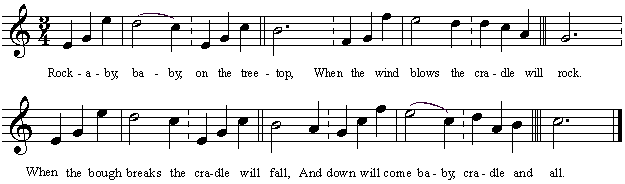
Rock-A-Bye, Baby
Analysis of the Melo-rhythm
This song is usually written in 6/8 time, starting on the first beat with the bar-lines
misplaced, but we will immediately pass to a well-written version withLevel -1bars of 3/4 time. You can confirm this by singing it and relying on thefootsies !to findLevel 0 which is at 0 + 3 (with no pick-up and 3 notes in the first Off-beat). You might also want to check, and review, theGraphicsand the Melo-rhythmicboxesof this song.
This disposition is useful to spot the Symmetry between the two lines. There are 4 cells in each of the 2 staff-lines, eight cells in all. The bar-lines - atLevel -1, the bar-lines are dashed, atLevel 0, the bar-lines are solid (single), atLevel +1, (in the middle of each staff-line), the bar-lines are double, atLevel +2(at the end of the first staff-line), the bar-line is triple, atLevel +3(at the end of the second staff-line), the bar-line is quadruple. We now have a reliable rhythmical analysis of the song.
Analysis of the Melo-harmony
This one will not be as easy as the others and patience will be required.
1. We start with the eighth and last cell (at the end of the second staff-line) - In theMelody, we find the notes B / C (surrounding the bar-line). In thetable, we see that the notes B / C are theOrbit 2toOrbit 1line in theM4Chord Pattern, DOMINANT / TONIC but we also find the note D which isOrbit 1also resolving toOrbit 1, as well as the note A which is p2 of B. We have two Melo-linesOrbit 1andOrbit 2 both resolving toOrbit 1. A Tenant Chord might be advisable here as we will later see (in 9.). 2. Next we look at the fourth cell (in the center of the song, at the end of the first
staff-line) - In theMelody, we find the notes A / G (surrounding the bar-line). In thetable, we see that the notes A / G are theOrbit 2toOrbit 1line in theM6Chord Pattern, COUNTER / TONIC. This is where we must be wary because there is little chance of this being a valid
choice. We will therefore move on and return to this fourth cell later (in 7.). 3. Let's look at the second cell (in the middle of the first staff-line) - In theMelody, we find the notes C / B (surrounding the bar-line), In thetable, we see that the notes C / B are theOrbit 1toOrbit 2line in theM3Chord Pattern, TONIC / DOMINANT, but we also find the notes E and G in the Off-beat of the cell which are pp3 andOrbit 0itself, resolving toOrbit 2on the Beat. Here we have two Melo-linesOrbit 0andOrbit 1 both resolving toOrbit 2. 4. The first cell is completely on notes of the Tonic chord (E, G, E / D, C, with
the D s2 of the C) evidently theM5Chord Pattern, TONIC / TONIC. 5. The fifth cell is identical to the first, patternM5with the same Melo-lines, and the sixth cell is identical to the second, patternM3. 6. The third cell is completely on notes of the DOMINANT chord (F, G, F / E, D, with
the E s6 of the D), evidently theM2Chord Pattern, DOMINANT / DOMINANT. 7. We are now in a position to re-evaluate the fourth cell which cannot beM6as we suspected, and must beM4DOMINANT / TONIC, regardless of the notes we find in the melody which strongly suggestM6. Much more will be said of this (possibly excessive) use of Non-chordal
Tones in Analysis. 8. And, finally, for the seventh cell, we find the notes F / E (surrounding the bar-line). In this specific rhytmic position, just before the final DOMINANT / TONIC of
the eighth cell, it is preferable to have the "cadential 64 chord" (TONIC, with Bass G) preceded
by the COUNTER. But we also have the notes G and C in the Off-beat, in this rhythmic position, clearly a "normal" TONIC chord. 9. Now back to the last cell,. in which an ANTE-1 tenant chord (possibly dominantized) will precede the
DOMINANT. A lot of tenant chords in the last two cells, the perfect place to put them,
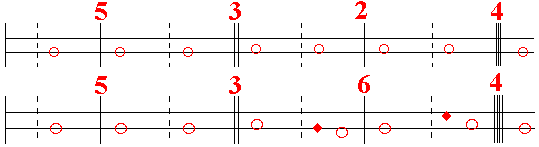
at the end of the song. The complete pattern is thusM5324 5364 TONIC / TONIC \ TONIC / DOMINANT \ DOMINANT / DOMINANT \ DOMINANT / TONIC TONIC / TONIC \ TONIC / DOMINANT \ (TONIC) - COUNTER / TONIC \ (ANTE-1) - DOMINANT
/ TONIC. C / C \ C6 / G \ G / G7 \ G7 / C \ C / C \ C6 / G-G/7 \ C/E-F6 / C/G \ D7-G7
/ C The most complex pattern in this group of seven songs, with several
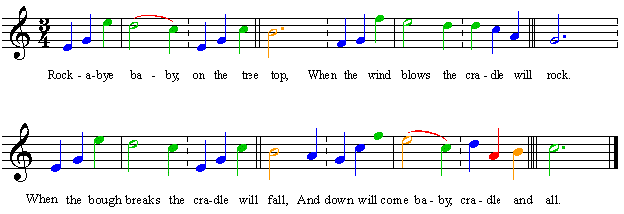
tenant chords. We now have all the information we need to place the Orbit colors on the musical text
of the song.
Observation of the Entities
In the Melo-rhythm, we have four identical 2-cell entities4x (K2F+ K2M). with a welcome added pick-up between the last two entities, which acts as fusion between these two entities, producing a MI-MI-MA. In the Melo-harmony, we have two similar 4-cell entitiesM5324andM5364. In the Melo-lines, we have one 8-cell entity - the fourth cell ends onOrbit 0and the eighth cell ends onOrbit 1. Three different sizes of Entities - a top score !.
Observation of the Symmetries
In the Melo-rhythm, there is - exact symmetry between the four 2-cell entities (two per staff-line), plus a bonus pick-up between the last two entities. However, the fusions are not constant where they should be - The Beat of the first cell has a Feminine Rhyme, while the Beat of the fifth cell has a Masculine Rhyme with a Pick-up, and the Beat of the third cell has a Masculine Rhyme with a Pick-up, while the Beat of the fifth cell has a Feminine Rhyme. In the Melo-harmony, there is a repeat of the same pattern inaAandaCbothM53, thecAM24andcCM64, being different, the best place to present a change. In the Melo-lines, there is an exact repeat ofaAandaC, but cAandcCare quite different. All in all, despite some irregularities, a fairly good score.
If you already know howGenerationworks, you might like to see it forthis song.
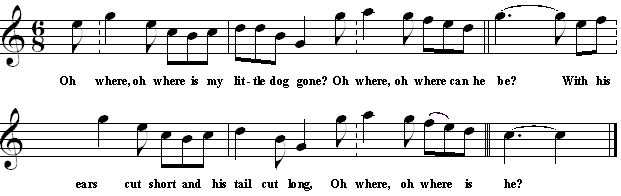
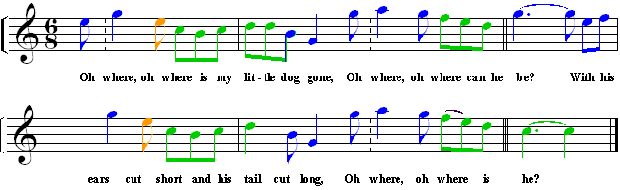
Oh Where, Oh Where, Is My Little Dog Gone?
Analysis of the Melo-rhythm
This song is usually well-written withLevel -1bars of 6/8 time. You can confirm this by singing it and relying on thefootsies !to findLevel 0 which is at 1 + 5 (with 1 note pick-up and 5 notes in the first Off-beat). You might also want to check, and review, theGraphicsand the Melo-rhythmicboxesof this song.
This disposition is useful to spot the Symmetry between the two lines. There are 2 cells in each of the 2 staff-lines. The bar-lines - atLevel -1, the bar-lines are dashed, atLevel 0, the bar-lines are solid (single), atLevel +1(at the end of the first staff-line), the bar-line is double, atLevel +2(at the end of the second staff-line), the bar-line is triple, We now have a reliable rhythmical analysis of the song.
Analysis of the Melo-harmony
No big problem here if we follow the order of the steps.
1. We start with the fourth and last cell (at the end of the second staff-line) - In theMelody, we find the notes D / C (surrounding the bar-line). In thetable, we see that the notes D / C are theOrbit 1toOrbit 1line in theM4Chord Pattern, DOMINANT / TONIC but we also find the notes A and G in the Off-beat of the cell which are the s2 andOrbit 0itself also resolving toOrbit 1, as well as the notes F and E which are ss7 and s6 of D. We have two Melo-linesOrbit 0andOrbit 1 both resolving toOrbit 1. 2. Next we look at the second cell (in the center of the song, at the end of the first
staff-line) - In theMelody, we find the notes D / G (surrounding the bar-line) which are theOrbit 1toOrbit 0line in theM4Chord Pattern, DOMINANT / TONIC even if this orbit combination does not appear in thetable because it is not a resolution (only a Primary Note option). This might seem like no more than a hunch, but it is confirmed by the fact that only the last note (the Beat) of this cell is different from what we
found in the fourth cell. These two cells obviously have the same Melo-harmony Pattern. This will be further confirmed by the pattern of the other two cells. Here again we have two Melo-linesOrbit 0andOrbit 1 this time resolving toOrbit 0. 3. Next we look at the first cell (at the beginning of the first staff-line) - In theMelody, we find the notes C / D (surrounding the bar-line), In thetable, we see that the notes C / D are theOrbit 1toOrbit 1line in theM3Chord Pattern, TONIC / DOMINANT, but we also find the notes G and E in the Off-beat of the cell which areOrbit 0andOrbit 2, both resolving toOrbit 1on the Beat. Here we have three Melo-linesOrbit 0,Orbit 2, andOrbit 1 all resolving toOrbit 1. 4. Finally, we look at the third cell (at the beginning of the second staff-line)
- which is identical to the first cell with the sameM3Chord Pattern, TONIC / DOMINANT. The complete pattern is thusM3434 TONIC / DOMINANT \ DOMINANT / TONIC \ TONIC / DOMINANT \ DOMINANT / TONIC. We now have all the information we need to place the Orbit colors on the musical text
of the song.
Observation of the Entities
In the Melo-rhythm, we have two almost identical 2-cell entities2x (pK3F pK3M). In the Melo-harmony, we have two identical 2-cell entitiesM3434. In the Melo-lines, we have one 4-cell entity - Orbit 1toOrbit 1,Orbit 1toOrbit 0, and Orbit 1toOrbit 1,Orbit 1toOrbit 1. The Melo-lines are different from the other two.
Observation of the Symmetries
In the Melo-rhythm, there is - almost exact symmetry between the two 2-cell entities (the two staff-lines), except for the process of fusion where, the first cell hasas Feminine Rhyme on the Beat, and the third cell hasin the corresponding position. The 2-note pick-up before the third cell is not only justified but advantageous, making the Masculine Rhyme of the second cell shorter than that of
the fourth cell. In the Melo-harmony, there is a repeat of the same patternM3434. In the Melo-lines, there is an almost exact repeat of the two lines, except for the
last note. All in all, par for the course.
If you already know howGenerationworks, you might like to see it forthis song.
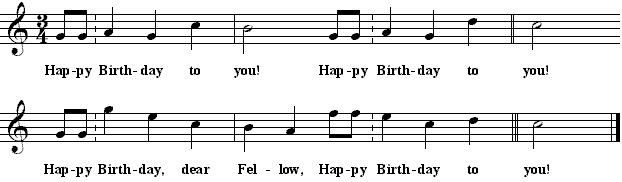
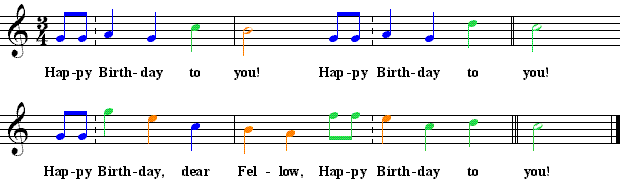
Happy Birthday
Analysis of the Melo-rhythm
This song is usually well-written withLevel -1bars of 3/4 time. You can confirm this by singing it and relying on thefootsies !to findLevel 0 with 2 notes pick-up and 3 notes in the first Off-beat (the first bar ofLevel -1). You might also want to check, and review, theGraphicsand the Melo-rhythmicboxesof this song.
This 2-line disposition is very useful to spot the MI-MI-MA structure of the song. There are 2 cells in each of the 2 staff-lines. The bar-lines - atLevel -1, the bar-lines are dashed, atLevel 0(at the center of each staff-line), the bar-lines are solid (single), atLevel +1(at the end of the first staff-line), the bar-line is double, atLevel +2(at the end of the second staff-line), the bar-line is triple, We now have a reliable rhythmical analysis of the song.
Analysis of the Melo-harmony
This is a simple song to analyse harmonically. The important thing is to remember
the order of the steps.
1. We start with the very last cell (at the end of the second staff-line) - In theMelody, we find the notes D / C (surrounding the bar-line). In thetable, we see that the notes D / C are theOrbit 1toOrbit 1line in theM4Chord Pattern, DOMINANT / TONIC (See "5." for analysis of the other notes in this cell.) 2. Next we look at the second cell (in the center of the song, at the end of the first
staff-line) - In theMelody, once again we find the notes D / C (surrounding the bar-line) In thetable, we see that the notes D / C are once again theOrbit 1toOrbit 1line in theM4Chord Pattern, DOMINANT / TONIC, but we also find the notes A and G in the Off-beat of the cell which are the sus2 andOrbit 0itself. This second cell has two orbits on the Off-beat, (Orbit 0, andOrbit 1) both resolving toOrbit 1on the Beat. With twoM4Chord Patterns, we know that we have two Melo-harmonic Entities in this song. 3. Next we look at the first cell (at the beginning of the first staff-line) - In theMelody, we find the notes C / B (surrounding the bar-line), In thetable, we see that the notes C / B are theOrbit 1toOrbit 2line in theM3Chord Pattern, TONIC / DOMINANT, but we also find the notes A and G in the Off-beat of the cell which are the sus2 andOrbit 0itself (as in the second cell). This first cell has two orbits on the Off-beat, (Orbit 0, andOrbit 1) both resolving toOrbit 2on the Beat. 4. Finally, we look at the third cell (at the beginning of the second staff-line)
- In theMelody, we find the notes C / B-A (surrounding the bar-line). In thetable, we see that the notes B / A are theOrbit 3toOrbit 2line in theM7Chord Pattern, TONIC / COUNTER. Observe, in the melody, that the note C (Orbit 0) is a substitution of the note B (Orbit 3), and that the note B is a sus4 of the note A (Orbit 2). But we also find the note G in the Off-beat of the cell which is theOrbit 1toOrbit 1line (resolving to the note F at the end of the Beat), as well as the note E in the Off-beat of the cell which is theOrbit 2toOrbit 1line (also resolving to the note F). This third cell has three orbits on the Off-beat - Orbit 1andOrbit 2, which resolve toOrbit 1on the Beat, as well as Orbit 0which resolves toOrbit 2on the Beat, substituting forOrbit 3. 5. The TONICtenantchord on the Off-beat of the fourth cell is absolutely necessary here, and the DOMINANT chord only occupies the end
of the Off-beat. In this TONIC tenant chord we find the note E, which is theOrbit 2toOrbit 1line, and the note C, which is theOrbit 1toOrbit 1line, from the TONIC to the DOMINANT (see theM3Chord Pattern in thetable). We now have all the information we need to place the Orbit colors on the musical text
of the song.
Observation of the Entities
In the Melo-rhythm, we have a MI-MI-MA, composed of - two identical 1-cell entities2x (p2K2M), and one 2-cell entityp2K2F p2K2M) In the Melo-harmony, we have two 2-cell entitiesM34andM74. In the Melo-lines, we have two 2-cell entities - Orbit 1toOrbit 2,Orbit 1toOrbit 1on theM34, and Orbit 0toOrbit 2,Orbit 1toOrbit 1on theM74, There is relatively little variety here, only the Melo-rhythmic MI-MI-MA, slightly different from the others, with its
divided first half. For all intents and purposes, we have a 2-piece pasting.
Observation of the Symmetries
In the Melo-rhythm, there is - not only exact symmetry between the two 1-cell entities (in the first staff-line),2x (p2H2M) but also Off-beat symmetry between the four cells, allp2H2, rich, but hardly excessive. In the Melo-harmony, there is a pasting of two patternsM34andM74, no veritable symmetry. In the Melo-lines, there is contour symmetry between the two 1-cell entities (in the
first staff-line). All in all, we find a reasonable quantity of symmetry in this song, in the Melo-rhythm and in the Melo-line contours.
If you already know howGenerationworks, you might like to see it forthis song.
Down in The Valley
We have found two versions of this song. They both have the same Melo-rhythm and the
same Melo-harmony, but not the same Melo-lines. The version presented here is different
from the one presented in Rhythm-Transformations (used in the Kurt Weill opera), and
has been chosen because the Melo-lines lead more directly to the Melo-harmony.
Analysis of the Melo-rhythm
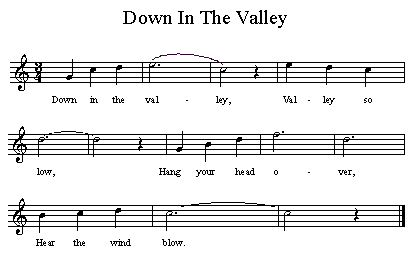
Beware ! We found the song looking like this -
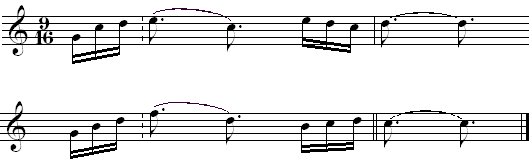
The bars are evidently too short and the staff-lines are not properly disposed. Go back to thefootsiesto establishLevel 0 which is at 3 + 5 (3 notes pick-up and 5 notes in the first Off-beat). You might also want to check, and review, theGraphicsand the Melo-rhythmicboxesof this song.
Place the right number of cells (no more, no less) on each staff-line, the same number
on each line.
This disposition, with 1 cell in each of the 2 staff-lines, clearly shows the Symmetry
between the two lines. The bar-lines - atLevel -1, the bar-lines are dashed, atLevel 0(at the end of the first staff-line), the bar-line is solid (single), atLevel +1(at the end of the second staff-line), the bar-line is double. We now have a reliable rhythmical analysis of the song.
Note that there is a considerable change in note-values - we have substitutedforstart because the bars are so much longer.
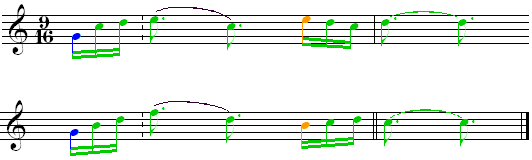
Analysis of the Melo-harmony
This version of the song is easy to analyse harmonically, and there are only 2 cells.
1. We start with the last, second cell (at the end of the second staff-line) - In theMelody, we find the notes D / C (surrounding the bar-line). In thetable, we see that the notes D / C are theOrbit 1toOrbit 1line in theM4Chord Pattern, DOMINANT / TONIC, but we also find the note B in the Off-beat of the cell which isOrbit 2also resolving toOrbit 1, the note F is a ss7 of D and the note C is a p4 of D. This second cell has two orbits on the Off-beat, (Orbit 2andOrbit 1) both resolving toOrbit 1on the Beat. 2. Next we look at the first cell (in the center of the song, at the end of the first
staff-line) - In theMelody, we find the notes C / D (surrounding the bar-line) In thetable, we see that the notes C / D are theOrbit 1toOrbit 1line in theM3Chord Pattern, TONIC / DOMINANT, but we also find the note E on the Off-beat of the cell which isOrbit 2also resolving toOrbit 1, the note D is a s2 of C. This first cell has two orbits on the Off-beat, (Orbit 2andOrbit 1) both resolving toOrbit 1on the Beat. We now have all the information we need to place the Orbit colors on the musical text
of the song.
Observation of the Entities
In the Melo-rhythm, we have 2 identical split cells, each fused together 2x (p2F=p2M)2x ( \ . . ' / . ' ) two identical 1-cell entities. In the Melo-harmony, we have one 2-cell entityM34. In the Melo-lines, we have two similar 1-cell entities - Orbit 2andOrbit 1toOrbit 1. The Melo-harmony is different from the 2 others.
Observation of the Symmetries
In the Melo-rhythm, there is - not only exact symmetry between the two 1-cell entities (the two staff-lines),2x (p2F=p2M) but exact symmetry between the four pick-ups, all, rich, but hardly excessive. In the Melo-harmony, there is only one patternM34, with the inverse symmetry of its generation. In the Melo-lines, there is contour symmetry between the Off-beats (with pick-up)
of the two cells, and inverse symmetry between the Beats (with pick-up) of the two cells, the result of Melo-line symmetry (Orbit 2andOrbit 1toOrbit 1) and inverse Melo-harmony. There is far more Symmetry here than there was in thefirst versionof this song.
Those on a Guided tour should click onin the Navigation Bar below.
Those browsing might wish to see the Next pageGeneration