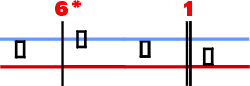
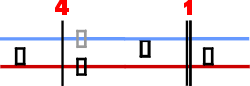
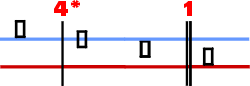
Definition - 1 Bridges are links between two (usually identical) Chord Pattern Entities. In the study of "Form", a Bridge is usually identified by the letter "B", the Entities being identified by the letter "A", the most common combinations being "AABA", and its ternary version
"ABA". A Bridge is attached to the Entity which follows it, not to the one that precedes
it. The breath before a Bridge is therefore deeper than the one after it. We could say that a Bridge is a kind of antecedent, its consequent being the next
Entity. It usually ends on a DOMINANT, as many antecedents do, but it does not necessarily begin with a TONIC, as antecedents do, because the TONIC has been firmly established in the preceding Entity. As a matter of fact, a Bridge can begin on just about any chord, and one can hardly find a better place to be harmonically audacious.
Definition - 2 As stated in Definition-1, at thelargerlevels of grouping, in Form, Arepresents an Entity, and Brepresents a Bridge. We will now add that, at thesmallerlevels of subdivision, Arepresents an Antecedent, and Crepresents a Consequent, each of which can be re-subdivided byaandc- aA cAandaC cC. Now for a few equations - A=A+C A=aA+cA C=aC+cC B=cA which seems to coincide perfectly with our Definition-1, and which will be very useful in our future observations.
We will present the generation of Bridges from the simplest, and shortest, to the longer and more complex.
One-Cell Entities
The M3 Pattern
As we know, chord progressionM3is TONIC / DOMINANT (C6 / G), the most basic way to reach the DOMINANT (within the nucleus).
This is a weak progression, identical to the COUNTER / TONIC progression (F6 / C). We could even say that the TONIC is a COUNTER of the DOMINANT. This is the chord pattern which we find as - BinTwinkle, Twinkle,M3333, and cAinM5324(thelistis too long to include here). It is alsocAin ALL the patterns of the central column of theTableof Chord Patterns. It is occasionally dominantized (Cm6 / G), but usually left in its weak diatonic
state. In the study of Bridges, we will considerM3an Entity, despite its "weakness".
The M1 Pattern
As we also know, chord progressionM1is ANTE-1 / DOMINANT (D(m)7 / G), less basic thanM3, reaching the DOMINANT from the tail.
When it isdominantized, this is a strong progression, identical to the DOMINANT / TONIC progression (G7 / C). We could even say that the dominantized ANTE-1 is a DOMINANT of the DOMINANT. This is the chord pattern which we find as - BinMexican Hat Dance,M1111, and cAinPolly, Put The Kettle on,M5154. It is usually dominantized (D7 / G as inMexican Hat Dance), but occasionally left in its weak diatonic state.
The M3 And M1 Patterns
Both Together At first sight it would seem impossible to have two different Chord Patterns at the
same time. That is because we only see one rhythmic level at a time. As soon as we accept several levels simultaneously, which is their normal behavior, we immediately see that one progression can be at a smaller level, and another
at a larger level.
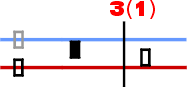
A chord of ANTE-1 is placed as a tenant on the second half of the Off-beat of anM3cell.
In order to accomodate the ANTE-1, the TONIC must pass into the Shadows (Metamorphosis 4). We see that we now have theM1pattern (probably dominantized) atLevel -1 all the while maintaining the weakM3pattern atLevel 0, which we will indicate asM3(1), TONIC-ANTE-1 / DOMINANT (C6-D7 / G). The DOMINANT is approached from both sides at different rhythmic levels.
This is the chord pattern which we find as - BinBye, Bye, Blackbird, seeM5*1(at a smaller level, which we will see later), cAin the verse ofMy Bonnie,M53(1)54 TONIC-COUNTER / TONIC \ TONIC-ANTE-1 / DOMINANT \ (C6-D7 / G) TONIC-COUNTER / TONIC \ ANTE-1-DOMINANT / TONIC, with the ANTE-1 dominantized (D7).
Two-Cell Entities
With the M3 Pattern
Preceded by the M5 Pattern
The only satisfactory antecedent to the weakM3cell seems to be theM5.
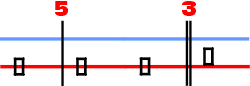
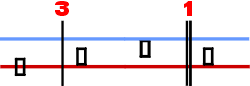
Two cells atLevel 0, M53, TONIC / TONIC \ TONIC / DOMINANT, (C / C \ C6 / G).
This is the chord pattern which we find as - Bin the French songJ'ai du bon tabac,M5353, and AinM5324, (see thelistand theTableof Chord Patterns). Another "antecedent-oriented" bridge, a completeAand not acA.
With the M1 Pattern
There seem to be two possibilities of antecedent here - one ending on the COUNTER, and one ending on the DOMINANT
Preceded by the M7 Pattern - Symmetry
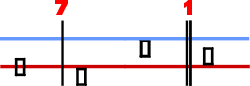
Two cells atLevel 0, M71, TONIC / COUNTER \ ANTE-1 / DOMINANT (C(7) / F6 \ D7 / G), with an openMetamorphosis 4 between COUNTER and ANTE-1.
This is the chord pattern which we find as - BinQuando, QuandoandSanta Claus Is Coming To Town, bothM7711 (C7 / F \ C7 / F \ D7 / G \ D7 / G). There is an interesting Symmetry between the two cells of this pattern with - theM7two "notches" (ofChrominicism) flatter (lower on the Harmonic Staff) than theM1.
Shadows
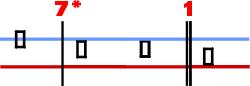
Both TONIC and COUNTER in the Shadows, becoming ANTE-2 / ANTE-1, M7*1, ANTE-2 / ANTE-1 \ ANTE-1 / DOMINANT, with noMetamorphosis 4.
The ANTE-2 is advantageously dominantized (A7 / Dm \ D7 / G). The Symmetry remains between the two cells of this pattern, this time with - theM7*one notch sharper (higher on the Harmonic Staff) than theM1.
Preceded by the M3 Pattern
Two cells atLevel 0, M31, TONIC / DOMINANT \ ANTE-1 / DOMINANT, (C6 / G \ D7 / G), with noMetamorphosis 4.
This is the chord pattern which we find as - Bin the second half ofRudolf The Red-nose Reindeer, seeM6431, with an interestingBass line- C / D \ D / G. A most unusual Bridge, theM64Pattern transposed to the DOMINANT with - theM31one notch sharper than theM64. We will see it again in the 4-cell entities.
With the M3(1) Pattern
Preceded by the TONIC
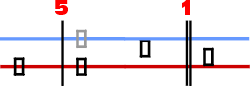
The TONIC pick-up creates a smallerLevel 0with two cells, M51, TONIC / TONIC \ ANTE-1 / DOMINANT (C / C6 \ D7 / G), withMetamorphosis 4on the second TONIC.
This is the chord pattern which we find as - AinPolly, Put The Kettle On,M51(C / C6 \ D7 / G). Note that, with the two TONIC chords at the beginning, this is an "antecedent-oriented" bridge, a completeAand not acA.
Shadows
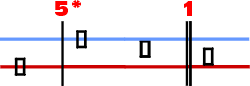
The second TONIC chord is placed in the Shadows, becoming an ANTE-2, M5*1, TONIC / ANTE-2 \ ANTE-1 / DOMINANT, (C / Am7 \ D7 / G) with an openMetamorphosis 4between TONIC and ANTE-2.
This is the chord pattern which we find as - BinBye, Bye, Blackbird,M5*1, TONIC / ANTE-2 \ ANTE-1 / DOMINANT (C6 / A7 \ Dm(7) / G7), with the ANTE-2 dominatized (A7), but the diatonic ANTE-1 withoutMOTRIX. The ANTE-2 is often dominantized (as inBye, Bye, Blackbird).
Preceded by the COUNTER
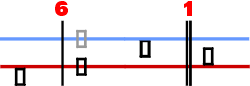
Two cells ofLevel 0, M61, COUNTER / TONIC \ ANTE-1 / DOMINANT (F6 / C \ D7 / G), withMetamorphosis 4on the TONIC.
This is the chord pattern which we find as - BinLichstensteiner Polka,M61, and cAinJingle Bells,M61, (both F6 / C \ D7 / G). The COUNTER is rarely dominantized. There is an inverse Symmetry between the two cells of this pattern with - theM6sharpening and theM1flattening.
Shadows
Both COUNTER and TONIC in the Shadows, becoming ANTE-1 / ANTE-2, M6*1, ANTE-1 / ANTE-2 \ ANTE-1 / DOMINANT (Dm6 / Am \ D7 / G), with noMetamorphosis 4.
This is the chord pattern which we find as - BinAu clair de la lune,M6*1(Dm6 / Am \ D7 / G). The diatonic sharpening ANTE-1 (Dm6) is already a dominant (in theDiatonic Minor Mode), and the first cell should technically be indicatedw4and notM6*, the complete pattern indicated asw4M1. This is a very effective way of using a change of mode. The same inverse Symmetry here, with the chord of D on the Off-beat of each cell (first
Dm6 and then D7).
Another case of Symmetry here with - theM4one notch flatter than theM1. This pattern will later be "opened", with theM4ascA, and theM1ascC.
Shadows
Both DOMINANT and TONIC in the Shadows, becoming ANTE-3 / ANTE-2, M4*1, ANTE-3 / ANTE-2 \ ANTE-1 / DOMINANT (Em7 / Am \ D7 / G), with noMetamorphosis 4.
This is the chord pattern which we find as - BinI Got Rhythm,M4*1, and cAin,. The ANTE-3 is often dominantized (E7 / Am \ D7 / G), as inI Got Rhythmwhere all the ANTES are dominantized (E7 / A7 \ D7 / G7). The same Symmetry here, but this time with - theM4*two notches sharper than theM1.
Four-Cell Entities
All of these 4-cell entities are the pasting of two 2-cell entities, the first ending withM4, DOMINANT / TONIC (thecA), and the second ending withM1, ANTE-1 / DOMINANT (thecC). The TONIC ofM4and the DOMINANT ofM1 produce anM3atLevel +2. Here again, we will always have anM1within anM3.
With Similar aA and aC
In this group, theaAand theaCwill be identical, with thecAbeingM4, and thecCbeingM1, to assure theM3atLevel +2. There is no real Symmetry betweenAandCin this group.
Ending with M51
TONIC / TONIC \ DOMINANT / TONIC \ TONIC / TONIC \ ANTE-1 / DOMINANT This a fairly simple pattern which is very effective in the Three-quarter Shadows.
Ending with M61
COUNTER / TONIC \ DOMINANT / TONIC \ COUNTER / TONIC \ ANTE-1 / DOMINANT Another simple pattern which is very effective in the Three-quarter Shadows.
Ending with M41
DOMINANT / TONIC \ DOMINANT / TONIC \ DOMINANT / TONIC \ ANTE-1 / DOMINANT This one is a little repetitive but very effective in the Three-quarter Shadows.
Ending with M71
TONIC / COUNTER \ DOMINANT / TONIC \ TONIC / COUNTER \ ANTE-1 / DOMINANT This pattern offers two possibilities of Shadows - one where only theM7TONIC / COUNTER is in the Shadows, ANTE-2 / ANTE-1 (see below), and one in the Three-quarter Shadows.
Shadows
ANTE-2 / ANTE-1 \ DOMINANT / TONIC \ ANTE-2 / ANTE-1 \ ANTE-1 / DOMINANT Don't forget the version in Three-quarter Shadows.
Ending with M31
TONIC / DOMINANT \ DOMINANT / TONIC \ TONIC / DOMINANT \ ANTE-1 / DOMINANT The Bass is interesting - C / G \ G / C \ C / D \ D / G.
With Similar A and C
In this group, there will always be Symmetry between theAand theC- theAone notch flatter than theC. ThecAwill always beM4, and thecCwill beM1, as they were in the previous group.
Ending with M51
COUNTER / COUNTER \ DOMINANT / TONIC \ TONIC / TONIC \ ANTE-1 / DOMINANT There is more movement with a few Shadows (see below).
DOMINANT / ANTE-1 \ DOMINANT / TONIC \ ANTE-1 / ANTE-2 \ ANTE-1 / DOMINANT Here again, the diatonic sharpening ANTE-1 is already a dominant (in theDiatonic Minor Mode), and the third cell should technically be indicatedw4and notM6*, the complete pattern indicated asM94w4M1.
COUNTER / TONIC \ DOMINANT / TONIC \ TONIC / DOMINANT \ ANTE-1 / DOMINANT This is the chord pattern which we find as - BinRudolf The Red-nose Reindeer,M6431. The first and fifth chords (COUNTER and TONIC) could advantageously bediminished as they are inRudolf The Red-nose Reindeer(F+6+1 / C/G \ G7 / C \ C+6+1 / G/D \ D7 / G).
Three-quarter Shadows
With M5351
ANTE-2 / ANTE-2 \ ANTE-2 / ANTE-3 \ ANTE-2 / ANTE-2 \ ANTE-1 / DOMINANT This is the chord pattern which prompted us to investigate this 3/4* process, and
which we found as - BinBella Nina(an Italian children's song),M5*3*5*1. It seemed evident to us that, from a generative point of view, this pattern was
basicallyM5353, with the melody a third higher (except for the last note which remained
the same). Placing the first three cells in the shadows imposedM1at the end rather thanM3, and there seemed to be no reason why this considerable use of shadows could
not be applied to other patterns. The first three cells are evidently in theChromatic Minor Mode, and could be indicatedm535rather thanM5*3*5*, the complete pattern indicated asm535M1, a most effective way of using a change of mode at the beginning of
a bridge.
With Similar A and C
This pattern was basicallyM147*1in the preceding section ANTE-1 / DOMINANT \ DOMINANT / TONIC \ ANTE-2 / ANTE-1 \ ANTE-1 / DOMINANT before placing the two first cells in the shadows. The Symmetry in that pattern had - theM14one notch flatter than theM7*1. In its present 3/4* state, the Symmetry has - theM1*4*two notches sharper than theM7*1. This is the chord pattern which we find as - Bin,, and Ain,. If we dominantize each Off-beat atLevel 0, B7 / Em \ E7 / Am \ A7 / Dm \ D7 / G, we remain firmly in the Diatonic Major mode (C major), with all the ANTEs
resolving in a flattening direction. Clik on the image as usual. If we dominantize each Off-beat atLevel +1, Bm7-5 / E \ E7 / Am \ Am7-5 / D \ D7 / G, theAof this pattern is really in theChromatic Minor Mode(A minor),Clik and should technically be indicatedm14(with them4automatically dominantized) rather thanM1*4*, the complete pattern indicated asm14M7*1. Another effective way of using a change of mode.
With Similar aA and aC
This pattern was basicallyM7471in the preceding section TONIC / COUNTER \ DOMINANT / TONIC \ TONIC / COUNTER \ ANTE-1 / DOMINANT before placing the three first cells in the shadows. There is no Symmetry in this pattern, either in the basic or the present
versions. This is the chord pattern which we find as - Bin,, and Ain,. TheAof this pattern is really in theChromatic Minor Mode, and should technically be indicatedm74(with them4automatically dominantized) rather thanM7*4*, the complete pattern indicated asm74M7*1, or possiblym747M1.
This pattern was basicallyM4441in the preceding section DOMINANT / TONIC \ DOMINANT / TONIC \ DOMINANT / TONIC \ ANTE-1 / DOMINANT before placing the three first cells in the shadows. There is no Symmetry in this pattern, either in the basic or the present
versions. This is the chord pattern which we find as - Bin,, and Ain,. TheAof this pattern is really in theChromatic Minor Mode, and should technically be indicatedm44(with them4automatically dominantized) rather thanM4*4*, the complete pattern indicated asm44M4*1, or possiblym444M1.
This pattern was basicallyM5451in the preceding section TONIC / TONIC \ DOMINANT / TONIC \ TONIC / TONIC \ ANTE-1 / DOMINANT before placing the three first cells in the shadows. There is no Symmetry in this pattern, either in the basic or the present
versions. This is the chord pattern which we find as - the complete verse inBye, Bye, Blackbird,M5*4*5*1. TheAof this pattern is really in theChromatic Minor Mode, and should technically be indicatedm54(with them4automatically dominantized) rather thanM5*4*, the complete pattern indicated asm54M5*1, or possiblym545M1.
This pattern was basicallyM6461in the preceding section COUNTER / TONIC \ DOMINANT / TONIC \ COUNTER / TONIC \ ANTE-1 / DOMINANT before placing the three first cells in the shadows. There is no Symmetry in this pattern, either in the basic or the present
versions. This is the chord pattern which we find as - Bin,, and Ain,. TheAof this pattern is really in theChromatic Minor Mode, and should technically be indicatedm64(with them4automatically dominantized) rather thanM6*4*, the complete pattern indicated asm64M6*1, or preferablym646M1.