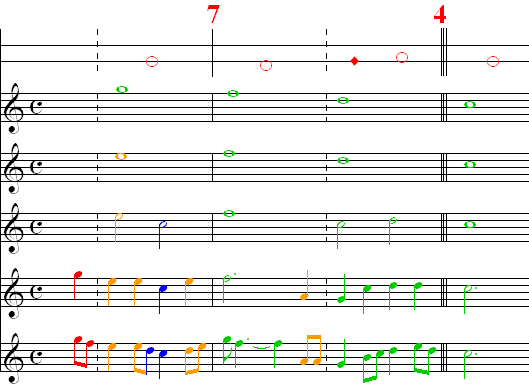
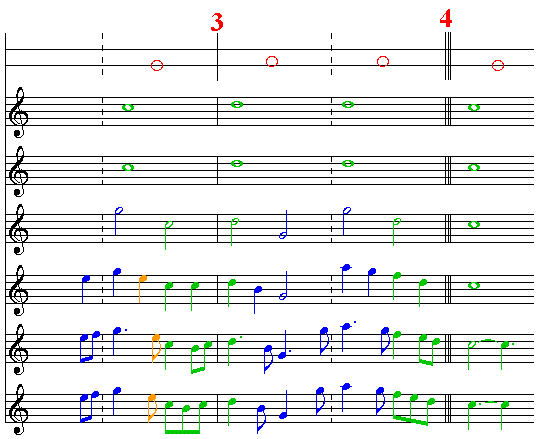
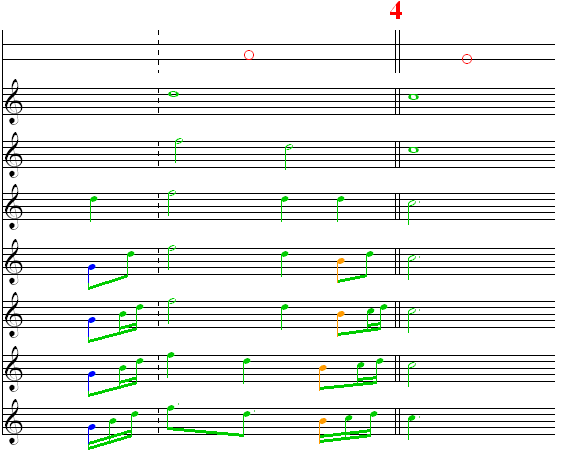
As in other forms of generation, we will procede from Basic Materials, through Transformations, to the finished product. In this case, the Basic Materials consist of - a complete, detailed Chord Pattern, placed on the harmonic staff, above the music staves, with the fundamentalOrbit 1toOrbit 1line, ins, placed just below the harmonic staff, on the top music staff. The Transformations, on the following music staves, consist of 1. changing to the secondary orbit lines while maintaining theLevel 0note-values (s) 2. progressing to the note-values of smaller levels, (,,), constantly adding the secondary Orbit Lines and Non-chordal Tones. 3. Finally operating whatever Rhythmic Transformation is required to produce
Ternary Levels. The Melody appears, complete and colored, in the last music staff.
Twinkle, Twinkle, Little Star
If you have not seen theAnalysisofthis song, we recommend that you do so.
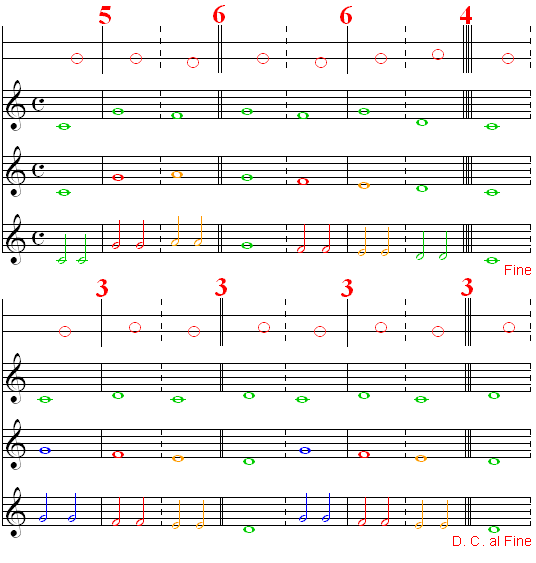
The A section We first see the harmonic staff with the chord PatternM5664 TONIC / TONIC \ COUNTER / TONIC \ COUNTER / TONIC \ DOMINANT / TONIC. Then, the fundamentalOrbit 1toOrbit 1line, ins, the notes C / G \ F / G \ F / G \ D / C. The opening notes C / G are bothOrbit 1on account of theMetamorphosis 1. Then, changes to the secondary orbit lines - Orbit 2toOrbit 1, in the second cell, the notes A / G, and Orbit 1toOrbit 2, in the third cell, the notes F / E. Then, in the smaller note-valuesofLevel -1, we have neither secondary Orbit-lines or Non-chordal tones to add, because each
note is simply repeated. The "A" section appears, complete and colored.
The B section We first see the harmonic staff with the chord PatternM3333 TONIC / DOMINANT \ TONIC / DOMINANT \ TONIC / DOMINANT \ TONIC / DOMINANT. Then, the fundamentalOrbit 1toOrbit 1line, ins, the notes C / D \ C / D \ C / D \ C / D. Then, changes to the secondary orbit lines - Orbit 0toOrbit 3, in the first and thid cells, the notes G / F, and Orbit 2toOrbit 1, in the second and fourth cells, the notes E / D . Then, in the smaller note-valuesofLevel -1, we have neither secondary Orbit-lines or Non-chordal tones to add, because each
note is simply repeated. The "B" section appears, complete and colored.
The complete ABA ADa Capo al fineproduces the complete song. Clik on the musical illustration to hear the evolution of the generation.
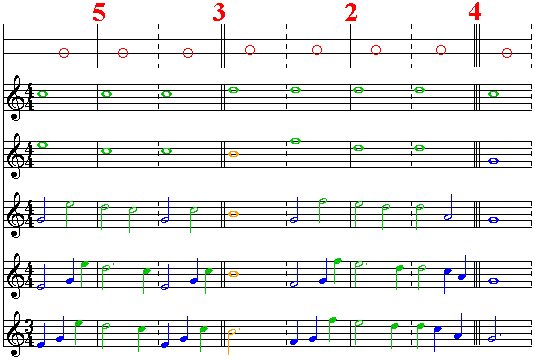
Polly, Put The Kettle On
If you have not seen theAnalysisofthis song, we recommend that you do so.
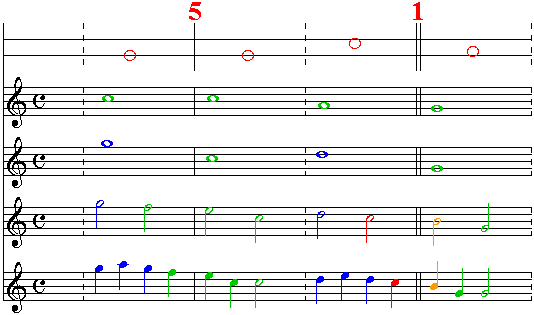
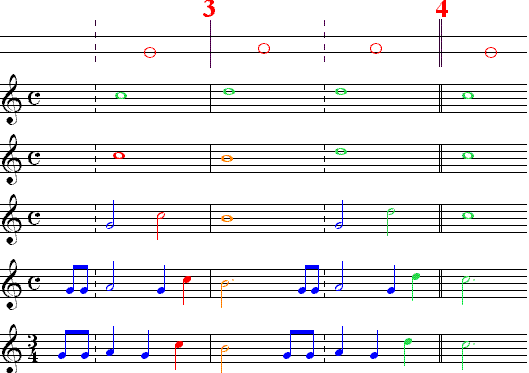
On two stave-systems We first see the harmonic staff with the chord PatternM5154 with an ANTE-1 tenant on the final DOMINANT chord. preceded by an ANTE-2 tenant on the Beat of the third cell. TONIC / TONIC \ ANTE-1 / DOMINANT \ TONIC / TONIC-ANTE-2 \ ANTE-1-DOMINANT /
TONIC. Then, the fundamentalOrbit 1toOrbit 1line, ins, the notes C / C \ A / G \ C / C \ D / C. Then, changes to the secondary orbit lines - Orbit 0toOrbit 1, in the first cell, the notes G / C, Orbit 0toOrbit 1, in the second cell, the notes D / G, and Orbit 0toOrbit 1, in the third cell, the notes G / C. Orbit 2toOrbit 1, in the fourth cell, the notes B / C. Then, in the smaller note-valuesofLevel -1, we find Non-chordal Tones added toOrbit 1in the first and third cells, the notes G-F / E-C, as well asOrbit 3andOrbit 2added in the second cell, the notes D-C / B-G, andOrbit 1substituting forOrbit 3in the tenant Ante-1 chord of the fourth cell, the notes A-B / C. The first and third cells have no resolutions being on the TONIC chord. Then, in the smaller note-valuesofLevel -2, we find - the Non-chordal Tone A in the first and third cells, the Non-chordal Tone E in the second cell, and a pick-up EOrbit 1on the ANTE-2 of the third cell. The song appears, complete and colored. Clik on the musical illustration to hear the evolution of the generation.
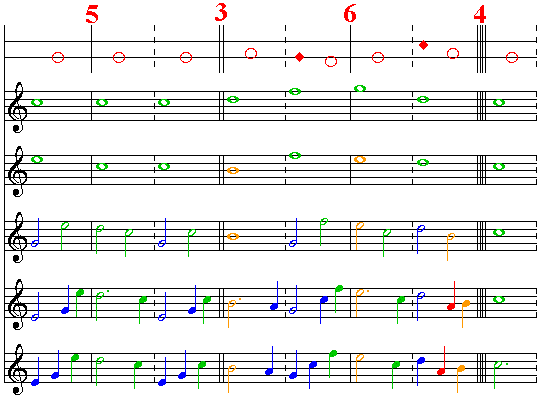
Red River Valley
If you have not seen theAnalysisofthis song, we recommend that you do so.
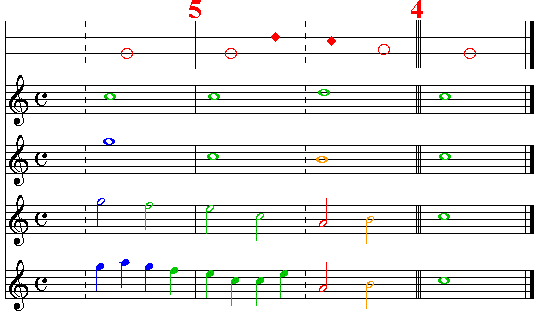
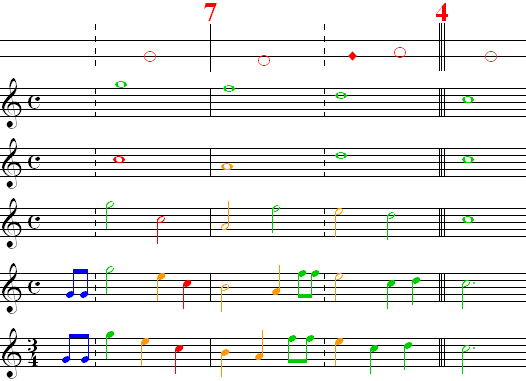
On two stave-systems We first see the harmonic staff with the chord PatternM5374 with a TONIC tenant on the final DOMINANT chord. TONIC / TONIC \ TONIC / DOMINANT \ TONIC / COUNTER \ TONIC-DOMINANT / TONIC. Then, the fundamentalOrbit 1toOrbit 1line, ins, the notes C / C \ C / D \ G / F \ D / C. Then, changes to the secondary orbit lines - Orbit 2toOrbit 1, in the first cell, the notes E / C, Orbit 2toOrbit 1, in the second cell, the notes E / D, and Orbit 2toOrbit 1, in the third cell, the notes E / F. The first cell might very well still be onlyOrbit 1with the Es double Non-chordal Tones of the C. Then, in the smaller note-valuesofLevel -1 we findOrbit 0added in the third cell, the notes E-C / F, bothOrbit 2andOrbit 0resolving toOrbit 1, and Orbit 1, on the TONIC tenant chord, added in the fourth cell, the notes C-D / C, resolving toOrbit 1on the DOMINANT chord. The two first cells have neither secondary Orbit-lines or Non-chordal tones to
add, because each note is simply repeated. Then, in the smaller note-valuesofLevel -2, we find - a pick-up to each of the four cells Orbit 1in the first and second cells, Orbit 0substituting forOrbit 3in the third cell, and Orbit 2in the fourth cell, Orbit 1andOrbit 0added to the Off-beat of the second cell, Orbit 1added to the tenant TONIC chord of the fourth cell. Then, in the smaller note-valuesofLevel -3, we find - in the first cell,Orbit 0added to the pick-up in the second cell,Orbit 0added to the pick-up and the Off-beat, andOrbit 1added to the Off-beat, in the third cell,Orbit 3added to the pick-up. No orbits are added to the fourth cell. The song appears, complete and colored. Clik on the musical illustration to hear the evolution of the generation.
Rock-A-Bye, Baby
If you have not seen theAnalysisofthis song, we recommend that you do so.
On two stave-systems We first see the harmonic staff with the chord PatternM5324 5364 with an ANTE-1 tenant on the final DOMINANT chord, and a TONIC tenant on the Off-beat of the seventh cell. TONIC / TONIC \ TONIC / DOMINANT \ DOMINANT / DOMINANT \ DOMINANT / TONIC TONIC / TONIC \ TONIC / DOMINANT \ TONIC-COUNTER / TONIC \ ANTE-1-DOMINANT /
TONIC. Then, the fundamentalOrbit 1toOrbit 1line, ins, the notes C / C \ C / D \ D / D \ D / C \ C / C \ C / D \ F / G \ D / C. Then, changes to the secondary orbit lines - a double Non-chordal Tone ofOrbit 1itself, in the first and fifth cells, the notes E / C, Orbit 1toOrbit 2, in the second and sixth cells, the notes C / B, a double non-chordal Tone ofOrbit 1itself, in the third cell, the notes F / D, Orbit 1toOrbit 0, in the fourth cell, the notes D / G, and Orbit 1toOrbit 2, in the seventh cell, the notes F / E. Then, in the smaller note-valuesofLevel -1, we find new Orbits and Non-chordal Tones - Orbit 0and s2 ofOrbit 1in the first and fifth cells, the notes G-E / D-C, Orbit 0in the second and sixth cells, the notes G-C / B, Orbit 0and s6 ofOrbit 1in the third cell, the notes G-F / E-D, s2 ofOrbit 0in the fourth cell, the notes D-A / G, Orbit 0on the TONIC tenant chord (Off-beat) andOrbit 1(Beat) in the seventh cell, the notes G-F / E-C Orbit 2in the eighth cell, the notes D-B / C. Then, in the smaller note-valuesofLevel -2, we find - pp3 ofOrbit 0in the first, second, fith, and sixth cells, the note E p2 ofOrbit 0in the third cell, the note F sss4 ofOrbit 0in the fourth cell, the note C (most unusual !) Orbit 1substituting forOrbit 3on the ANTE-1 tenant chord (Off-beat) in the eighth cell, the note A. Then, the Transformation of Ablation is made into 3/4 time. The song appears, complete and colored. Clik on the musical illustration to hear the evolution of the generation.
Oh Where, Oh Where, Is My Little Dog Gone?
If you have not seen theAnalysisofthis song, we recommend that you do so.
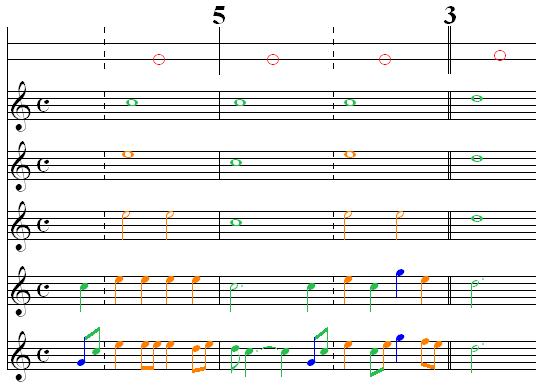
On two stave-systems We first see the harmonic staff with the chord PatternM3434 TONIC / DOMINANT \ DOMINANT / TONIC \ TONIC / DOMINANT \ DOMINANT / TONIC. Then, the fundamentalOrbit 1toOrbit 1line, ins, the notes C / D \ D / C \ C / D \ D / C. Then, one single change to the secondary orbit lines - Orbit 1toOrbit 0, in the second cell, the notes D / G. Then, in the smaller note-valuesofLevel -1, we find Orbit 0in the four cells, the notes G-C / D-G \ G-D / G \ G-C / D-G \ G-D / C. Then, in the smaller note-valuesofLevel -2, we find - Orbit 2E and ss3 ofOrbit 0B in the first and third cells, s2 ofOrbit 0A and ss7 ofOrbit 1F in the second and fourth cells, and a pick-up pp3 ofOrbit 0E at the end of the second cell. Then, in the smaller note-valuesofLevel -3, we find - pick-ups to the four cells - pp3 toOrbit 0E in the first cell, Orbit 0G in the second and fourth cells, and pp3 and p4 toOrbit 0E-F in the third cell, as well as p7 ofOrbit 1B in the first and third cells, and s6 ofOrbit 1E in the second and fourth cells. Then, the Transformation of Ablation is made into 6/8 time. The song appears, complete and colored. Clik on the musical illustration to hear the evolution of the generation.
Happy Birthday
If you have not seen theAnalysisofthis song, we recommend that you do so.
On two stave-systems We first see the harmonic staff with the chord PatternM3474 with a TONIC tenant on the final DOMINANT chord. TONIC / DOMINANT \ DOMINANT / TONIC \ TONIC / COUNTER \ TONIC-DOMINANT / TONIC. Then, the fundamentalOrbit 1toOrbit 1line, ins, the notes C / D \ D / C \ G / F \ D / C. Then, changes to the secondary orbit lines - Orbit 1(substituting forOrbit 3) toOrbit 2, in the first cell, the notes C / B, and Orbit 0(substituting forOrbit 3) toOrbit 2, in the third cell, the notes C / A. Then, in the smaller note-valuesofLevel -1, we find Orbit 0in the first and second cells, the notes G-C / B, and G-D / C, Orbit 1in the third cell, both on the Off-beat and on the Beat, the notes G-C / A-F, and Orbit 2on the TONIC tenant chord in the fourth cell resolving toOrbit 1on the DOMINANT chord, the notes E-D / C. Then, in the smaller note-valuesofLevel -2, we find - a pick-up to each of the four cells Orbit 0in the first, second, and third cells, Orbit 1in the fourth cell. NOTE that, in this generation, we treat theof each pick-up as if it were to avoid another, rather useless, generation staff-line, since theare merely repeated notes. Then, the Transformation of Ablation is made into 3/4 time. The song appears, complete and colored. Clik on the musical illustration to hear the evolution of the generation.
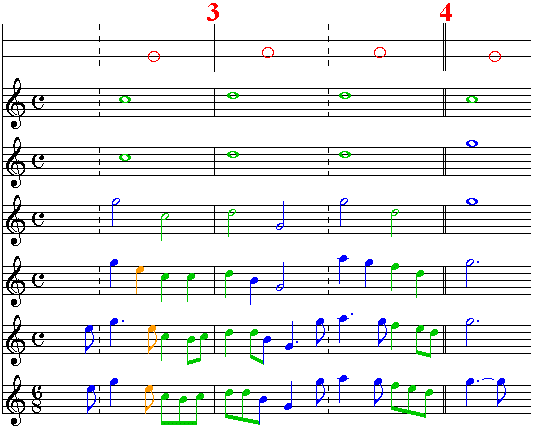
Down in The Valley
If you have not seen theAnalysisofthis song, we recommend that you do so.
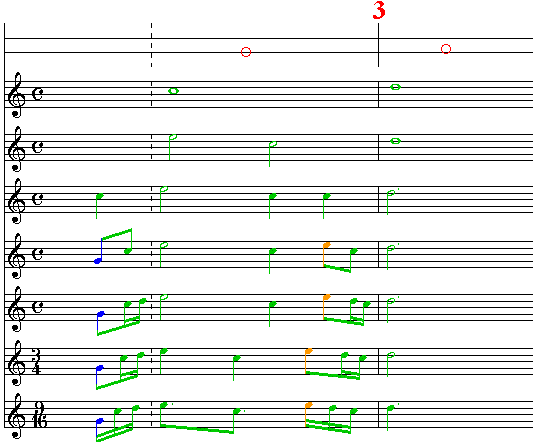
On two stave-systems We first see the harmonic staff with the chord PatternM34 TONIC / DOMINANT \ DOMINANT / TONIC. Then, the fundamentalOrbit 1toOrbit 1line, ins, the notes C / D \ D / C . There will be no changes to this fundamental line. Then, in the smaller note-valuesofLevel -1, we find ss3 ofOrbit 1in the first cell, the notes E-C / D, and ss7 ofOrbit 1in the second cell, the notes F-D / C. Then, in the smaller note-valuesofLevel -2, we find - 2 pick-ups in each of the two split cells, allOrbit 1, the notes C, C, and D, D. Then, in the smaller note-valuesofLevel -3, we find - always in the pick-ups, Orbit 0andOrbit 2, in each cell, the notes G-C, E-C, and G-D, B-D. Then, in the smaller note-valuesofLevel -4, we find - always in the pick-ups, s2 ofOrbit 1in the first cell, the note D, and pp3 and p4 ofOrbit 1in the second cell, the notes B and C. Then, the Transformation of Ablation is made into 3/4 time, and finally, a second Transformation of Ablation is made into 9/16 time. The song appears, complete and colored. Clik on the musical illustration to hear the evolution of the generation.
Those on a Guided tour should click onin the Navigation Bar below.
Those browsing might wish to see theexercisesfor this section, go back toAnalysis, or back toHome.