We advise you to have seen theMelo-rhythmand theMelo-harmonysections before seeing the Melo-lines. They are a necessary prerequisite.
Here again, as with all generations, we will find Basic Materials and Transformations.
Basic Materials
The most important element of the Basic Materials of Melo-lines is the priority of theOrbit 1-Orbit 1line. .The most fundamental melody would have onlyOrbit 1, from beginning to end. Believe it or not, examples exist of this (the "A" sections ofAu clair de la lune).
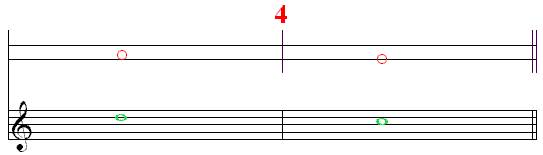
As was the case for the Basic Materials of Melo-rhythm and Melo-harmony, we start with the Fundamental Cell, the very last one. It will be attributed the Basic Melo-line which is theOrbit 1-Orbit 1line on the Melo-harmony Fundamental cellM4DOMINANT / TONIC, and we will have the notes D / C, in the usual key of C major. This basic cell is the most common ending in melodies.
Transformations
The first form of Transformation is one in which the off-beat of this basic Melo-line
can be changed - 1. ToOrbit 2which "substitutes" for the originalOrbit 1 producing theOrbit 2-Orbit 1Melo-line. On the Melo-harmony Fundamental cellM4, we will have the notes B / C, which are found in several melodies. 2. ToOrbit 0which "substitutes" for the originalOrbit 1 producing theOrbit 0-Orbit 1Melo-line. On the Melo-harmony Fundamental cellM4, we will have the notes G / C, the Fundamental Bass, which are found in a few melodies.
It is interesting to note that the Orbit priorities are not the same as they were
for Harmony - where theOrbit 3-Orbit 2line was the most prominent, followed by theOrbit 2-Orbit 1line, the resolutions of the two Secondary Notes. In Melody, theOrbit 1-Orbit 1is the prominent line with theOrbit 2-Orbit 1line substituting for it, in a secondary role. TheOrbit 0-Orbit 1line is less prominent still used almost exclusively when several lines are combined.
Two Cells
If we open the Fundamental Melo-harmonic cellM4DOMINANT / TONIC - the chord pattern will becomeM34TONIC / DOMINANT \ DOMINANT / TONIC.
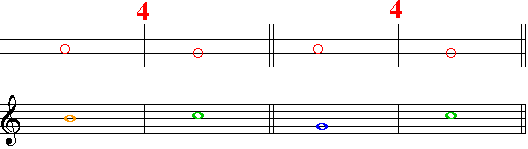
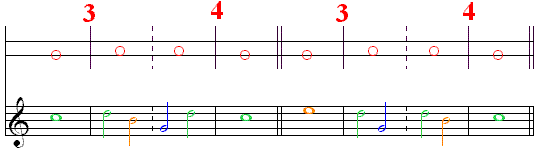
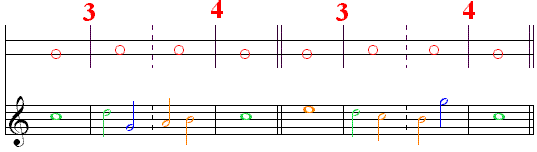
The Basic Fundamental Melo-line CellOrbit 1-Orbit 1, with the notes D / C, can be preceded by eitherOrbit 1orOrbit 2 on the TONIC chord at the beginning for which we have the notes C / D \ D / C, or E / D \ D / C. We keep the same orbit on the two DOMINANT chords. The C / D \ D / C line is the totallyOrbit 1line of which we spoke a little earlier. It is not seen as often as the E / D \ D / C line which has more Orbit variety.
Symmetry Note the inverse symmetry in the C / D \ D / C line, and the direct symmetry in the E / D \ D / C line.
The first Transformation Melo-line CellOrbit 2-Orbit 1, with the notes B / C, can be preceded by eitherOrbit 3itself or by its substitutionOrbit 1 (colored here like the originalOrbit 3) always on the TONIC chord at the beginning, for which we have the notes A / B \ B / C, or C / B \ B / C. We keep the same orbit on the two DOMINANT chords. The C / B \ B / C line is used more often than the A / B \ B / C, Melody preferingOrbit 1toOrbit 3.
Symmetry Note the inverse symmetry in the C / B \ B / C line, and the direct symmetry in the A / B \ B / C line.
The second Transformation Melo-line CellOrbit 0-Orbit 1, with the notes G / C, is seldom used by itself, and we will return to it when we combine several lines.
Several Lines
In the preceding examples, we can take advantage of the repeated DOMINANT chords to
combine several lines at first only two lines, and eventually three. The chord pattern remainsM34TONIC / DOMINANT \ DOMINANT / TONIC.
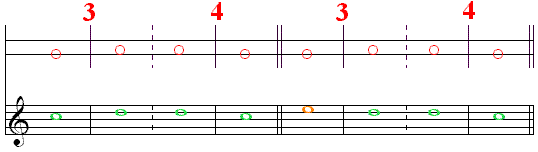
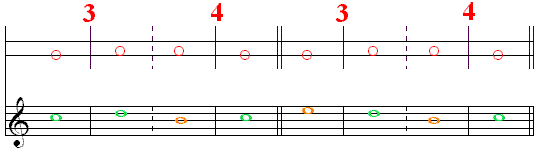
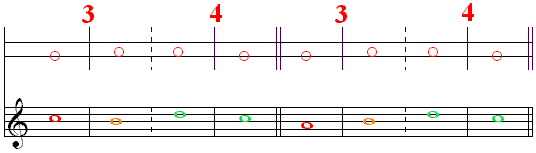
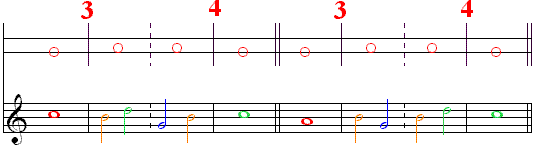
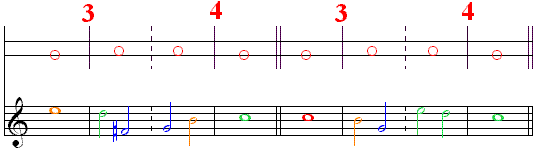
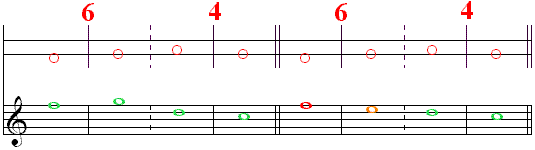
Lines 1-1 and 2-1 Orbit 1will be placed on one DOMINANT chord andOrbit 2on the other. Both orbits on the DOMINANT chord will resolve toOrbit 1on the final TONIC chord.
On the opening TONIC chord, we find - Orbit 1, the note C, in the first example, and Orbit 2, the note E, in the second example. In both examples, we find - Orbit 1, the note D, on the first DOMINANT chord and Orbit 2, the note B, on the second DOMINANT chord, which both resolve toOrbit 1, the note C, on the final TONIC chord. These examples will be evaluated a little later, some more valid than others.
Symmetry Note the inverse symmetry in the E / D \ B / C line, and the direct symmetry in the C / D \ B / C line.
On the opening TONIC chord, we find - Orbit 1, the note C, (substituting forOrbit 3) in the first example, and Orbit 3, the note A, in the second example. In the both examples, we find - Orbit 2, the note B, on the first DOMINANT chord and Orbit 1, the note D, on the second DOMINANT chord, which both resolve toOrbit 1, the note C, on the final TONIC chord.
Symmetry Note the inverse symmetry in the A / B \ D / C line, and the direct symmetry in the C / B \ D / C line.
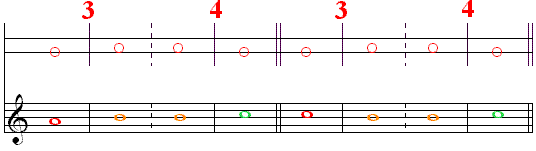
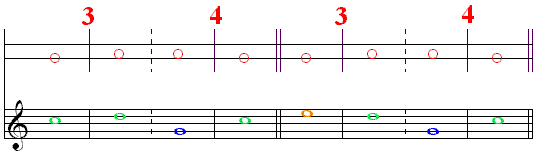
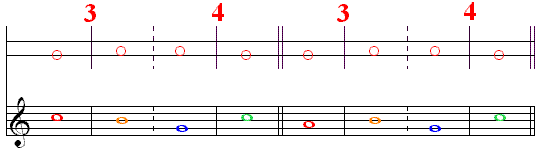
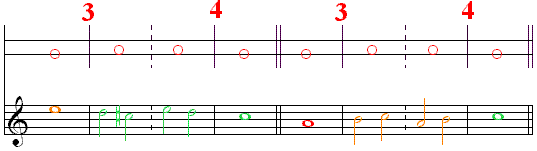
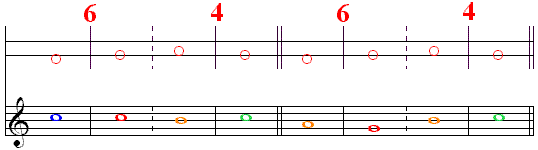
Adding Line 0-1 Orbit 0will be placed on the second DOMINANT chord and eitherOrbit 1orOrbit 2on the first. Both orbits on the DOMINANT chord will resolve toOrbit 1on the final TONIC chord.
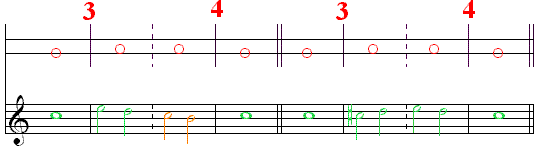
On the opening TONIC chord, we find - Orbit 1, the note C, in the first example, and Orbit 2, the note E, in the second example. In the both examples, we find - Orbit 1, the note D, on the first DOMINANT chord and Orbit 0, the note G, on the second DOMINANT chord, which both resolve toOrbit 1, the note C, on the final TONIC chord.
On the opening TONIC chord, we find - Orbit 1, the note C, (substituting forOrbit 3) in the first example, and Orbit 3, the note A, in the second example. In the both examples, we find - Orbit 2, the note B, on the first DOMINANT chord and Orbit 0, the note G, on the second DOMINANT chord, which both resolve toOrbit 1, the note C, on the final TONIC chord. Orbit 0, the note G, is often placed an octave higher.
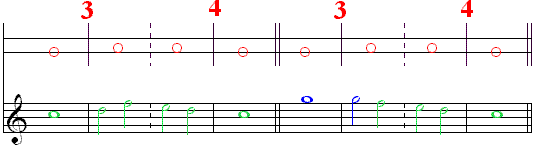
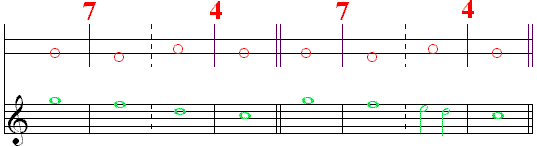
Combining Three Lines In order to have enoughspace("box-compartments") to place the three lines, we will subdivide the twoon the DOMINANT chords into.
On the opening TONIC chord, we find - Orbit 1, the note C, in the first example, and Orbit 2, the note E, in the second example. On the two DOMINANT chords, we find - Orbit 1,Orbit 2,Orbit 0,Orbit 1, the notes D / B \ G / D, in the first example, and Orbit 1,Orbit 0,Orbit 1,Orbit 2, the notes D / G \ D / B, in the second example, which all resolve toOrbit 1, the note C, on the final TONIC chord.
On the opening TONIC chord, we find - Orbit 1, the note C, (substituting forOrbit 3) in the first example, and Orbit 3, the note A, in the second example. On the two DOMINANT chords, we find - Orbit 2,Orbit 1,Orbit 0,Orbit 2, the notes B / D \ G / B, in the first example, and Orbit 2,Orbit 0,Orbit 2,Orbit 1, the notes B / G \ B / D, in the second example, which all resolve toOrbit 1, the note C, on the final TONIC chord.
These combinations of three lines evidently give the melody an "arpeggio" flavor.
The possibilities become more numerous as we are offered more choices.
Non-chordal Tones
AddingNon-chordal Toneswill evidently multiply the possibilities far beyond our capacity of listing them
- each Non-chordal Tone offering the possibility of superior or inferior possibly both, as we will soon see. These "Non-chordal Tones" may, or may not be, incorporated into the harmony of
the accompaniment. When they are NOT incorporated into the harmony they are often called "Non-harmonic
Tones" which seems a very good idea. The chord pattern remainsM34TONIC / DOMINANT \ DOMINANT / TONIC, and we will continue our variations on theof the two DOMINANT chords.
On the opening TONIC chord, we find - Orbit 1, the note C, in both examples. On the two DOMINANT chords, we find - sus6 andOrbit 1itself, sus4 andOrbit 2itself, the notes E - D - C - B, in the first example, and push+4 andOrbit 1itself, sus 6 andOrbit 1itself, the notes C# - D - E - D, in the second example, which all resolve toOrbit 1, the note C, on the final TONIC chord. The first example is simpler in Non-chordal Tones (both descending) and more complex in lines (combining two). The second example is more complex in Non-chordal Tones (one chromatic ascending,
one descending) and simpler in lines (only one).
On the opening TONIC chord, we find - Orbit 3, the note A, in the first example, and Orbit 1, the note C, (substituting forOrbit 3) in the second example. On the two DOMINANT chords, we find - sus4 andOrbit 2itself, sus6 andOrbit 1itself, the notes C - B - E - D, in the first example, and sus4 andOrbit 2itself, push2 andOrbit 2itself, the notes C - B - A - B, in the second example, which all resolve toOrbit 1, the note C, on the final TONIC chord. Here again, the first example is simpler in Non-chordal Tones (both descending) and more complex in lines (combining two) and the second example is more complex in Non-chordal Tones (one descending, one ascending) and simpler in lines (only one).
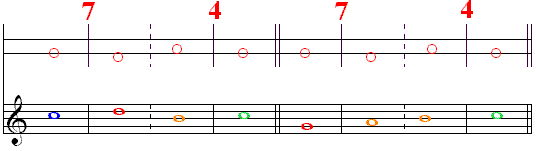
With the Three Lines It is possible to place a Non-chordal Tone with the three lines.
On the opening TONIC chord, we find - Orbit 1, the note C, in the first example, and Orbit 2, the note E, in the second example. On the two DOMINANT chords, we find - Orbit 1,Orbit 0, push2 andOrbit 2itself, the notes D - G - A - B, in the first example, and Orbit 1, sus4 andOrbit 2itself,Orbit 0, the notes D - C - B - G, in the second example, which all resolve toOrbit 1, the note C, on the final TONIC chord.
On the opening TONIC chord, we find - Orbit 2, the note E, in the first example. Orbit 1, the note C, (substituting forOrbit 3) in the second example. On the two DOMINANT chords, we find - Orbit 1, push+7 andOrbit 0itself,Orbit 2, the notes D - F# - G - B, in the first example, and Orbit 2,Orbit 0, sus6 andOrbit 1itself, the notes B - G - E - D, in the second example, which all resolve toOrbit 1, the note C, on the final TONIC chord.
Two Non-chordal Tones in a Row It is possible to place two successive Non-chordal Tones within a given line.
On the opening TONIC chord, we find - Orbit 2, the note E, in the first example. Orbit 3, the note A, in the second example. On the two DOMINANT chords, we find - Orbit 1, push+4, sus6, andOrbit 1itself, the notes D - C# - E - D, in the first example, and Orbit 2, sus4, push2, andOrbit 2itself, the notes B - C - A - B, in the second example, which all resolve toOrbit 1, the note C, on the final TONIC chord. These are occasionally called "double embroideries".
Double Non-chordal Tones It is possible to place Double Non-chordal Tones within a given line.
On the opening TONIC chord, we find - Orbit 1, the note C, in the first example. Orbit 0, the note G, in the second example. On the two DOMINANT chords, we find - Orbit 1, sus-sus7, sus6, andOrbit 1itself, the notes D - F - E - D, in the first example, and Orbit 0, sus-sus7, sus6, andOrbit 1itself, the notes G - F - E - D, in the second example, which all resolve toOrbit 1, the note C, on the final TONIC chord. The second example is so popular that we affectionately call it "the winner".
Other Chord Patterns
All the generative procedures applied above could be repeated on different chord patterns. We have chosen a few of the most popular and presented them with some examples. Since the closingM4DOMINANT / TONIC is always the same we only present new choices in the first cell.
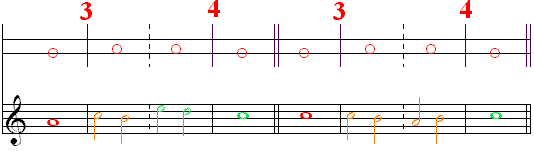
The 64 Pattern M64is composed of COUNTER / TONIC \ DOMINANT / TONIC The is aMetamorphosis 1on the first TONIC which inversesOrbit 0andOrbit 1.
In the first example, we find - Orbit 1, the note F, on the COUNTER chord, Orbit 1, the note G (which becomesOrbit 0), on the TONIC chord, Orbit 1, the note D, on the DOMINANT chord, and Orbit 1, the note C, on the TONIC chord, in all, the notes F / G \ D / C. Since each note is on a different chord, it immediately resolves to the following
chord. In the second example, we find - Orbit 1, the note F, (which substitutes forOrbit 3) on the COUNTER chord, (and is here colored accordingly) Orbit 2, the note E, on the TONIC chord, Orbit 1, the note D, on the DOMINANT chord, and Orbit 1, the note C, on the TONIC chord, in all, the notes F / E \ D / C. The second example is a slightly shorter version of our "winner".
In the first example, we find - Orbit 0, the note C, on the COUNTER chord, Orbit 0, the note C (which substitutes forOrbit 3), on the TONIC chord, Orbit 2, the note B, on the DOMINANT chord, and Orbit 1, the note C, on the TONIC chord, in all, the notes C / C \ B / C. In the second example, we find - Orbit 2, the note A, on the COUNTER chord, Orbit 1, the note G (which becomesOrbit 0and substitutes forOrbit 3), on the TONIC chord, Orbit 2, the note B, on the DOMINANT chord, and Orbit 1, the note C, on the TONIC chord. in all, the notes A / G \ B / C. The second example is a Mozart favorite.
The 74 Pattern M74is composed of TONIC / COUNTER \ DOMINANT / TONIC There is aMetamorphosis 4on the COUNTER (inversing 0-3 and 1-2) and aMetamorphosis 1on the DOMINANT (inversing 0-1).
In the first example, we find - Orbit 1, the note G, on the TONIC chord, Orbit 1, the note F (which becomes a double Non-chordal Tone ofOrbit 0), on the COUNTER chord, Orbit 1, the note D, on the DOMINANT chord, and Orbit 1, the note C, on the TONIC chord, in all, the notes G / F \ D / C. In the second example, we find - Orbit 1, the note G, on the TONIC chord, Orbit 1, the note F (which becomes a double Non-chordal Tone ofOrbit 0), on the COUNTER chord, sus6 andOrbit 1itself, the notes E - D, on the DOMINANT chord, and Orbit 1, the note C, on the TONIC chord, in all, the notes G / F \ E-D / C. The second example is another version of "the winner".
In the first example, we find - Orbit 0, the note C, on the TONIC chord, Orbit 3, the note D (which becomesOrbit 0, a substitution ofOrbit 3), on the COUNTER chord, Orbit 2, the note B, on the DOMINANT chord, and Orbit 1, the note C, on the TONIC chord, in all, the notes C / D \ B / C, a better solution on theM74than on theM34, (as the following table will show us). In the second example, we find - Orbit 1, the note G (a substitution ofOrbit 3), on the TONIC chord, Orbit 2, the note A (which becomesOrbit 1, a substitution ofOrbit 3) on the COUNTER chord, Orbit 2, the note B, on the DOMINANT chord, and Orbit 1, the note C, on the TONIC chord, in all, the notes G / A \ B / C.
Table of Orbit Lines
You will find the following table useful not only in the quest for harmonic origins when we analyse the Melo-harmony, but also in the evaluation of the quality of the various options.
Orbits Chord Pattern
0/3
3 / 2
1 / 2
2 / 1
1 / 1
M6
C / B
D / E
F / E
A / G
F / G
M7
C / D
B / A
G / A
E / F
G / F
M3
G / F
A / B
C / B
E / D
C / D
M4
G / A
F / E
D / E
B / C
D / C
In the top line, you will find the fundamental melodic orbit-lines - Orbit 1toOrbit 1,Orbit 2toOrbit 1,Orbit 1toOrbit 2,Orbit 3toOrbit 2, andOrbit 0toOrbit 3. Note that they are disposed from right to left, in the order they were generated, starting from the the last cell. They are now in the order in which time flows (from left to right) with the most "consequent-oriented" on the right, and the most "antecedent-oriented" on the left. In the left column, you will find the four fundamental (nucleus) harmonic cellpatterns- M6, COUNTER / TONIC,M7, TONIC / COUNTER,M3, TONIC / DOMINANT, andM4, DOMINANT / TONIC. They are symmetrically disposed around the TONIC, and also placed as time
flows, from the antecedent-oriented above to the consequent-oriented below. In the four-by-five lower-right matrix, you will find the notes produced by the various
combinations, in the key of C major, in which all our songs will be presented. Since the two notes of each combination are always conjunct (neighbors), we find here the 14 possible basic combinations (2 for each note), in bold type, on the right-hand side. However, two combinations (D / E and F / E ) appear a second time, in light type, in theOrbit 3toOrbit 2line of theM6andM4patterns. This should not surprise us, for we know that there is a "borrowing process" between the COUNTER and DOMINANT chords, in whichOrbit 3of one chord is borrowed fromOrbit 1of the other, more specifically from theOrbit 1toOrbit 2line, as illustrated in theJordan Diamonds. Moreover, four more combinations (C / B, C / D, G / F, and G / A) appear a second
time, also in light type, in theOrbit 0toOrbit 3procuration line of the four patterns (in the column on the left). These are the most "antecedent-oriented" Orbit Lines of the whole table, especially in the top corner, and theOrbit 1toOrbit 1lines, on the right, are the most "consequent-oriented" especially in the bottom corner.
This table will enable us to retrace the Chord Pattern which generated any given Melody.
Those on a Guided tour should click onin the Navigation Bar below.