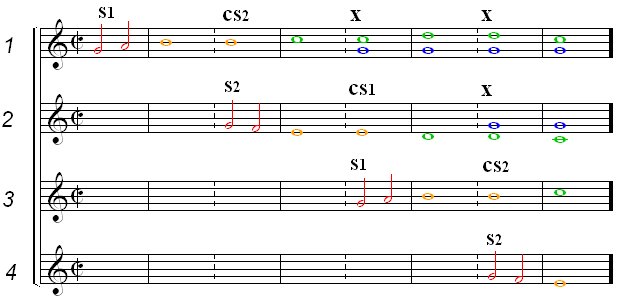
The length of the Subject being 2 bars, atLevel -1, Chord PatternM3, the Exposition AAAA will be 8 bars, Chord PatternM3434, the Divertimento BB will be 4 bars, Chord PatternM4s1, a half-circle, ending on the DOMINANT, and the Exposition AA will also be 4 bars, Chord PatternM34. . The complete fugue will be 16 bars long.
The Expositions
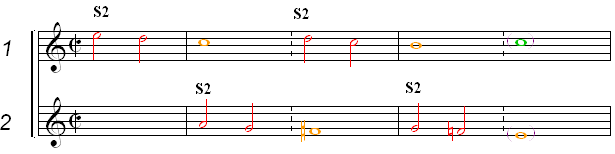
The Fugue-lines
Since the S1 and the S2 are placed on harmonies which resolve in opposite directions, the S1 on the TONIC / DOMINANT progression and the S2 on the DOMINANT / TONIC progression, it is normal and logical that the Fugue-lines will also be in opposite directions, symmetrically disposed around theCOMMON TONE,Orbit 0(the note G). NOTE that eachOrbit 3has been replaced by0(3), 3 to facilitate the entrance by attacking on a more fundamental note, theCOMMON TONE, and to "improve" the Sonorities between the Subject and the Counter-subject (see
below). In each Fugue-line (except the last), a CS2 will follow the S1, or a CS1 will follow
the S2. The same symmetry will exist between CS1 and CS2 as between S1 and S2. The fill sections ("X" in lines 1 and 2) will offer the choice between the remaining
Orbit lines, in this case,1-1and0-0, with advantageous use of theFundamentalBassfor cadences. Decisions will be taken in the Choral Dispositions.
Sonorities When only 2 Lines are heard (at the second A of an Exposition AAAA and in a 2-part Divertimento), one should take care of theSonoritiesbetween them. Since this question of Sonorities pertains to cultural habit and usage far more than to technical structure, we will use the classical, academic norms as our starting point.
The first choice will be the triadic Sonority of the third (sixth), major or minor.
We will then eventually progress to both more pure, fundamental sonorites (octave and fifth), as well to the more discordant, pungent sonorities of the second (seventh), major or minor. In the Subject of this fugue,Orbit 3is replaced by0(3), 3 not only to facilitate its entry, but also to produce the triadic Sonority of the third (sixth) withOrbit 2of the Counter-subject.
The Choral Dispositions
The last Exposition (AA)
The last Exposition, being a consequent, must come to a full close (cadence), for which 2 criteria must apply - 1. the Bass Voice must have theFundamentalBass, and 2. the Soprano Voice must have the1-1Orbit line, thus placing the static fundamental harmonic Primary Notes of theFRAME exposed in the outer voices (S and B) and the kinetic polyphonic Secondary Notes (3-2and2-1) concealed in the inner voices (A and T). In this case, which Fugue-lines meet these criteria ? - only lines 1 and 2 could offer theFB, and - only lines 1 and 2 could offer the1-1Orbit line in the Soprano. We have 2 possible dispositions with lines 1 and 2 alternating in the outer voices, with the preceding Divertimento BB between these two voices.
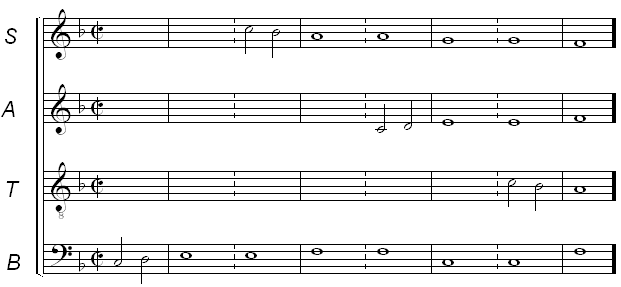
The first disposition - If Fugue-line 1 is placed in the Bass Voice, with theFBfor the last 2 cells (in XX), Fugue-line 2, with its1-1Orbit line option (in X), must be in the Soprano Voice, Fugue-line 3, in the same direction as Fugue-line 1, must be in the Alto Voice, Fugue-line 4 in the Tenor Voice, entries in descending, clockwise order. Placing this in the Key of F, gives us a good Choral Disposition. The first Exposition (AAAA) of this disposition will be seen later.
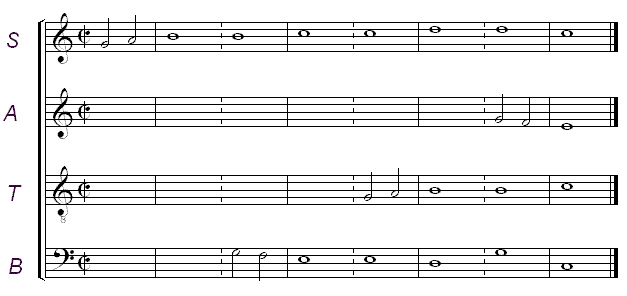
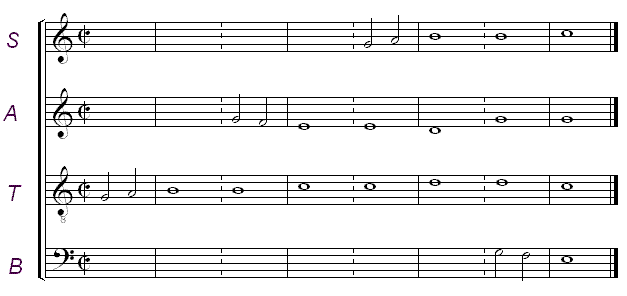
The second disposition - If Fugue-line 2 is placed in the Bass Voice, with theFBfor the last cell (in X), Fugue-line 1, with its1-1Orbit line option (in X), must be in the Soprano Voice, Fugue-line 4, in the same direction as Fugue-line 2, must be in the Alto Voice, Fugue-line 3 in the Tenor Voice, entries in ascending, counter-clockwise order. Placing this in the Key of C, gives us a good Choral Disposition. The first Exposition (AAAA) of this disposition will also be seen later.
NOTE - Only the second half of the last Exposition will be used, because it is only an AA, the first AA being replaced by the BB, in the outer voices.
The first Exposition (AAAA)
To avoid the full close (cadence) in the first Exposition, an antecedent, and remain in the same key, with the same range of voices, one must invert - 1. the high Voices (Soprano and Tenor) and 2. the low Voices (Alto and Bass) The kinetic polyphonic Secondary Notes (3-2and2-1) are now exposed in the outer voices (S and B) and the static fundamental harmonic Primary Notes of theFRAME(without theFB) are now concealed in the inner voices (A and T).
The first disposition, in F NOTE the choice of Orbit-lines for the "X"s - in the Alto Voice, at the first "X", it is preferable to choose the0-0-0-0line, and avoidFRAMEInversion (by not hearing the root above the fifth in the Bass Voice entrance). in the Tenor Voice, one places the only Orbit-line left,1-1.
The second disposition, in C NOTE the choice of Orbit-line for the "X" in the Alto Voice, one places the only Orbit-line left,0-0.
Ornaments
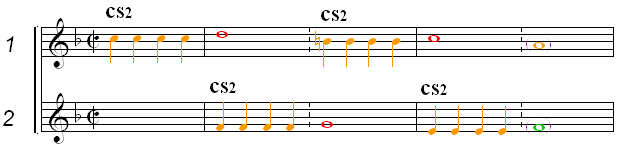
The use of repeated notes (subdivision of the) adds interest to the important elements (especially the Subject and the Counter-subject). Since the Subject is already subdivided (ins), it would be interesting to subdivide the Counter-subject (ins). One could find simple, explanatory words to fit this Melo-rhythm, such as - for the Subject : "Subject first," for the Counter-subject : "Counter-subject next," for the first "X" : "Fill in" for the second "X" : "the rest." for the solitary "X" : "Fill in the rest.", in shorter note values.
The Divertimento
The Fugue-lines
We could use either the Subject or the Counter-subject as a motif for this canon on the half circle -ANTE-3 / ANTE-2 \ ANTE-1/ DOMINANT, with the ANTE-1dominantized(possibly also the ANTE-3). We will limit ourselves, for now, to a 2-part canon, using the Orbit Chain3-2(or2-3) andVoice-leading C.
The Subject as canon motif -
In the Key of C, using S2 as motif, with the words "Subject first," the canon starts in Fugue-line 1 with0(3), 3-2on the Ante-3, (E)D-C and is answered in Fugue-line 2, also with0(3), 3-2on the Ante-2, (A)G-F#. At the end of the Divertimento, we see (in parentheses) the resolutions, which we will need to tie in the lines of this Divertimento with the next
(and last) AA. Fugue-line 1 resolving toOrbit 1ties in with an "X", and Fugue-line 2 resolving toOrbit 2ties in with CS1.
The Counter-subject as canon motif -
In the Key of F, using CS2 as motif, with the words "Counter-subject next." the canon starts in Fugue-line 1 with2-10(3)on the Ante-3, C-D(C) and is answered in Fugue-line 2, also with2-10(3)on the Ante-2, F-G(F). NOTE that the CS2 is subdivided intos as suggested in the "Ornaments". At the end of the Divertimento, we see (in parentheses) the resolutions, which we will need to tie in the lines of this Divertimento with the next
(and last) AA. Fugue-line 1 resolving toOrbit 2ties in with CS1, and Fugue-line 2 resolving toOrbit 1ties in with an "X".
The Complete Fugue
General Instructions For either of the 2 dispositions, the one in F or the one in C, 1. Place the Expositions - The AAAA at the beginning, and the AA at the end (leaving 4 bars empty for
the BB). 2. Insert the BB Divertimento in the 2 Voices which donotpresent the Subject in the AA, making sure that the resolutions at the end of the Divertimento, tie in perfectly with the lines at the beginning of the AA. 3. It is elegant to have some voice tie in the AAAA with the BB, preferably one of the Voices performing in the BB, but possibly one of the other 2 voices which would rebound after the AAAA. 4. There will be adjustments required in the words at a few places.
The fugue in F - Version 1 with a Counter-subject canon
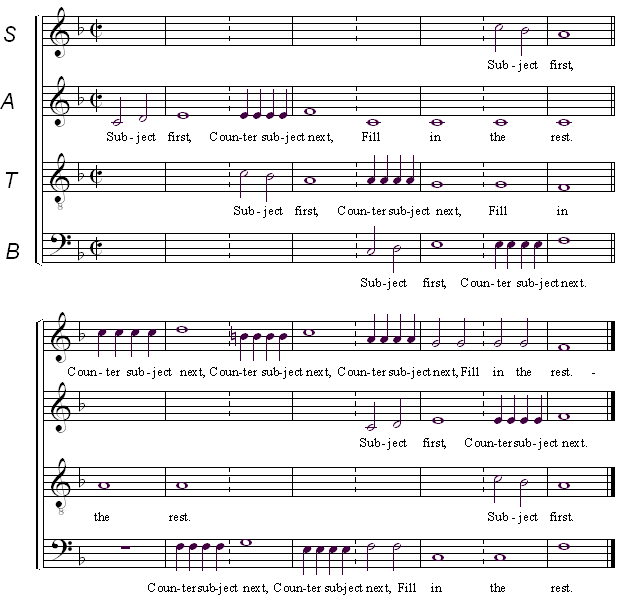
The first Exposition AAAA is theinversionofversion 1 of the last disposition. The last Exposition AA is the second half ofversion 1 of the last disposition. NOTE (in the Soprano Voice) the subdivision ins to place the words of the 2 "X"s into 1 "X". The 2 DivertimentoCounter-subject lineshave been disposed in the Soprano and Bass Voices, replacing the 2 first entries in the originalversion 1 of the last disposition, to tie in to the second half ofversion 1 of the last Exposition, Fugue-line 1 tying in to the CS1 in the Soprano Voice, and Fugue-line 2 tying in to the 2 "X"s the Bass Voice. NOTE, in the Tenor Voice, a rebound from the preceding AAAA Exposition, with the words "the rest", NOTE, in the Bass Voice, the word "next" is shortened (to a) to fit in the word "Fill" of the 2 "X"s.
The fugue in C - Version 2 with a Subject canon
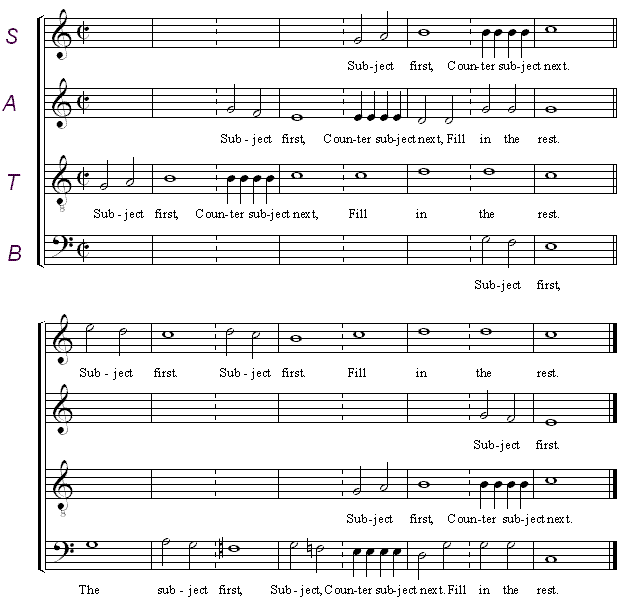
The first Exposition AAAA is theinversionofversion 2 of the last disposition. NOTE (in the Alto Voice) the subdivision ins to place the words of the 2 "X"s into 1 "X". The last Exposition AA is the first half ofversion 2 of the last disposition. NOTE (in the Bass Voice) the subdivision ins to place the words of the 2 "X"s into 1 "X". The 2 DivertimentoSubject lineshave been disposed in the Soprano and Bass Voices, replacing the 2 first entries in the originalversion 2 of the last disposition, to tie in to the second half ofversion 2 of the last Exposition, Fugue-line 1 tying in to the 2 "X"s in the Soprano Voice, and Fugue-line 2 tying in to the CS1 the Bass Voice. NOTE, in the Bass Voice, the added note at the beginning of the Divertimento with the word "The", the word "first" missing in Bar 4 of the Divertimento for lack of space.
Exercise
Write your own fugue Keeping the same Specifics- FormAAAA BBAA, Chord PatternM34, for the AAAA with a half circle to the DOMINANT for the BB,M4s1 Subject line3-2, and Counter-subject line2-1, but freely choosing- disposition 1 or disposition 2 of the last Exposition, the Subject or the Counter-subject, as motif, for the canon of the Divertimento, and freely changing- the Melo-rhythm time signature (6/8, 3/4 ... atLevel -1) the Substitution "formula" for the Subject, the repeated note "formula" for the Counter-subject, the words (or possibly scat singing) for the Subject, the Counter-subject, and
the "X"s. Check each Voice carefully(Soprano, Alto, Tenor, and Bass) from beginning to end, making sure that the melodic movements are easy and natural, and that the words are coherent. Correction is in the performance - Get some friends together, at least 4, preferably 8 (for a double quartet), and evaluate the results - 1. How quickly, and easily, was it performed ? 2. How did the performers evaluate it, both singing it and hearing
it ? 3. What did you, the composer, think of it ? Don't spend too much time correcting it, move on to the next one. All the performers should ideally be writing their own fugues.