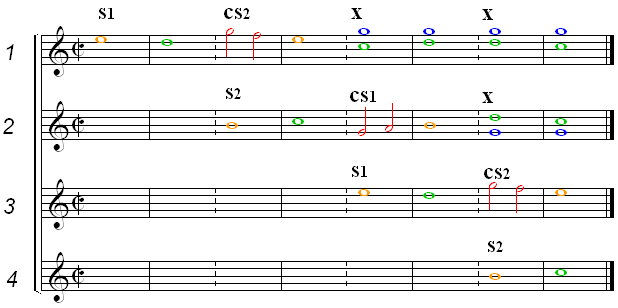
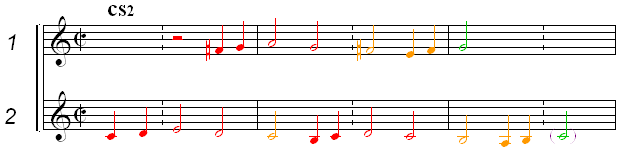
Here again eachOrbit 3has been replaced by0(3) 3 in CS2 (G)F, in CS1 (G)A, to facilitate the entrance by attacking on a more fundamental note, theCOMMON TONE, and to "improve" the Sonorities between the Subject and the Counter-subject (seeClass 1). We have the same choices of "X"s in Fugue-lines 1 and 2 (Orbit lines1-1with thePROPER TONEand0-0with theCOMMON TONE).
The Choral Dispositions
The last Exposition (AA)
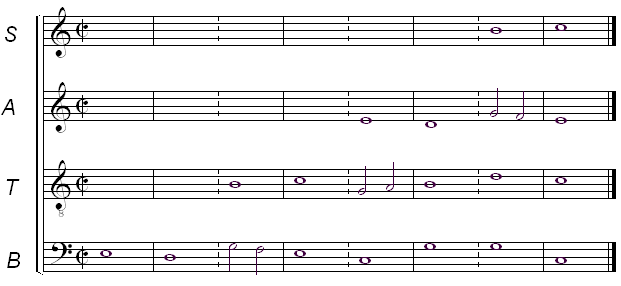
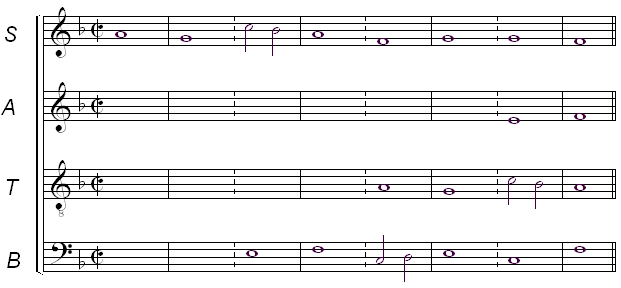
2 dispositions The last Exposition, being a consequent, must come to a full close (cadence), Here again, we have 2 possible dispositions because Fugue-lines 1 and 2 can offer both theFB, and the1-1required in the Soprano (the outer voices), leaving the kinetic polyphonic Secondary Note lines3-2and2-1 in the inner voices (A and T).
The first disposition - If Fugue-line 1 is in the Bass Voice, with theFBfor the last 2 cells (4 bars), Fugue-line 2, with its static1-1line must be in the Soprano Voice, Fugue-line 3, in the same direction as Fugue-line 1, must be in the Alto Voice,
and Fugue-line 4 is thus in the Tenor Voice. Leaving this in the Key of C gives us a good Choral Disposition. The first Exposition (AAAA) of this disposition will be seen later.
The second disposition - If Fugue-line 2 is placed in the Bass Voice, with theFBfor the last cell (2 bars), Fugue-line 1, with its "X"s on Orbits1-1-1-1, must be in the Soprano Voice, Fugue-line 4, in the same direction as Fugue-line 2, must be in the Alto Voice,
leaving Fugue-line 3, in the Tenor Voice. Placing this in the Key of F, gives us a good Choral Disposition. The first Exposition (AAAA) of this disposition will also be seen later.
NOTE - Remember that only the second half of the last Exposition will be used, because it is only an AA, the first AA being replaced by the BB.
The first Exposition (AAAA)
Remember to invert the high Voices (Soprano and Tenor) and the low Voices (Alto and
Bass) to avoid the full close (cadence) in the first Exposition, an antecedent.
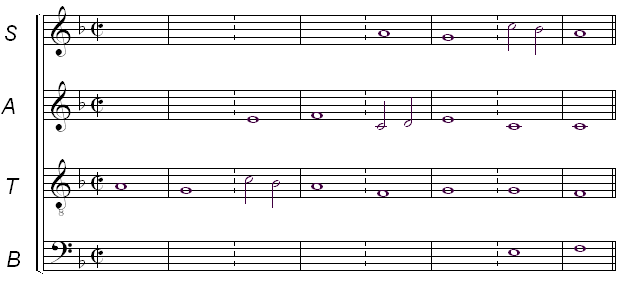
The first disposition, in C NOTE the choice of Orbit-line for the "X"s in the Alto Voice,- 1-1-1-0to avoidFRAMEinversion with the Bass Voice on the DOMINANT chord.
The second disposition, in F The choice of Orbit-lines for the "X"s in the Tenor and Alto Voices is as simple and evident as possible, the Soprano and Bass Voices elegantly avoiding a strong cadence.
Ornaments
In this class, we will add embroideries as melodic ornaments for the Subject or the
Counter-subject. Embroidering the Subject, where there is no movement, produces particularly successful sonorities with the substitution (and theMOTRIX) of the Counter-subject.
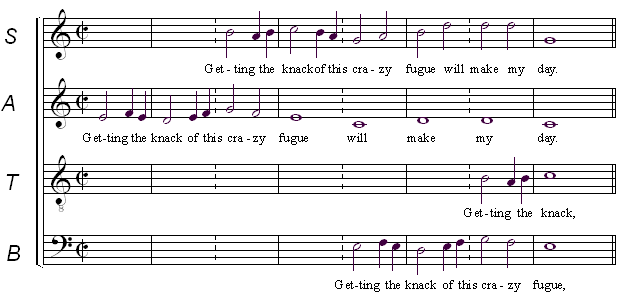
One could find simple, possibly silly, words to fit this Melo-rhythm, such as - for the Subject : "Getting the knack" for the Counter-subject : "of this crazy fugue" for the first "X" : "will make" for the second "X" : "my day." NOTE the addition of passing tones as a pick-up to the Counter-subject (with the words "of this").
The Divertimento
The Fugue-lines
The Counter-subject as canon motif -
In the Key of C, using CS2 as motif, with the words "Of this crazy fugue" the canon starts in Fugue-line 2 with the pick-up followed by0(3) 3 / 2on the Ante-3, CD\ED/C, and is answered in Fugue-line 1, also with the pick-up followed by0(3) 3 / 2, on the Ante-2, F#G/AG\F#. NOTE that the CS2 is subdivided into / / as suggested in the "Ornaments". At the end of the Divertimento, we see (in parentheses) the resolutions, which we will need to tie in the lines of this Divertimento with the next
(and last) AA. Fugue-line 1 resolving toOrbit 1ties in with an "X", and Fugue-line 2 resolving toOrbit 2ties in with CS1.
The Complete Fugue
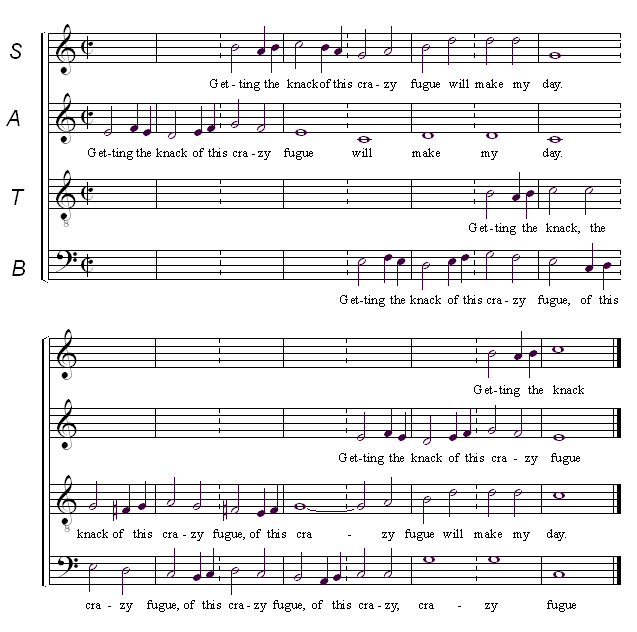
The fugue in C - Version 1 with a Counter-subject canon
Place the Expositions, insert the BB Divertimento, have some voice tie in the AAAA with the BB, and adjust the words.
The first Exposition AAAA is theinversionofversion 1 of the last disposition. The last Exposition AA is the second half ofversion 1 of the last disposition (with theembroideriesadded, of course). NOTE (in the Tenor Voice) the subdivision ins to place the words of the 2 "X"s into 1 "X". (for the words "will make my day", at the end of the first line). The 2 DivertimentoCounter-subject lineshave been disposed in the Soprano and Bass Voices, replacing the 2 first entries in the originalversion 1 of the last disposition, to tie in to the second half ofversion 1 of the last Exposition, Fugue-line 1 tying in to the CS1 in the Soprano Voice, and Fugue-line 2 tying in to the 2 "X"s (theFB) in the Bass Voice. NOTE, in the Soprano Voice, a rebound from the preceding AAAA Exposition, with the words "the knack", (at the same time as the CS2 pick-up in the Bass Voice), as well as a longer note-value after the Divertimento in the CS1 on the word "cra-zy". NOTE, in the Bass Voice, the word "crazy" is repeated (ins) to fill in the 2 "X"s (at the end).
You should be able to work out the second version of voice disposition, in F, using the Subject as canon motif. .
Exercise
Write your own fugue Keeping the same Specifics- FormAAAA BBAA, Chord PatternM3434, for the AAAA with a half circle to the DOMINANT for the BB,M4s1 Subject line2-1, and Counter-subject line3-2, but freely choosing- either disposition of the last Exposition, the Subject or the Counter-subject, as motif, for the canon of the Divertimento, and freely changing- the Melo-rhythm time signature (6/8, 3/4 ... atLevel -1) the Substitution "formula" for the Counter-subject, the embroideries for both the Subject and the Counter-subject, the words (or possibly scat singing) for the Subject, the Counter-subject, and
the "X"s. Check each Voice carefully(Soprano, Alto, Tenor, and Bass) from beginning to end, making sure that the melodic movements are easy and natural, and that the words are coherent. Correction is always in the performance.
RESEARCH - You might enjoy finding a melody which starts withM3(orM4), which uses Orbit Line3-2or2-1, to act as S1 (or S2) for your fugue.