Definition If a chord has a strongMEDIAN, major if the progression is flattening, minor if the progression is sharpening, itsOrbit 0, when it procuresOrbit 3in Voice-leading A, can be chromaticized to bring it closer to its resolution.
As a matter of fact, chromaticization always brings a note closer to its resolution. It is because a note moves in a specific direction that it can be chromaticized, not because it is chromaticized that it moves in that direction. The cause has often been confused with the effect.
Terminology We call this particular chromaticism "Orbit 4" because it has a very high degree of tension and is clearly no longerOrbit 0. Since it resolves toOrbit 3, and resolution is always to the next lower degree of tension, it seems appropriate to call itOrbit 4.
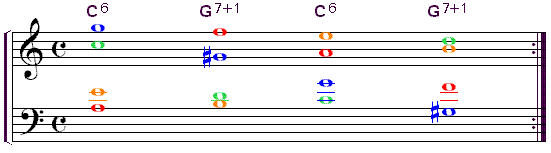
TONIC-DOMINANT Swing -In a TONIC-DOMINANT Swing with Voice-leading A, only the DOMINANT Chord, G7, has a strongMEDIAN - itsOrbit 0, G, can be chromaticized toOrbit 4, G#, giving the chord a diminished seventh sound, usually indicated G#dim7.
Beware! It is still fundamentally a G7 chord (G7+1). Much more of this illusory harmony still to come.
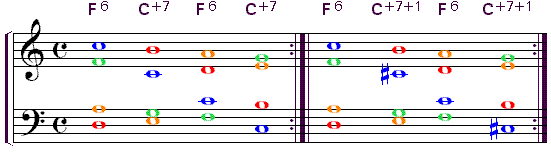
COUNTER-TONIC Swing -This possibility does not limit itself to DOMINANT-shape chords. In a COUNTER-TONIC Swing with Voice-leading A, it is the TONIC Chord which has a strongMEDIANE and itsOrbit 0, C, can be chromaticized toOrbit 4, C#, giving the chord a half-diminished sound (usually indicated C#m7-5). But it is still fundamentally a C+7 chord, now C+7+1.
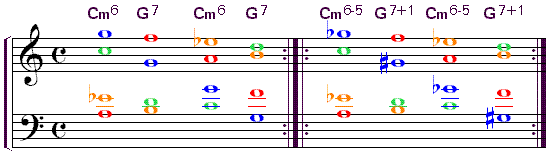
Dominantized TONIC -In a TONIC-DOMINANT Swing with Voice-leading A, where the TONIC Chord has been dominantized to Cm6, theOrbit 0of each chord, G, can be chromaticized toOrbit 4, Gb and G#. We have here the diminished seventh sound on each chord: (usually indicated Adim7 for the chord of Cm6 and G#dim7 for the chord of G7) but they are really Cm6-5 and G7+1.
Metamorphosis 4 This is the third time we present this example of 2 consecutive applications of metamorphosis
4 - the first time in itsdiatonic state with the chord pattern C+7, F6Dm7, G6Em7, Am-6, Em7G6, Dm7F6, the second time with each chorddominantized(the second function of each metamorphosed chord) with the chord pattern C7, D7, E7, Am6, Gm6, Fm6, all Dominant-shape chords. We will now apply the chromaticim ofOrbit 4to each of these dominant-shape chords, with the chord pattern C7+1, D7+1, E7+1, Am6-5, Gm6-5, Fm6-5, (usually indicated C#dim7, D#dim7, E#dim7, F#dim7, Edim7, Ddim7). We have here the diminished seventh sound on each chord: NOTE that the Cb (-5) in the Soprano (at the end),Orbit 4resolving toOrbit 3, Bb, at the beginning, would be a B (p+4), aNon-chordal ToneofOrbit 0, as it leads into the last chord. You might wish to hear the versionwithouttheOrbit 4, or even the versionwithoutthe dominantisation to compare.
We now suggest that you see the chromaticism of Diminution