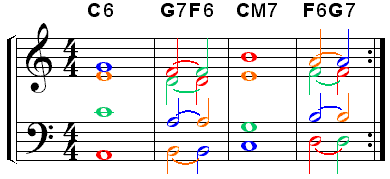
Metamorphosis 3 is usually presented closed, in the form common to both functions. The chord changes: - its direction; - its position in the series of fifths (2FRAMEs away); - the swing to which it belongs; (1 fifth away - with the metamorphosed chord in exterior position); - the notes which acts asOrbit 0(COMMON TONE) of both chord positions. There are 2 orbit exchanges here: - there is an exchange betweenOrbit 0andOrbit 2 (the note which wasOrbit 0becomesOrbit 2and the note which wasOrbit 2becomesOrbit 0); - there is an exchange betweenOrbit 1andOrbit 3 (the note which wasOrbit 1becomesOrbit 3and the note which wasOrbit 3becomesOrbit 1). In Metamorphosis 2, the Non-Chordal Tone ofOrbit 0was required on one of the chords to make it exactly like the other. In Metamorphosis 3, the Non-Chordal Tone ofOrbit 0is required on both chords to make them exactly the same.
-We have here the following chords: C6, the complete Tetrad G7s2F6p+4- Metamorphosis 3 - with a Non-Chordal Tone ofOrbit 0on each chord, A on the chord of G7s2(which isOrbit 2of F6) in the Tenor, and B on the chord of F6p+4(which isOrbit 2of G7) in the Bass, C+7, the complete tetrad F6p+4G7s2- Metamorphosis 3 - with a Non-Chordal Tone ofOrbit 0on each chord, Tenor and Soprano. The chords of Rest (on the Beat), C6and C+7, are presented as completeTetrads to differentiate them from each other. This will be all the more evident when the chords areDominantized