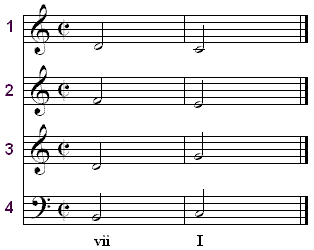
Minimal definitions of the two forms of Triads found in each Tetrad were already presented in theopening page, and we will now elaborate on them further, more specifically, detailed descriptions of the two kinds of deceptive triads. A "seventh" Tetrad (V7), one which possesses a Seventh as secondary note, will have a deceptive triad (vii) composed of, the Third, the Fifth, and the Seventh of the original Tetrad. Which means that - the root of the deceptive triad (B) is basically the Third of the original
Tetrad, the third of the deceptive triad (D) is basically the Fifth of the original
Tetrad, the fifth of the deceptive triad (F) is basically the Seventh of the original
Tetrad. A "sixth" Tetrad (IV6), one which possesses a Sixth as secondary note, will have a deceptive triad (ii) composed of, the Sixth, the Root, and the Third of the original Tetrad. Which means that - the root of the deceptive triad (D) is basically the Sixth of the original
Tetrad, the third of the deceptive triad (F) is basically the Root of the original
Tetrad, the fifth of the deceptive triad (A) is basically the Third of the original
Tetrad. NOTE that only the Third of the original Tetrad appears in both forms of deceptive
triad.
Like Transposing Instruments Constantly imagining the reality of the Tetrad every time one sees a deceptive triad
is somewhat like the process of mentally adjusting to the notation of transposing
instruments, seeing one thing written on paper and hearing another when it is performed.
This transposing process remains a complete and baffling mystery to most pianists
and players of string instruments, but those who play clarinet, saxophone, trumpet
or horn take it for granted and will probably be in a better position to understand
the "transposition" from the illusion of deceptive triads to the reality of the basic
underlying Tetrad.
Comparison with Real Triads The Real Triad has a primary note (of the basic Tetrad) "at each end", and a secondary note (of the basic Tetrad) "in the middle". The deceptive triad has a secondary note (of the basic Tetrad) "at each end", and a primary note (of the basic Tetrad) "in the middle". Knowing that the primary notes are free to resolve anywhere and that they can be doubled, and that secondary notes have obliged resolutions and should preferably not be
doubled, one can appreciate the crucial importance of being able to distinguish between Real Triads and deceptive triads.
The IV-V Progression
Start with Tetrads Real Triads, like their Tetrad progenitors, only resolve by ascending or descending
fifth, and theIV-Vprogression, by ascending second, was presented (inClass 3) as unusual Real Triad behavior, with equally unusual, though simple, Voice-leading. The explanation, as expected, lies in the operation of the Basic Tetrads whereIV6andII7are composed of exactly the same notes (D, F, A, C), which do not have the same function with respect to what precedes and what
follows. In theI+7-IV6-V7-Iprogression, theI+7resolves (by descending fifth) toIV6, but it is aII7which resolves (by descending fifth) toV7. The same notes (D, F, A, C) constitutedIV6with respect to what preceded andII7with respect to what followed, as a man may be son to his father, and then father to his
son.
Then Triads A Real Triad ofIVfrom theIV6Tetrad became a deceptive triad ofivfrom theII7Tetrad. The situation was further slightly complicated by the fact that the doubling of the note F onIVwas not changed to the doubling of the note A oniv, not a very serious matter.
Another case A similar situation occurred in theI-IIprogression. A Real Triad ofIfrom theI6Tetrad became a deceptive triad ofifrom theVI7Tetrad, which resolved (by descending fifth) to theII7Tetrad, in the form of itsIIReal Triad.
No More FB
The Fundamental Bass consists of the Root of each basic Tetrad. Since the root of a deceptive triad is a secondary note (either a Third or a Sixth), placing it is root position does not produce a Fundamental Bass. With increased use of deceptive triads, VLL 4 will become more and more like the other three, even if it is always disposed in the bass voice for performance.
Doubling and Voice-leading Lines
Once a deceptive triad is recognized for the illusion (or misconception) that it is,
both its doubling and its Voice-leading become remarkably simple and constant. This
will apply to both forms of deceptive triads, those from Seventh Tetrads and those
from Sixth Tetrads. The progressions imposed by deceptive triads in Root Position
will also be strongly influenced by the preference for progressions by ascending second.
This is the category which will be presented first.
Constants In both forms of deceptive triads - The "outside notes" (the root and the fifth) will cave in toward each other, the root (usually in the bass voice) ascending a second, and the fifth (in an upper voice) descending a second. The "middle note" (the third) will be doubled. One VLL will go to the note missing to complete the following triad, and the other VLL will go to the note to be doubled in the following
triad. This procedure (which might entail crossings between VLLs) will be inevitable in the voice-leading of each deceptive triad.
Three possibilities left There are four possibilities of progressions between triads - from a Real Triad to another Real Triad, from a Real Triad to a deceptive triad, from a deceptive triad to another deceptive triad, and from a deceptive triad to a Real Triad. The first possibility, Real Triad to Real Triad, has been seen in classes 1-5, and the other three possibilities will be seen in the order shown above.
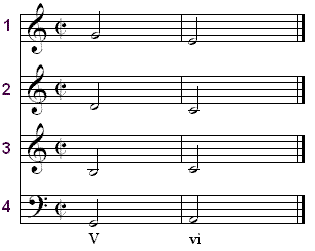
From Real Triad to deceptive triad The triad progressionV-vifrom the TetradsV7-I6 NOTE the Voice-leading in - VLL 4 (G-A), the two triads in root position, Root to Sixth in the Tetrads (no
FB); VLL 3 (B-C), resolution of the Tetrad Third; VLL 2 (D-C), doubling the C, third of ther deceptive triad, thus avoiding having the four lines in the same direction, and avoiding parallel fifths with VLL 4; VLL 1 (G-E) to the Tetrad Third of the next chord. VLLs 1, 2, and 3 are identical to those in theV-Iof thediad version of Class 1.
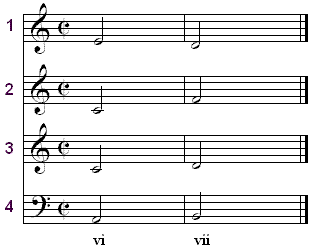
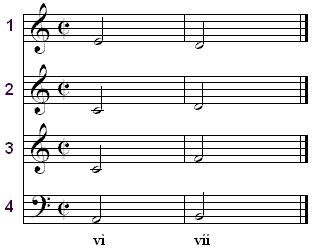
From deceptive triad to deceptive triad The triad progressionvi-viifrom the TetradsI6-V7 NOTE the Voice-leading in - VLL 4 (A-B), the two triads in root position, Sixth to Third in the Tetrads (no
FB); VLL 1 (E-D), resolution of the Tetrad Third, in both of the above examples. VLLs 2 and 3 are involved in doubling the C. As we saw inConstantsabove, one C will go to the note missing in the next triad (C – F) and the other to the doubling on the next triad (C – D). In either case there is a potential crossing with VLL 1, which will not materialize if we dispose the two crossing VLLs (VLL 1 and
either VLL 2 or 3) in the soprano and tenor voices. Going to the upper note in VLL 2 (C-F), and to the lower note in VLL 3 (C-D), in the example on the left, will place the potential crossing between VLL 1 and VLL 2 (to be disposed in the soprano and tenor voices), and keep the VLLs in the same range for a possible repeat of the completeV-vi-vii-Ichord pattern. Going to the upper note in VLL 3 (C-F), to the lower note in VLL 2 (C-D), in the example on the right, and including the previousV-viprogression, will produce G-E-D in VLL 1, D-C-D in VLL 2, and B-C-F in VLL 3, which cannot be disposed (in SAT) without crossing. The isolated progressionvi-viiis possible with either choice but the second choice is incompatible with the precedingV-vi.
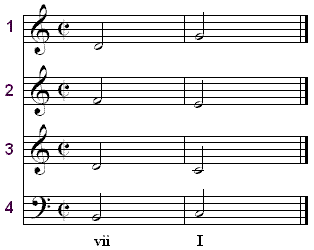
From deceptive triad to Real Triad The triad progressionvii-Ifrom the TetradsV7-I6 NOTE the Voice-leading in - VLL 4 (B-C), the two triads in root position, Third to Root in the Tetrads (no
FB); VLL 2 (F-E), resolution of the Tetrad Seventh; in both of the above examples. Once again, there is a choice to be made between the doubling of the Ds - one to the note missing in the next triad (D-G), and one to the doubling on the
next triad (D-C). It seems preferable to avoid crossings between VLLs (on the left), thus going to the upper note in VLL 1 (D-G), and to the lower note in VLL 3 (D-C), crossing only VLL 1 and VLL 2 (as in the previous progression), and keeping the VLLs in the same range for a possible repeat of the completeV-vi-vii-Ichord pattern. However, going to the upper note in VLL 3 (D-G) and to the lower note in VLL
1 (D-C), will produce G-E-D-C in VLL 1, D-C-F-E in VLL 2, and B-C-D-G in VLL 3, which can also be disposed without crossing (on the right). With either choice, if the VLL containing D-G is placed in the soprano voice, there might be clamors of a direct fifth.
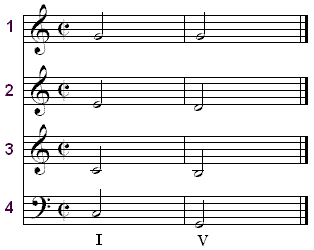
From Real Triad back to Real Triad The triad progressionI-Vfrom the TetradsI6-V7 NOTE that if what we call the preferential choice from the doubled note has been taken
both times, (in the example on the left) the VLLs in theI-V, back to the beginning of the completeV-vi-vii-Ichord pattern are exactly what was presented in Class 1.
Melody The jumps of a fourth (or possibly fifth in the opposite direction) are particularly interesting here because they are not necessarily in VLL 4, but may also appear in VLLs 1, 2, and 3.
Chord Patterns
These progressions by ascending second will offer us interesting new chord patterns
- TheV-vi-vii-Ipattern, a weak form of consequent, thevii-Icadence not being as strong as theV-Icadence, was presented piece-meal in the various progressions presented above. TheI-ii-iii-IVpattern, an interesting antecedent, a tonal transposition of theV-vi-vii-Ipattern, can be combined with an appreciable number of consequents.