Definitions Triads come in 2 very different, almost opposite, categories but, because chord functions
are logically based on Tetrads, they are best defined by relating them to Tetrads.
Tetradshave:
2 primary notes, the root and the fifth, which are free to resolve anywhere, and can be doubled
2 secondary notes, the third and the seventh (or sixth), which have obliged resolutions, and cannot be doubled.
Triads If the 4 notes of a tetrad are disposed in thirds, a triad can be formed by removing
the note at either end and conserving the others.
Removing the seventh from the top or the sixth from the bottom produces aReal Triad, with
root, third, and fifth (of the Tetrad).
Removing the root from the bottom or the fifth from the top produces adeceptive triad, with
third, fifth, and seventh (of the Tetrad), when removing the root from the bottom
sixth, root, and third (of the Tetrad), when removing the fifth from the top.
That's all there is to it And it immediately establishes order for doubling and voice-leading.
See also More information can be found in the page on theDiatonic Major Mode.
Terminology and symbols To easily distinguish between the 2 forms of triads:
Real Triads are indicated by
upper case Roman numerals (I,V,IV),
upper case first letter for their Root, Third, and Fifth,
deceptive triads are indicated by
lower case Roman numerals (ii,iii,vi,vii),
lower case first letter for their root, third, and fifth.
Set-up
Basics first
Bass :Start with triads in root position, producing a "fundamental bass" (FB). Mode :Start with the nucleus of the major mode (its 3 major chords), leaving the circle
and its minor chords to be dealt with later. Triads :Start with the Real Triads,I,V, andIV, and see the deceptive triads later,ii,iii,vi, andvii. Key :First present examples and exercises in the key of C, transposing later, as required. Rhythm :First present examples and exercises with simple rhythmic structures in binary groups
of 4, 8, 16. Alternation :Apply the concept of Antecedent and Consequent, with weak and strong cadences, to
phrases, often at 2 levels simultaneously (in the case of 4 phrases). With the antecedent (a) and consequent (c) of the smaller level the Antecedent (A) and Consequent (C) of the larger level the 4 phrases are then indicated asaA,cA,aC,cC
Doubling and Voice-leading Lines
The Major Nucleus The nucleus of the major mode consists of - theItriad, placed in the center, theVtriad, placed a fifth above theI, and theIVtriad, placed a fifth below theI. TheItravels freely, back and forth, to the other two, and theI-IV-I-V-Ipattern will be our first building block.
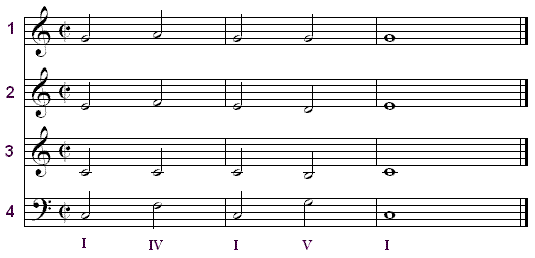
Here are the 3 voice-leading lines (VLL) of thisI-IV-I-V-Ipattern, and the fundamental bass (FB) indicated in line 4. NOTE the same disposition for all theITriads, theIVand theVreturning exactly where they came from. NOTE the common tone C in the first, second, and third Triads in VLL 3, and the common tone G in the third, fourth, and fifth Triads in VLL 1. NOTE, in VLL 2, how the Third ofI(the note E) (a) ascends to F in theI-IVprogression, and (b) descends to D in theI-Vprogression. NOTE, (a) in VLL 1, how the Third ofIV(the note A) descends to G in theIV-Iprogression, and (b) in VLL 3, how the Third ofV(the note B) ascends to C in theV-Iprogression. The Third always resolves in the direction opposite to that of the progression. If the progression is by ascending fifth, the Third descends, and if the progression is by descending fifth, the Third ascends. NOTE the Root of each Triad in line 4, which, as FB, will always be disposed in the bass voice, as long as triads are in root position, and whichproduces the doubling in each Triad. NOTE that these VLLs are not musically disposed in any way, and can be placed at any octave. They are only "horizontal sketches" and become "real music" only when they are in vocal disposition placed in the performances voices (see below).
Variations Removing one of theITriads will produce interesting 4-chord patterns - 1. Removal of the lastITriad will produce an Antecedent (A)I-IV-I-Vpattern, which cadences weakly because it ends onV. 2. Removal of the firstITriad will produce a Consequent (C)IV-I-V-Ipattern, which cadences strongly because it ends withV-I. 3. Removal of the centralITriad will produce a completeI-IV-V-Ipattern, which is complete because it begins withIand ends withV-I. NOTE that, in theIV-Vprogression, VLLs 1, 2, and 3 all descend while the FB (line 4) ascends, because the progression is by second and not by fifth, and there is no common tone (explanation to come later). The disposition of the 4 remaining Triads will be unchanged, and so will the doubling and voice-leading lines. These three 4-chord patterns will always be useful, especially in the exercises dealing with Real Triads.
Gradual development Beginning with the nucleus of the major mode, we will eventually include the complete circle with the tail of minor chords. Within the nucleus of the major mode, we will start with the Real Triads and later proceed to the deceptive triads.
Mostly directives and very little restrictions The directives will be mostly positive, assuring success and musical quality, rather than restrictions of procedures to avoid. Clear and valid indications of doubling and voice-leading are evidently high on the list of priorities. And so are rhythmic precisions of Antecedent and Consequent.
No exceptions Probably our most important promise. When triads are carefully identified as being either Real or deceptive, everything becomes far more reliable.
Vocal Disposition
Disposition of VLL in SATB The next step is to dispose these four voice-leading lines (VLL 1, 2, 3, and 4) in the four performance voices, soprano, alto, tenor, and bass (SATB).
Line 4 (the FB) is always disposed in the bass voice.
A choice of VLLs 1, 2, and 3 will then be disposed in the soprano voice, according to rhythmic exigencies of cadential strength - weak in an Antecedent (aorA), and strong in a Consequent (corC), a strong cadence by ending on the note C, and a weak cadence by ending on
E or G.
In each phrase, once a line has been chosen for the soprano voice, the remaining 2 lines (from VLL 1, 2, 3) will be disposed in the alto and tenor
voices, either in open or close disposition, to complete the harmonic choral.
Choice of Key
The last thing to do is to choose the most appropriate key (tonality) for the range
of the voices - a first glance to see that the highest note of the soprano and the lowest note
of the bass are approximately the same distance from middle C, then a last check to see that the alto does not drop too low, nor the tenor rise
too high.
Melody
What about Melody in all this? In a harmony course, it is common practice to ask the
student to "harmonize" a melody, or even, possibly, to "compose" one. The approach
here will be rather different. In both cases, the solution will be to refer to the
Voice-leading Lines (VLL) of the different chord patterns. It will therefore be important
to remember these VLLs as each chord pattern is employed, so as to refer to them when
the time comes. Start with thechord pattern given on this page.
Harmonizing a Melody This will consist of associating the notes of the given melody with identical notes in a VLL of a specific chord pattern. In other words, which chord pattern has the notes of this melody in one of its VLLs? This will identify the chord pattern this melody "came from".
Composing a Melody This will consist of (a) choosing a chord pattern, (b) choosing one of its VLLs, that ends on the note C for a consequent, that does not end on the note C for an antecedent. (c) This will give us a very primitive form of melody, with only one note for each chord as in the Lutheran hymn tunes. (d) The melody can then be developed and elaborated by subdivision into smaller note-values as inTwinkle, Twinkle,, by the addition of non-chordal tones, or by the use of several VLLs during the same chord.