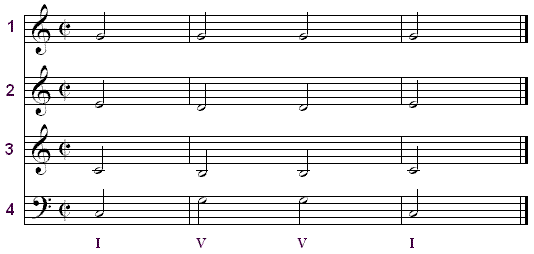
Doubling and Voice-leading Lines For the first class, we will use only the chords ofVandIin theI-V-V-Ichord pattern, taken directly from theI-IV-I-V-Iin the precedingopening pageof Triad Harmony, by using only the three last chords and inserting anotherV. These are the only VLLs possible for this Real Triad pattern in Root Position that assure (a) proper resolution of the Third of each Triad and (b) complete 3-note Triads everywhere. NOTE the same disposition for theITriads, and for theVTriads. NOTE the common tone G in VLL 1. NOTE, in VLL 2, how the Third ofI(the note E) descends to D in theI-Vprogression, and, in VLL 3, how the Third ofV(the note B) ascends to C in theV-Iprogression. NOTE the Root of each Triad in line 4 (the FB) producing the doubling in each Triad (with VLL 3 and VLL 1).
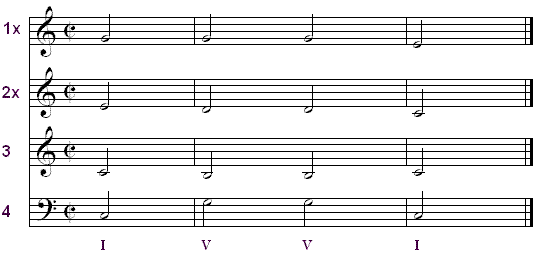
Another possibility On condition of paying the price of an incomplete Triad at the end, VLL 2 may be changed from the original E-D-D-E to the notes E-D-D-C (VLL 2x), which means that the Third of theIat the end (the note E) must now be placed in VLL 1 (VLL 1x). The common tone G is evidently missing on the lastI, there being now one Third E and three Roots C, what could very well be called a "diad". This VLL 2x (diad) option could be used for theV-Icadence, at the end of any chord pattern, usually in the soprano voice, as well as during certain chord patterns, as we will later see.
Melody The use of a diad on the last chord (I) has changed both VLL 1 and VLL 2, only VLL 3, with its obligatory resolution of the Third, has remained the same. VLLs 2 and 3 both end on the note C (DC and BC) offering two consequent choices for the soprano voice, the ending DC being more fundamental and more popular. This VLL information will be crucial when dealing with a melody.
Exercises
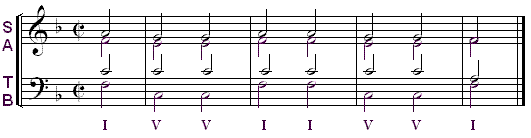
Exercise 1 TheI-V-V-Ipattern will be used twice, with the FB (line 4) in the bass voice, first as an antecedent (a), and then as a consequent (c). In the soprano voice, a VLL which does not end on the note C will be placed in the antecedent (a) for a weak cadence , and a VLL which ends on the note C will be placed in the consequent (c), for a strong cadence. It is perfectly permissible, often preferable, in the soprano voice, to make the larger skip of a sixth, rather than that of a third, between the antecedent (a) and the consequent (c). In the alto and tenor voices, the remaining VLLs will be placed, in either open or close position. Transposition to a more appropriate key may be required for vocal performance.
Here is an example which is particularly, almost excessively, repetitive, but it illustrates what these exercises are all about. VLL 2 and VLL 2x are in the soprano voice, the first cadencing weakly, the second strongly. VLL 3 is in the alto voice twice. VLL 1 and VLL 1x are in the tenor voice. The FB (line 4) is, by default, in the bass voice twice. NOTE the key (in F) to which it has been transposed.
Exercise 2 TheI-V-V-Ipattern will be used four times, with the FB (line 4) in the bass voice each time, the first and third as antecedents (a), the second and fourth as consequents (c), a completeaA,cA,aC,cC. In the soprano voice, a VLL which which does not end on the note C, and cadences weakly, will be placed in theaAand one in theaC(they may or may not be the same line). A VLL which ends on the note C, and cadences strongly, will be placed in thecC. In thecA, one may place either a strong or a weak cadence. In the alto and tenor voices, the remaining VLLs will be placed, in either open or close position. Transposition to a more appropriate key may be required for vocal performance.