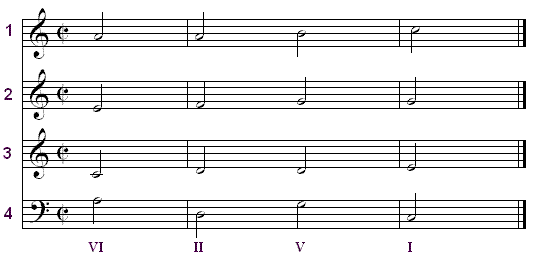
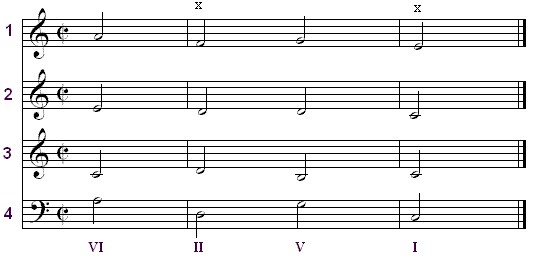
Doubling and Voice-leading Lines In this class, we will see theVI-II-V-Ichord pattern, adding one more chord in the major mode "tail" of fifths above theV. We have already seen theII, a fifth higher than theV, in classes 3 and 4, and now we see theVI, a fifth higher than theII, producing three consecutive progressions by descending fifth. These are the only VLLs possible for this Real Triad pattern in Root Position that assure proper resolution of the Third and complete Triads in the four chords. NOTE how these VLLs ascend, as they did in the original VLLs ofClass 4. The Root of each Triad in line 4 (the FB) produces the doubling in each Triad (with VLL 1, VLL 3, VLL 2, and VLL 1).
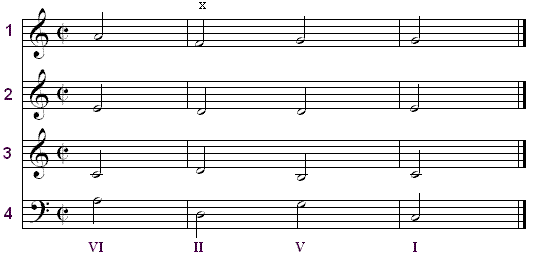
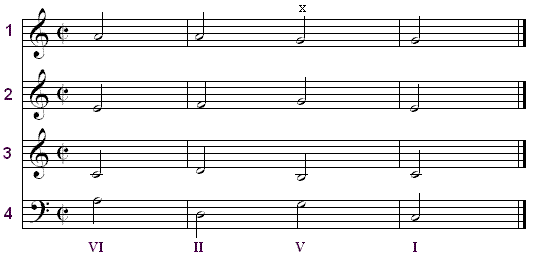
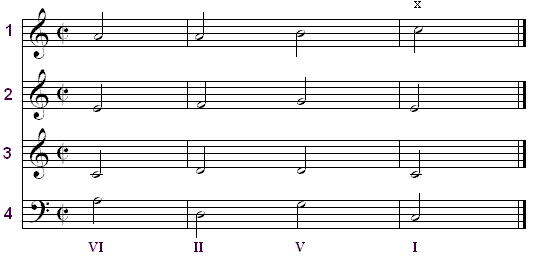
Preventing the rise of the VLLs Here again it is possible to use diads (indicated "x") to prevent this rising of the
lines. Let's see what happens if a diad occurs on different chords -
If the diad occurs on II NOTE onVI- in VLL 2, the Fifth (E) resolves to the Root D instead of the Third F, forcing the Root (A) to resolve to the F in VLL 1, VLL 3 remaining the same, the normal resolution of the Third to the
Root (C-D). This is the normal resolution into a diad chord which has no common tone Fifth
(A). NOTE onII- in VLL 2, the normal common tone resolution (D-D), in VLL 1, the normal resolution of the third (F-G), in VLL 3, the resolution of the doubling of the common tone to the
Third (D-B). This is how a diad normally resolves. NOTE onV, the normal resolution toIin the three VLLs, each VLL ending on the same note it started on.
If the diad occurs on V NOTE onII- in VLL 1, the Fifth (A) resolves to the Root G instead of to the Third B, forcing the Root (D) to resolve to the B in VLL 3, VLL 2 remaining the same, the normal resolution of the Third to the
Root (F-G). Again, normal resolution into a diad chord. NOTE onV- in VLL 1, the normal common tone resolution (G-G), in VLL 3, the normal resolution of the Third (B-C), in VLL 2, the resolution of the doubling of the common tone to the
Third (G-E). Again, the normal resolution of a diad, each VLL ending on the same note it started on.
If the diad occurs on I NOTE onV- in VLL 3, the Fifth (D) resolves to the Root (C) instead of to the Third (E), forcing the Root (G) to resolve to the E in VLL 2, VLL 1 remaining the same, the normal resolution of the Third to the
Root (B-C). Again, normal resolution into a diad chord, VLLs 2 and 3 ending on the same note they started on, but VLL 1 ending higher, coming down only if it resolved toIV.
If the diad occurs on both II and I NOTE the progressionVI-IIwith its three specific VLLs, and the progressionV-Iwith its three specific VLLs, normal resolutions into a diad chord, and how theV-Iis a second lower than theVI-II. In VLL 1, the Root resolves to the Third twice (A-F and G-E). In VLL 2, the Fifth resolves to the Root twice (E-D and D-C). In VLL 3, the Third resolves to the Root twice (C-D and B-C). NOTE the progressionII-Vwith its three specific VLLs, normal resolution from a diad chord, with the three VLLs ending lower than the note they started on.
Melody The diads produce a veritable wealth of VLLs here, producing VLLs which both rise and fall.
I-V-II-VI
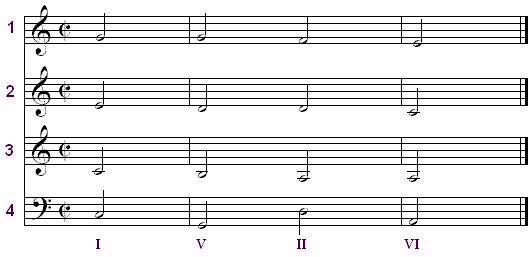
Doubling and Voice-leading Lines It is possible to reverse (in time) and invert (in pitch) theVI-II-V-Ichord pattern, producing theI-V-II-VIchord pattern, with three consecutive progressions by ascending fifth, and constantly descending VLLs 1, 2, and 3. These are also the only VLLs possible for this Real Triad pattern in Root Position that assure proper resolution of the Third and complete Triads in the four chords. VLL 1 ofI-V-II-VI(GGFE) is the inversion of VLL 1 ofVI-II-V-I(AABC). VLL 2 ofI-V-II-VI(EDDC) is the inversion of VLL 3 ofVI-II-V-I(CDDE). VLL 3 ofI-V-II-VI(CBAA) is the inversion of VLL 2 ofVI-II-V-I(EFGG). All inversions are symmetrical around the note D. The Root of each Triad in line 4 (the FB) produces the doubling in each Triad. Here again it is possible to use diads to prevent this falling of the lines, as was the case above for theVI-II-V-Ichord pattern. A model for a diad in a progression by ascending fifth was presented inClass 2in the finalIV-Icadence. This interesting and effectivea(ntecedent) will be used in Exercise 3.
Exercises
Exercise 1 With theI-V-V-Ichord pattern asaand theVI-II-V-Ichord pattern asc, and with the FB (line 4) in the bass voice (C-G-G-C, A-D-G-C), use the diad freely in thec. In the soprano voice, any may VLL be placed in the antecedent (a), and a VLL which ends on the note C will be placed in the consequent (c), for a strong cadence. In the alto and tenor voices, the remaining VLLs will be placed, in either open or close position. Transposition to a more appropriate key may be required for vocal performance.
Exercise 2 With theI-IV-V-Ichord pattern asaand theVI-II-V-Ichord pattern asc, and with the FB (line 4) in the bass voice both times (C-F-G-C, A-D-G-C), use the diad freely in thec. In the soprano voice, a VLL which does not end on the note C will be placed in the antecedent (a) for a weak cadence , and a VLL which ends on the note C will be placed in the consequent (c), for a strong cadence. In the alto and tenor voices, the remaining VLLs will be placed, in either open or close position. Transposition to a more appropriate key may be required for vocal performance.
Exercise 3 With theI-V-II-VIchord pattern asaand theVI-II-V-Ichord pattern asc, and with the FB (line 4) in the bass voice both times (C-G-D-A, A-D-G-C), use the diad freely in both theaand thec. In the soprano voice, any VLL may be placed in the antecedent (a), and a VLL which ends on the note C will be placed in the consequent (c), for a strong cadence. In the alto and tenor voices, the remaining VLLs will be placed, in either open or close position. Transposition to a more appropriate key may be required for vocal performance.