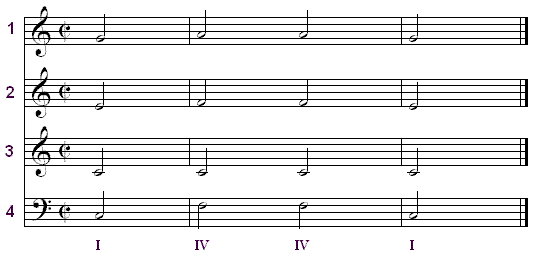
Doubling and Voice-leading Lines In this class, we will see the chord ofIVin theI-IV-IV-Ichord pattern, taken directly from theI-IV-I-V-Iin the precedingopening pageof Triad Harmony. These are the only VLLs possible for this Real Triad pattern in Root Position that assure proper resolution of the Third of each Triad. NOTE the same disposition for theITriads, and for theIVTriads. NOTE that the common tone C is now in VLL 3. NOTE, in VLL 2, how the Third ofI(the note E) ascends to F in theI-IVprogression, and, in VLL 1, how the Third ofIV(the note A) descends to G in theIV-Iprogression. NOTE the Root of each Triad in line 4 (the FB) producing the doubling in each Triad (with VLL 3 and VLL 2).
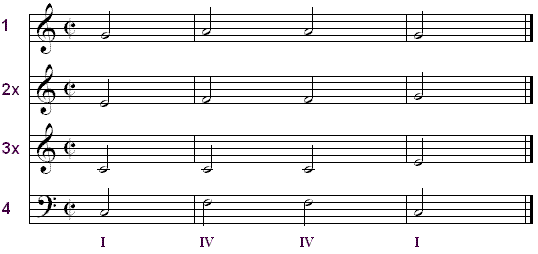
Another possibility Here again, VLL 2 may be changed from the original E-F-F-E to the notes E-F-F-G (VLL
2x), which means that the Third of theIat the end (the note E) must now be placed in VLL 3 (VLL 3x). The common tone C is evidently missing on the lastIof VLL 3x, but the triad is completed by line 4 (the FB), because theIV-Iprogression is by ascending fifth. This VLL 2x option could be used for theIV-Icadence, at the end of a phrase, usually in the soprano voice.
Melody Here again, the use of a diad on the last chord (I) has changed both VLL 2 and VLL 3, both of which will prove useful. Only VLL 1, with its obligatory resolution of the Third, has remained the same.
Cadential Strength In Class 1, cadential strength was involved only in the disposition of VLLs in the soprano voice, a superficial position. Here, it will be involved in the chord patterns themselves, a far more fundamental position. TheV-Iprogression is the only one to be strong, and is placed at the end of consequents. The other progressions,I-IV,I-V,IV-I, are all weak, and are placed in antecedent positions. Although VLL disposition in the soprano voice is not as pertinent in the weak progressions as it is in theV-Iprogression, it is useful to know which ones produce a stronger cadence - in theI-IVprogression, the VLLs ending on the note F, in theI-Vprogression, the VLLs ending on the note D, in theIV-Iprogression, the VLLs ending on the note G.
Examples of new chord patterns An antecedentI-IV-IV-Iwith a consequentI-V-V-I. An antecedentI-I-IV-Iwith a consequentIV-I-V-I(from the precedingopeningpage). VLL 2xmay be used in theV-Icadence of either pattern.
Exercises
Exercise 1 With the weakI-IV-IV-Ipattern in theaand the strongI-V-V-Ipattern in thec, and with the FB (line 4) in the bass voice throughout - In the soprano voice, a strong VLL ending on C will be placed in the consequent and any VLL may be placed in the antecedent. In the alto and tenor voices, the remaining VLLs will be placed, in either open or close position. Transposition to a more appropriate key may be required for vocal performance.
Exercise 2 A longeraA cA aC cCpattern, with the weakI-IV-IV-Iin theaAand theaC, the strongI-V-V-Iin thecAand thecC, and with the FB (line 4) in the bass voice throughout - In the soprano voice, a strong VLL ending on C will be placed in thecC, a weak VLL (not ending on C) in thecA, and any VLL in theaAand theaC(they may both be the same). In the alto and tenor voices, the remaining VLLs will be placed, in either open or close position. Transposition to a more appropriate key may be required for vocal performance.
Exercise 3 With the weakI-I-IV-Ipattern in theaand the strongIV-I-V-Ipattern in thec, and with the FB (line 4) in the bass voice throughout (C-C-F-C, F-C-G-C) - In the soprano voice, choose the 2 appropriate VLLs for the melody ofTwinkle, Twinkle, one in theaand one in thec. An adjustment must be made at the very beginning. In the alto and tenor voices, the remaining VLLs will be placed, in open position. Transposition to a more appropriate key (F) will be required.