It will be quite evident here that deceptive triads reverse the normal ascending lines
produced by the Real Triads and, as far as the direction of the VLLs is concerned,
the effect of deceptive triads is quite similar here to what was the case with diads
inClass 10. Another similarity is that, in a circle with triads in root position, a deceptive
triad cannot resolve to another deceptive triad, just as two diads could not be placed
in a row. Finally, here is also the appropriate place to examine true triad progressions
by ascending second and by descending third.
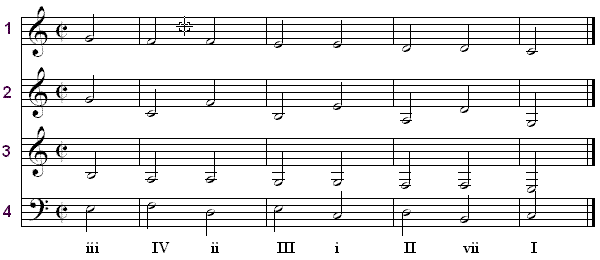
iii-IV-ii-III-i-II-vii-I
Doubling and Voice-leading Lines Starting with the maximum amount of deceptive triads possible in the circle, we have here a deceptive triad on each odd-numbered chord (numbers 1, 3, 5, and
7), with VLLs 1, 2, 3 descending two positions with the four deceptive triads. VLL 4 seems to descend only one position, but that is without its resolution
toIV. NOTE that each deceptive triad (iii,ii,i,vii) progresses by ascending second, and that each Real Triad (IV,III,II) progresses by descending third.
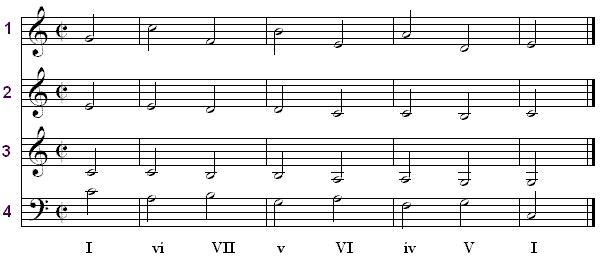
I-vi-VII-v-VI-iv-V-I
Doubling and Voice-leading Lines We have here a deceptive triad on three even-numbered chords (numbers 2, 4, and 6), with VLLs 1, 2, 3 descending one position with the three deceptive triads. VLL 4 seems to descend more on account of the Fundamental Bass at the end.
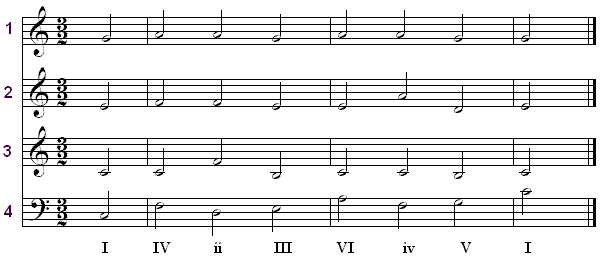
I-IV-ii-III-VI-iv-V-I
Doubling and Voice-leading Lines We have here a deceptive triad on two chords (numbers 3 and 6), with VLLs 1, 2, 3 remaining in their original position. VLL 4 climbs a whole octave with a ternary melodic grouping, perfectly synchronized with the 3/2 bars.
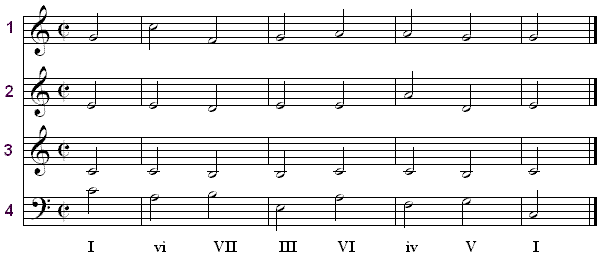
I-vi-VII-III-VI-iv-V-I
Doubling and Voice-leading Lines We also have here a deceptive triad on two chords (this time numbers 2 and 6), with VLLs 1, 2, 3 remaining in their original position. This time, VLL 4 drops a whole octave with a quaternary melodic grouping, perfectly synchronized with the 2/2 bars (taken two by two).
Exercises
Exercise 1 As in Class 10, there will only be one exercise here but the deceptive triads, which control the movement of the lines, can be disposed at will, on condition that there are not two deceptive triads in a row. With the basicI-IV-VII-III-VI-II-V-Ichord pattern, line 4 will, as usual, be placed in the bass voice (CFBE ADGC), but affected by the deceptive triads, placed a third higher. In the soprano voice, a VLL which ends on the note C will be placed to produce a strong cadence. In the alto and tenor voices, the remaining VLLs will be placed. Transposition may be required for vocal performance.