"The three flats in the key signature of C minor, for example, indicate that the third, sixth, and seventh degrees of the scale are inflected with
flat signs, in contrast to the same degrees in the scale of the parallel mode, C major. But in all our ordinary experience of music in C minor, having the key signature of
three flats, miscellaneous B naturals are nearly always to be found, and often A naturals as well, when no change of key has taken place."
Parallel Comparison This typical, classical presentation of the (chromatic) minor mode clearly admits the risk of parallel construction, and yet has nothing else to offer. Subsequent reference to scales (with both notes flat, both notes natural, one
of each), only displaces the problem because there is no indication as to when each scale is to be used. One is left with "more often than not", "often", "usually", without any indication of "how", "where", and above all "why".
Solution 1. Using the best key to associate with C major, which is the key A minor and not the key of C minor, remaining within the same Window of natural notes, and relying on processes of inversion rather than processes of parallel comparison. 2. Forgetting about scales and relying onchords which create and impose the chromaticism. (a) First the swings of the nucleus - the DOMINANT/TONIC swing (E7/Am6) which imposes the chromatic notes (F# and G#), and the COUNTER/TONIC swing (Dm6/Am7) which maintains the diatonic notes (G and F). (b) Then the circle, of which the first half is all major, being the second half of the major circle, and the only chromatic note is the G# in the penultimate (DOMINANT) chord. 3. Despite the fact that the Diatonic Major and Chromatic Minor modes each possess a DOMINANT of the same shape/sound (G7andE7), the DOMINANT of the Major mode (G7) is an Outward chord placed in the center of the Window, with a complete3-chord Tailabove it (the three minor chords), but the DOMINANT of the Minor mode (E7) is an Inward chord placed at the very edge of the Window, with theBUCKLE chordimmediately above it. All harmonic operations on the sharper side (above) will be far more delicate and precarious forE7than forG7. 4. The tetrad ofEm7and the triad ofEmdo not exist in the Chromatic Minor mode ofAm. It thus does not seem advisable to modulate to the Key of Em from the principal key of Am, the Keys of E (major) and Dm (and, of course, C major) being far preferable, as illustrated in the following example.
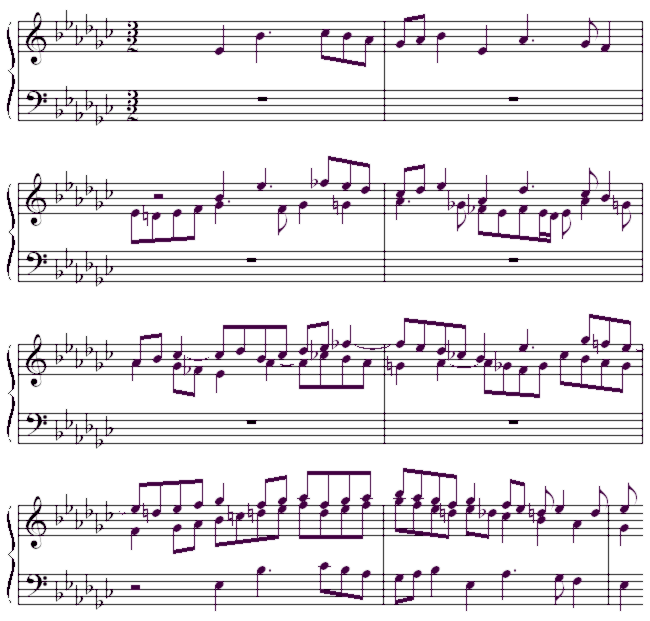
The Bach Fugue in Eb minor In the Unknown Container we suggested arhythmically altered version of this fugue in 3/2 meter, in which the second entry of the first exposition in is the key of Bb minor. We suggest here the recommendation of placing this second entry, in Ab minor rather than in Bb minor, with adjustments in bars 2 and 4, and with transposition of bar 3 a tone lower. The third entry returns to Eb minor as it originally did. This is a much more subtle change than the previous rhythmical one (from 4/4 to 3/2), and will require more intensive and repeated hearings of both versions. It will probably also meet with greater resistance, and provoke more controversy, considering the concept of the parallel relationship between the major and minor
modes, prevalent in Bach's day and unfortunately still alive and well today.
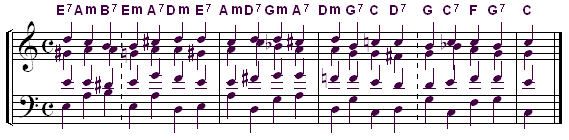
Applications In the Key of C major, the chord progressions E7 - Am - B7 / Em - A7 - Dm - E7 / Am - D7 - Gm - A7 / Dm - G7 - C - D7 / G - C7 - F - G7 / C, fiveM74chord patterns, with the first chordDominantized, in the Keys ofEm,Am,Dm,G, andCrespectively, are perfectly acceptable (a Bach favorite). NOTE - (a) the progressionB7 - Em(chords 3 and 4), which is possible because the principal Key is that of C major; and (b) the progressionD7 - Gm(chords 9 and 10), which is imposed by the temporary Key of D minor.
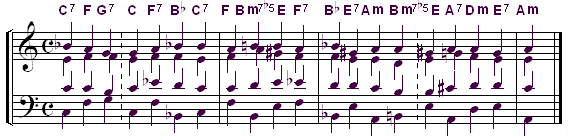
In the Key of A minor, the corresponding chord progressions are quite different, C7 - F - G7 / C - F7 - Bb - C7 / F - Bm7-5 - E - F7 / Bb - E7 - Am - Bm7-5 / E - A7 - Dm - E7 / Am, especially the thirdM74across the BUCKLE chord (Bm7-5 - E - F7 / Bb). NOTE - (a) the two firstM74s (chords 1 to 8), as well as the lastM74(chords 17 to 20), which are perfectly normalM74s in the Keys of C, F, and Am respectively ; (b) the progressionBm7-5 - E(chords 9 and 10, as well as chords 15 and 16), an ANTE-1/DOMINANT progression, which is imposed by the principal Key of A minor, instead of the progressionB7 - Em, a DOMINANT/TONIC progression, in the preceding Major Mode example (chords 3 and 4); (c) the progressionF7 - Bb(chords 11 and 12), a DOMINANT/TONIC progression, to the Neapolitan Sixth of the principal Key of A minor.
We will probably be adding other examples to illustrate BUCKLE chord activity in the chromatic modes. In the meantime, you might enjoy inverting these two examples into Diatonic Minor and Chromatic Major.
1. In each parameter there is a + and a -with an evident preference of priority for the + :the Major TONIC Triad is more fundamental than the Minor TONIC Triad,having frequencies in a proportion of 4-5-6 for the Major and 10-12-15 for the Minor ;diatonicism seems simpler and more fundamental than chromaticism,although Free Harmony might lead us to believe that the Dominantized chords came first,modes are essentially Window-structured and diatonically oriented ;flattening progressions seem more definite and final than sharpening progressions,even if the reason still seems to elude us.2. The order of popularity and common usage (above)also seems to establish priority in the parameters themselveswith Direction as the most pertinent, then the Window, and last the Mode.The Flattening Diatonic Major Modemight very well be to Harmonywhat Binary is to Rythm.
<-->