|
|
| home | news | cq | clips | color | definitions | rcode | chord symbols | numbering | contribution |
| Structure of Time / Unknown Container / 1995 |
|
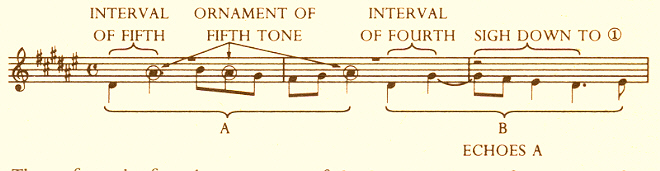
In the two preceding sections (books written in1960and in1978), we dealt only with music of irreproachable rhythmic structure. At no time was there question of changing anything in the music itself, only possibly changing the way in which it was set to paper (as in the Chopin and the Brahms). The problem now will be much deeper, affecting the music itself, more specifically its rhythmic structure, its container. This might not be for the weak of heart, and a certain discretion is required before deciding to dive in. The cultural critic of a major newspaper wrote an essay in which he explores "the inner life of music and mathematics", and in an exploration of "melodic echos and tensions", quotes the theme of Bach's Eb minor fugue (from Book I of theWell-tempered Clavier). The Problem
The subject of the fugue is quoted here as it appears in its first entry, in the central
voice (Alto-Tenor) of the of the 3-voice fugue. The author of the book clearly identifies
the two phrases of the subject, A and B, the second acting as an "echo" of the first.
Each phrase occupies the length of 3 Click on the music to hear the sound. The Solution
As far as the subject of the fugue is concerned, the solution is very much the same
as it was at the beginning of the Brahms song. Giving it thefootsiestreatment (for each One Container For The Whole Fugue ? If the opening subject is in 3/2 time, should each appearance of the subject also be in 3/2 time ? should each appearance of the subject also start on beat 2 of a 3/2 bar ? should the whole fugue be in 3/2/ time, or should the fugue alternate between sections in 3/2 and sections in 4/4 ? (a little like the Brahms song). This is where the going gets rough - the answers aren't easy.
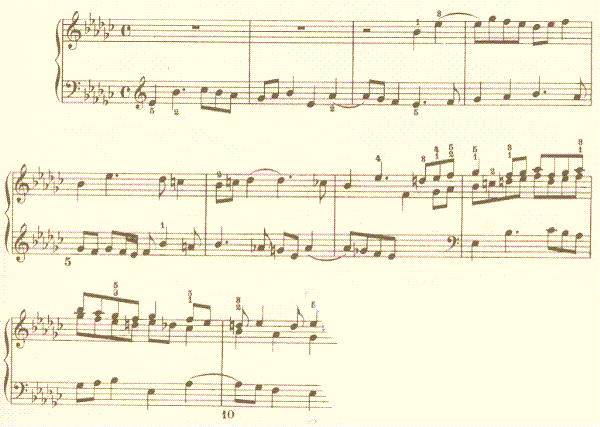
We have above, in 4/4, the original version of the opening exposition with its three entries of the subject, and a short "divertimento" (interlude) between the second and third entries of the subject.
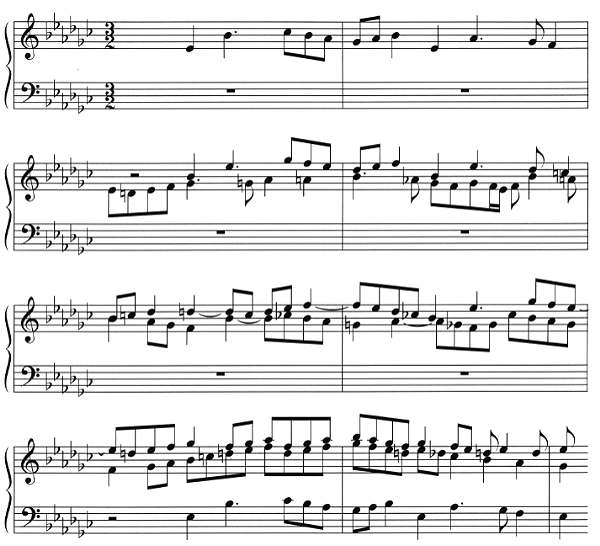
We have above a suggestion for the 3/2 version of the opening exposition, with its
three entries of the subject, all starting on beat 2, as well as the short "divertimento"
(interlude) between the second and third entries of the subject, two short (1-bar)
canonic entries which also start on beat 2 (Alto-Tenor, then Soprano, in the third
line of the musical text). Since the original version consists of 10 bars of 2/2 (20 Another modification to this fugue has been suggested inThe Chromatic Minor Mode Revisited. Back to theUnknown Container chapter page |
| Previous | Top | Next |
| sitemap | Copyright © 1971-2026 Cosmos-Square Inc. ALL RIGHTS RESERVED. - Powered by DNAOS | contact |