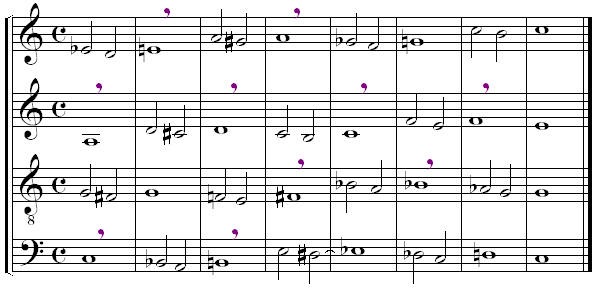
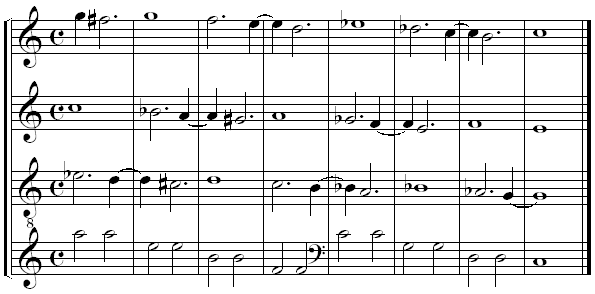
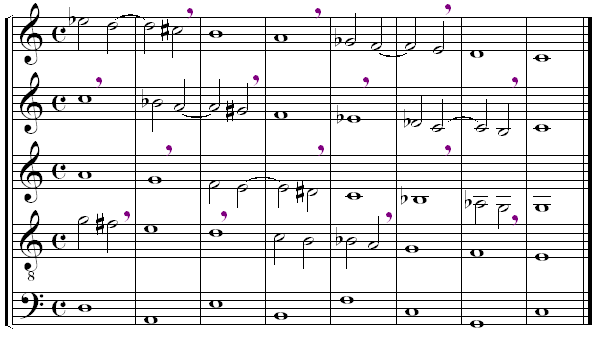
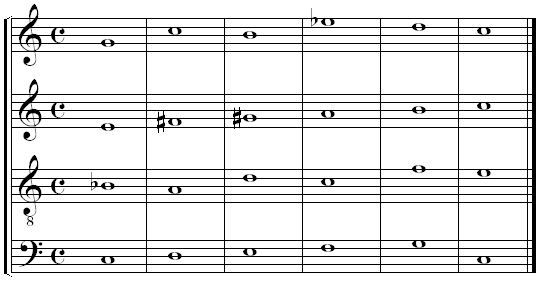
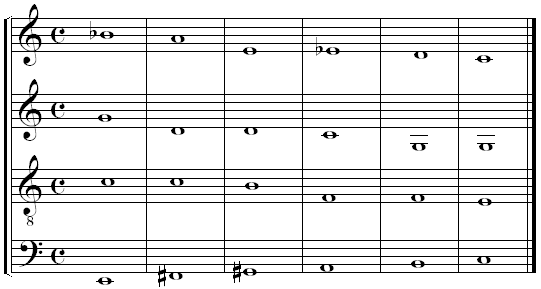
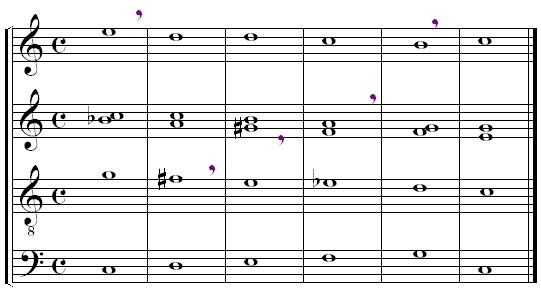
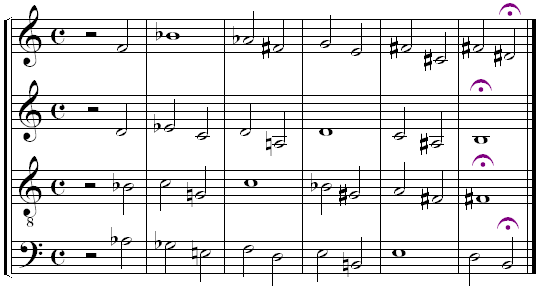
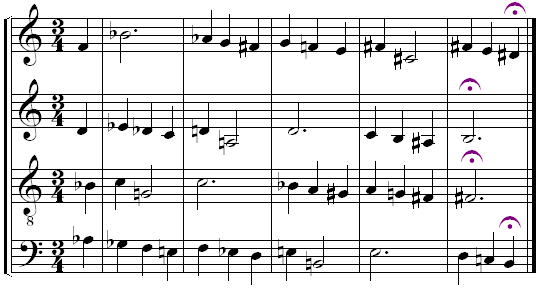
At the end of Harmony/Transformations/Incompleteness, we added a "Coda 1" chapter
with combinations of Voice-leading and Incompleteness. Here, at the end of the Harmony/Transformations/Metamorphoses,
we are adding a "Coda 2" page in which the 15 possibilities of Voice-leading and Metamorphoses
will be examined.
This might be as good a place as any to elaborate on the nature of a "generative"
approach. The essence of generation is the process and not the result. In more practical terms this means that it is far preferable to remember how the transformations operate rather than what they produce. You will really appreciate this site if you scout and discover, letting the results be your source of inspiration !
NOTE that there will be no Orbit colors in this page - neither in the text nor in the musical examples, because the Orbit changes are too numerous and too complex. However, all Orbit changes will be meticulously indicated in the text accompanying each musical example.
In the top line we find the 5 forms of Metamorphosis (0, 1, 2, 3, and 4, all hlinked
within the page), and in the left column we find the 3 forms of Voice-leading (A, B, and C). Each Metamorphosis is accompanied by its Orbit changes (if any) - Metamorphosis 0 (no Metamorphosis) has no Orbit changes and produces a Swing. Metamorphosis 1 exchanges Orbits0and1and produces a circle. Metamorphosis 2 exchanges Orbits2and3and produces a convenient half-circle. Metamorphosis 3 exchanges Orbits0and2as well as Orbits1and3, and, like Metamorphosis 1, produces a circle. Metamorphosis 4 exchanges Orbits0and3as well as Orbits1and2, and, like Metamorphosis 2, produces a half-circle. Each Voice-leading is accompanied by its procuration of Orbit3- Voice-leading A with procuration0-3 Voice-leading B with procuration1-3 Voice-leading C with procuration2-3 Each of the 15 interior squares (all hlinked within the page) indicates the disposition
of the Orbit lines - the grouping - "4" when the 4 lines use the same 4-orbit chain, "3-1" (or "1-3") when 3 lines use the same 3-orbit chain and the other line uses the remaining Orbit, "2-2" when 2 lines use the same 2-orbit chain and 2 lines use the other 2-orbit chain, "2-1-1" (or "1-2-1") when 2 lines use the same 2-orbit chain and 2 lines each use the individual orbit-lines left, "1-1-1-1" when the 4 lines each use individual orbit-lines, and (below) the details of the Orbits involved. We will see all these possibilities, one Metamorphosis at a time.
Metamorphosis 0
Since there is no Metamorphosis here, the following examples have already been seen.
0A - with Voice-leading A
This specific Swing was already seen inVoice-leading A. NOTE the 4 grouping with its3-2-1-0Orbit chain. It was also presenteddominantized, as one would find it inFree Harmony. TheFundamentalBass is not possible here because it interferes with1-0.
0B - with Voice-leading B
This specific Swing was already seen inVoice-leading B. NOTE the 3-1 grouping with its3-2-1Orbit chain, and the "V" approach in the procuration1-3, as well as the isolated line on Orbit0. It could also be dominantized, even if this was not officially done on the
site. TheFBis possible here.
0C - with Voice-leading C
This specific Swing was already seen inVoice-leading C. NOTE the 2-1-1 grouping with its3-2Orbit chain, as well as the isolated lines on Orbits1and0. It was also presenteddominantized, as one would find it inFree Harmony. TheFBis also possible here.
Metamorphosis 1
Since this Metamorphosis produces the "Circle", several examples have also already been seen. Never lose sight of its10 01orbit exchange.
1A - with Voice-leading A
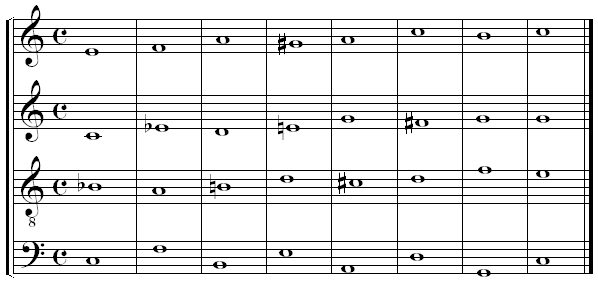
The Voice-leading A Circle was already seen inMetamorphosis 1. NOTE the 3-1 grouping with its3-2-10Orbit chain, and the "V" approach in the procuration10-3. The isolated line on Orbit01is usually left out, but theFBis very useful here. NOTE also that the0Acombination had a 4 grouping which was changed by the10orbit exchange. This Circle was also presented partlydominantized, in the second half, from the ANTE-3 to the end. It would also be possible to dominantize the 2 first chords because - (a) the diatonic Buckle chord has an inverse dominant sonority (Bm7-5sounding like Dm6), and (b) the preceding F7ties into it perfectly, producing the chord pattern C7- F7- Bm7-5- E7- A7- D7- G7- C. In the example above - the first line (Soprano) has the Orbit chain2-10-3-2-10-3-2-1, the second line (Alto) has the Orbit chain10-3-2-10-3-2-10-0, the third line (Tenor) has the Orbit chain3-2-10-3-2-10-3-2, and the fourth line (Bass) has theFB.
You will find an interesting example of open Metamorphosis 1 inFree Harmony.
1B - with Voice-leading B
The Voice-leading B Circle was already seen inMetamorphosis 1. With either (a) the jump of a sixth to produce the "V", or the0(3)substitution to circumvent it - NOTE the 4 grouping with its3-2-10-01Orbit chain, possibly0(3)-2-10-01. TheFBis possible here but not absolutely necessary. NOTE also that the0Bcombination had a 3-1 grouping which was changed by the10orbit exchange.
You will find an interesting example of the jump version in the Voicve-leading B ofExercise 3c.
These circles can be dominantized all the way through, as we did in1A
1C - with Voice-leading C
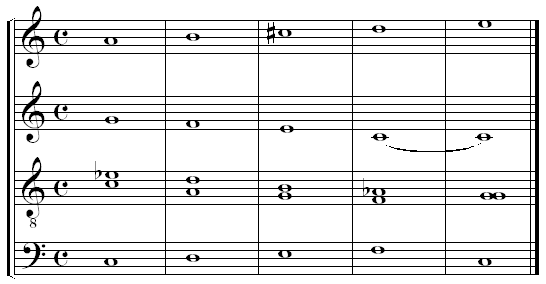
The Voice-leading C Circle was already seen at the beginning ofMetamorphosis 1. NOTE the 2-2 grouping with its3-2Orbit chain, as well as a10-01Orbit chain. TheFBis possible here but not absolutely necessary. NOTE also that the0Ccombination had a 2-1-1 grouping which was changed by the10orbit exchange, uniting both the individual1and0lines into the10-01Orbit chain. This Circle was also presented partlydominantized, in the second half, from the ANTE-3 to the end.
This circle can be dominantized all the way through, as we did in1A
Metamorphosis 2
This Metamorphosis is much deeper and more subtle than the preceding Metamorphosis
1, and we will limit ourselves to "half-circles" rather than complete ones. Moreover, progressions from one bar to the next, will be by second, more precisely
2 fifths, having moved 2 swings away (as in Metamorphosis 4). One no longer has the clear harmonic effect of Metamorphosis 1, but rather a horizontal, polyphonic effect. Never lose sight of its23 32orbit exchange.
2A - with Voice-leading A
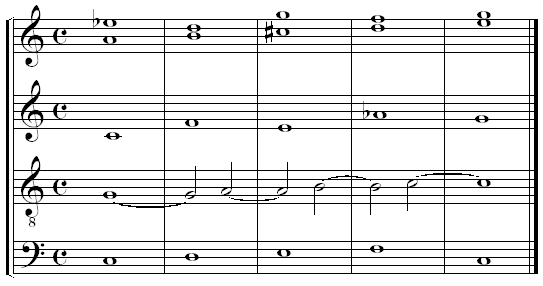
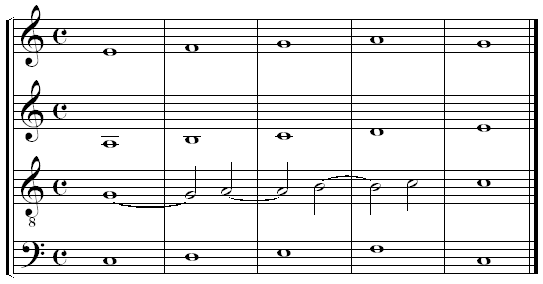
The example given inMetamorphosis 2"cheated" a little, by presenting only 1 metamorphosed chord, and by removing its Orbit0, thus eliminationg the change of note involved. There is also adominantizedversion of this example. We will be more "honest" and straightforward here, by presenting several complete metamorphosed Tetrads in a row. NOTE the 1-3 grouping with the isolated23orbit line, as well as its32-1-0Orbit chain. TheFBstill consists of the root of each chord (second function), but now moves in seconds (2 swings away). In the example above, we have - the chord pattern Cm6- (G7)Dm6- (A7)Em6- (Bm-7-5)Fm6- C, with the metamorphosis closed, all the chords in parentheses eliminated. the first line (in the Soprano voice) has the isolated23orbit line, in all,3-23-23-23-2, the next 3 lines have the32-1-0Orbit chain - the Alto voice with0-32-1-0-0, the Tenor 1 voice with2-1-0-32-1, the Tenor 2 voice with1-0-32-1-1, and the fifth line (in the Bass voice) has theFBwith1-1-1-1-0.
You might enjoy hearing it in itsdiatonicstate without the dominantization. NOTE how one hears individual polyphonic lines more than actual harmonic chords.
2B - with Voice-leading B
NOTE the 1-2-1 grouping with the isolated23orbit line, as well as its32-1Orbit chain, and another isolated0orbit line. TheFBstill consists of the root of each chord. In the example above, we have - the same chord pattern Cm6- G7Dm6- A7Em6- Bm-7-5Fm6- C, with the metamorphosis now presented open, the change quite evident in the0line. the isolated23orbit line is in the Soprano 2 voice with3-23-23-23-2, the32-1Orbit chain is in - the Soprano 1 voice with2-1-32-1-1, the Alto voice with1-32-1-32-1, the isolated0orbit line is in the Tenor voice with0-0 0-0 0-0 0-0, including the note-changes, and the fifth line (in the Bass voice) has theFBwith1-1-1-1-0(as in2A).
You might enjoy hearing it in itsdiatonicstate without the dominantization. We once again have a very polyphonic sound.
2C - with Voice-leading C
NOTE the unusual 1-1-1-1 grouping with 4 isolated orbit lines,23,32,1, and0. In the example above, we have - the same chord pattern C6- G7Dm6- Am7Em-6- Bm7-5F6- C, with the metamorphosis also presented open, the change quite evident in
the0line. the isolated23orbit line is in the Alto voice, in all,3-23-23-23-2, the isolated32orbit line is in the Soprano voice, in all,2-32-32-32-1, the isolated1orbit line is in the Bass voice, in all,1-1-1-1-0, acting asFB, and the isolated0orbit line is in the Tenor voice, in all,0- 0 0- 0 0- 0 0- 0, with the note-changes. This diatonic version cannot be dominantized because2would be placed farther from its procuration2-3. We once again have a very polyphonic sound.
Metamorphosis 3
This is another deep and subtle Metamorphosis. Since it progresses by fifths (like Metamorphosis 1), it will enable the construction of full circles, but in the opposite direction. This will not produce the clear harmonic effect of Metamorphosis 1, but rather the horizontal, polyphonic effect of Metamorphosis 2. We have 2 orbit exchanges here,02-20and13-31.
3A - with Voice-leading A
The example given inMetamorphosis 3also "cheated" a little, by presenting only 1 metamorphosed chord, and by placing a Non-chordal Tone on each Orbit0, to facilitate the02-20exchange. There is also adominantizedversion of this example. We will present enough Tetrads in a row to make a complete circle, with each metamorphosis open. NOTE the 4 grouping with its13-20-31-02Orbit chain. There is noFBbecause it interferes with31-02. In the example above, we have - the chord pattern Cm6D7- Gm6A7- Dm6E7- Am6B7- Ebm6F7- Bbm6C7- Fm6G7- C, with each metamorphosis open, the 4 voices using the same13-20-31-02Orbit chain - the Soprano voice with a20-31-02-13-20-31-02-1orbit line, the Alto voice with a31-02-13-20-31-02-13-2orbit line, the Tenor voice with a02-13-20-31-02-13-20-0orbit line, and the Bass voice with a13-20-31-02-13-20-31-1orbit line.
You might enjoy hearing it in itsdiatonicstate without the dominantization. A little more harmonic than with Metamorphosis 2, but quite polyphonic nevertheless. Each bar sounds as if a Dominant-shape chord is preceded by its ANTE-1.
3B - with Voice-leading B
NOTE the 3-1 grouping with its13-20-02Orbit chain, as well as the isolated31orbit line, with its1-3procuration over and over again. There is noFBbecause it interferes with31-31. In the example above, we have - the same chord pattern Cm6D7- Gm6A7- Dm6E7- Am6B7- Ebm6F7- Bbm6C7- Fm6G7- C, with each metamorphosis open, but the parallel movements spread in time
- 02on the second beat, and20on the fourth beat of each bar, 3 lines using the same13-20-02Orbit chain - the Soprano voice with a02-13-20-02-13-20-02-1orbit line, the Alto voice with a13-20-02-13-20-02-13-2orbit line, the Tenor voice with a20-02-13-20-02-13-20-0orbit line, and the "Bass voice" using the isolated31orbit line, in all31-31-31-31-31-31-31-1, starting way up high, above the Soprano, and ending below the Tenor, always progressing downward to make the "V" in the1-3procuration.
You might enjoy hearing it in itsdiatonicstate without the dominantization. Once again, a semi-harmonic, semi-polyphonic sound.
3C - with Voice-leading C
NOTE the 4 grouping with its13-20-02-31Orbit chain. It is possible to have theFBhere because there is no interference with the orbit lines. In the example above, we have - the same chord pattern Cm6D7- Gm6A7- Dm6E7- Am6B7- Ebm6F7- Bbm6C7- Fm6G7- C, with each metamorphosis open, 4 lines using the same13-20-02-31Orbit chain - the Soprano voice with a20-02-31-13-20-02-31-1orbit line, the Alto 1 voice with a13-20-02-31-13-20-02-1orbit line, the Alto 2 voice with a31-13-20-02-31-13-20-0orbit line, the Tenor voice with a02-31-13-20-02-31-13-2orbit line, and the Bass voice has theFBwith0-0-0-0-0-0-0-1. NOTE that while the 4 upper lines are all melodically descending, with flattening (descending) progressions at each bar-line, theFBis melodically ascending, with sharpening (ascending) progressions at each bar-line.
You might enjoy hearing it in itsdiatonicstate without the dominantization. Still in a semi-harmonic, semi-polyphonic style.
Metamorphosis 4
Since this Metamorphosis is used in theI-IV-V-Ichord progression, (C+7-F6Dm7-G7-C) numerous examples have also already been seen, in all possible combinations of Voice-leading. Never lose sight of its 2 orbit exchanges,03 30and12 21.
4A - with Voice-leading A
The examples given inMetamorphosis 4also "cheated" a little, by presentingonly 1metamorphosed chord in theI-IV-V-I, andonly 2consecutive metamorphosed chords in another example. There is also adominantizedversion of this last example. We will present here 4 metamorphosed Tetrads in a row, producing a generous half-circle, similar to those usingMetamorphosis 2, but in the opposite direction, with 7th chords instead of 6th chords. NOTE the 2-1-1 grouping with its03-21Orbit chain, as well as an isolated31orbit line, and another isolated12orbit line. In the example above, we have - the chord pattern C7- D7- E7- F7- G7- C, with each metamorphosis closed, 2 lines using the same03-21Orbit chain - the Soprano voice with a1-03-21-03-21-1orbit line, and the Tenor voice with a3-21-03-21-03-2orbit line, as well as an isolated2-12-12-12-12-1orbit line in the Alto voice, and an isolated0-30-30-30-30-1orbit line in the Bass voice, which acts as theFB.
You might enjoy hearing it in itsdiatonicstate without the dominantization.
4B - with Voice-leading B
NOTE the 3-1 grouping with its03-21-30Orbit chain, and another isolated12orbit line. In the example above, we have - the same chord pattern C7- D7- E7- F7- G7- C, with each metamorphosis closed, 3 lines using the same03-21-30Orbit chain, always jumping downward to make the "V" in the21-30procuration - the Soprano voice with a3-21-30-03-21-1orbit line, the Alto voice with a1-30-03-21-30-0orbit line, and the Tenor voice with a0-03-21-30-03-2orbit line, as well as an isolated2-12-12-12-12-1orbit line in the Bass voice. TheFBcould possibly have been added. You will probably prefer to sing this a fourth higher.
You might enjoy hearing it in itsdiatonicstate without the dominantization.
4C - with Voice-leading C
NOTE the 4 grouping with its03-21-12-30Orbit chain, and theFBadded as a fifth line. In the example above, we have - the same chord pattern C7- D7- E7- F7- G7- C, with each metamorphosis closed, 4 lines using the same03-21-12-30Orbit chain, the Soprano voice with a2-30-03-21-12-1orbit line, the Alto 1 voice with a0-03-21-12-30-0orbit line, the Alto 2 voice with a3-21-12-30-03-2orbit line, and the Tenor voice with a1-12-30-03-21-1orbit line, as well as theFBin the Bass voice,0-0-0-0-0-1.
You might enjoy hearing it in itsdiatonicstate without the dominantization.
4CA - with Voice-leadings C and A
In the previous examples (4A,4B, and4C), Metamorphosis 4 was always presented closed. In its diatonic state, there is not much point in presenting Metamorphosis 4
open, unless one does it with onlyreal triads, because the two tetrads are composed of exactly the same notes. However, inFree Harmony, with only dominant-shape chords, the result can be quite striking and worth-while. Remember that there is no Window here, no line between chromaticism and diatonicism, no point of reference, just travel in non-gravitational space. In the example above, we have - the chord sequence Bb7- Ebm6C7- Fm6D7- Gm6E7- Am6F#7- BmB, starting anywhere and ending anywhere, with each metamorphosis open, Voice-leading A across each bar-line, and Voice-leading C from the beginning of a bar to the beginning of the
next bar, in each bar, the orbit before and after the metamorphosis, usually (3 times out of 4) followed by another orbit of the same chord, both of these orbits resolving to (or procuring) the beginning of the
next bar, 1-1and2-1,2-3and0-3,0-0and1-0, with3-2remaining constant, the 4 lines using the same03 - 21 2 - 12 0 - 30 1Orbit chain - the Soprano voice with a1 - 03 - 21 2 - 12 0 - 30 1 - 0 2orbit line, the Alto voice with a2 - 12 0 - 30 1 - 03 - 21 2-1orbit line, the Tenor voice with a0 - 30 1 - 03 - 21 2 - 12 0 - 0orbit line, and the Bass voice with a3 - 21 2 - 12 0 - 30 1 - 03 - 2 1orbit line.
Change of Orbit Why do we feel the need to change orbit in the middle of a bar ? Let's take the first complete bar (with chords Ebm6C7) as an example - 1. The main difficulty lies with the21exchange in the Bass voice - the Gb (2of Ebm6) becomes1(more precisely a -5) of C7, with an obliged, chromatic resolution to the F,1of the next (Fm6) chord, must NOT be chromaticized to G in the C7, but followed by E (2of the C7), which ALSO resolves to the F (1of the Fm6chord), (the resolutions1-1and2-1). 2. This obliges the Eb in the Alto voice to be followed by C (0of the C7), and BOTH the Eb and the C will procure the D of the Fm6, (the procurations2-3and0-3). 3. The movement from C to G (0to1), in the Tenor voice, re-establishes the equilibrium of the orbits in the chord, (producing the orbit options0-0and1-0). 4. The Bb in the Soprano voice (3of the C7) remains unchanged, the3-2resolution being common to both Voice-leadings.
This is a heavy piece to digest - take your time ! You might even want to print the musical example and write in all the orbit numbers
involved.
Passing Tones It is possible to add passing (non-chordal) tones to theprevious example, (a) in the21 2orbit displacement, and (b) in the12 0orbit displacement, a flat note in this last case, to accomodate the minor chord of the
following bar, giving the impression of an added chord. With this addition, we now have - the chord sequence Bb7- Ebm6(Bbm6)C7- Fm6(Cm6)D7- Gm6(Dm6)E7- Am6(Em6)F#7- BmB, with each added (passing tone) chord in parentheses. Each voice remains very much as it was, only the passing tones have been added.