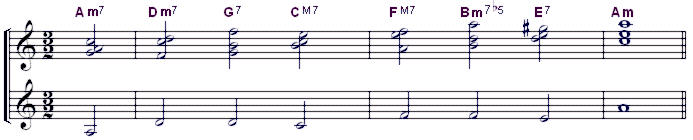
It will be wise at this stage to examine the normal Minor Circle, which will not only be useful as the Minor "New Key" circle, but will also act as a model for our major "Original Key" Modulation Circle, which we will subsequently complete.
Being of binary structure, the Minor Circle is presented here first with Voice-Leading
C (in 2/2). However, when it is combined with the Major Circle in Exterior Modulations, it will be convenient to have it with Voice-Leading A (in 3/2), which is also presented here. The first half of the Minor Circle is identical to the second half of the Major Circle, with the chord pattern (Am7, Dm7, G7, C(+7)). It is precisely the [VIm7 IIm7 V7 I] in Major which the ear perceives, and not the [Im7 IVm7 VII7 III] in Minor. Since the cadence in major is stronger than the cadence in minor, it is preferable, and usual, to use theC+7chord to attenuate its strength. Cadencing to both relative keys (in the same Key Signature) seems a good idea and will also be included in the complete major Modulation Circle which follows.
The Complete Major Modulation Circle
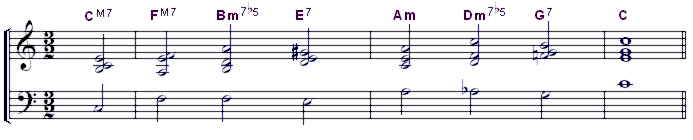
We will now pass the half-way point in the circle, with the ANTE 2 [VIm(Am)], and work toward the beginning, with the ANTE 3 [III7(E7)], and the BUCKLE chord [VIIm7-5(Bm7-5)], to produce a complete Modulation Circle, which we will use not only to establish the original Key, but also to reach the new Key if it is also major.
Modulation 4 - the ANTE 2
TONIC Shadow The ANTE 2 (Am) is theShadow(relative minor) of the TONIC (C) and the most important Secondary TONIC [VI] or more accurately [I of VI].
Modulation 5 - the ANTE 3
DOMINANT Shadow The ANTE 3 (E7) is theShadowof the DOMINANT (G7) and the most important Secondary DOMINANT [III7] or more accurately [V7 of VI].
Modulation 6 - the BUCKLE Chord
The Perfect ANTE-1 The BUCKLE chord (Bm7-5) is the Shadow of the ANTE 1 (Dm7-5) and the most important Secondary ANTE 1 [VIIm7-5] or more accurately [IIm7-5 of VI].
Together
Complete Putting all this together would give us 6 of the 8 required chords, leaving only the 2 first chords [I+7andIV+7] which would be left intact to eliminate interfering modulation within the circle.
Being of ternary structure, the complete major Modulation Circle is presented here with Voice-Leading A.