Probably the most popular and often performed choral piece is the "Alleluia Chorus"
from Handel's Messiah. A growing number of performances are now colored with modern
phrasing, frequently of a "gospel" nature. We thought it might be an interesting harmonic
exercise to see how many variations we could find of its "Amen"-style ending.
The Original
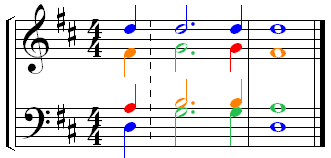
Here is the original version of the last 2 bars of Handel'sAlleluia, withSubstitution1(3)on both TONIC and COUNTER chords D \ G, G / D, Real Triadsin Root Position, with note-values\.,/.
Orbit Lines- Soprano -0\0,0/0, notes D \ D , D / D, Alto -2\1,1(3)/2, notes F# \ G , G / F#, Tenor -1(3)\2,2/1, notes A \ B , B / A, Bass -theFundamentalBass/, notes D \ G , G / D.
Possible Changes
We will now apply changes to this simple Triad version - replacethe missingMOTRIXs, first on the 2s, then on the., dominantizeboth the TONIC and the COUNTER chords, first on the 2s, then on the.; half-diminishthe COUNTER chord, first on the second, then on the.; augmentthe TONIC chord, on the first.
The Soprano and Bass voices will remain unchanged, Soprano on theCOMMON TONE, notes D \ D, D / D, Bass on theFundamentalBass, notes D \ G, G / D. The Alto voice will have six different possibilities - 1. the original line2\1,1(3)/2, notes F# \ G, G / F# ; 2. with theMOTRIXon the second, notes F# \ G, E / F# ; 3. with a diminishedMOTRIXon the second, notes F# \ G, E# / F# ; 4. with theMOTRIXon the.and the second, notes F# \ E, E / F# ; 5. with theMOTRIXon the., diminished on the second, notes F# \ E, E# / F# ; 6. with the diminishedMOTRIXon both the.and the second, notes F# \ E#, E# / F#. The Tenor voice will have nine different possibilities - 1. the original line1(3)\2,2/1, A \ B, B / A ; 2. with a dominantized COUNTER on the, A \ B, Bb / A ; 3. with a dominantized COUNTER on the.and on the, A \ Bb, Bb / A ; 4. with a dominantizedMOTRIXon the TONIC, C \ B, B / A ; 5. with dominantizeds on both TONIC and COUNTER, C \ B, Bb / A ; 6. with dominantized.ands, C \ Bb, Bb / A ; 7. with major seventh on the TONIC, C# \ B, B / A ; 8. with augmented fifth on the TONIC, A# \ B, B / A ; 9. with augmented fifth on the TONIC, and dominantizedon the COUNTER, A# \ B, Bb / A. The six Alto lines are compatible with the nine Tenor lines, producing 54 different
combinations. You might feel like working them out.
Examples
However, presenting a few particularly pleasant combinations might be a good idea.
. . .
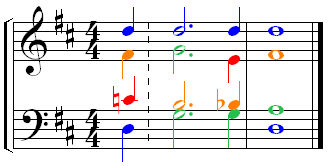
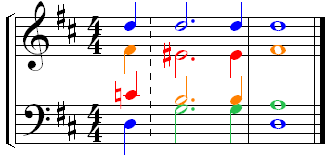
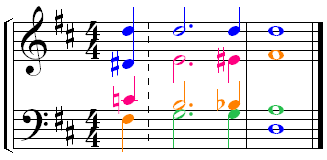
The first example, on the left, consists of Alto Line 2 and Tenor Line 5 - F# \ G, E / F# and C \ B, Bb / A, with chords D7\ G, Gm6/ D, eachis complete and dominantized. Very current usage, especially in Dixieland. The second example, on the right, consists of Alto Line 6 and Tenor Line 4 - F# \ E#, E# / F# and C \ B, B / A, with chords D7\ G+6, G+6/ D, the firstis complete and dominantized, the.and the secondare complete and half-diminished. No mistaking this one, pure Blues.
. . .
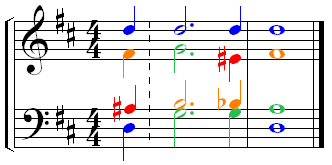
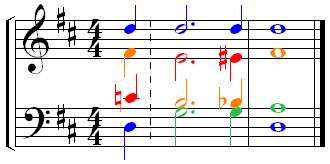
The first example, on the left, consists of Alto Line 3 and Tenor Line 9 - F# \ G, E# / F# and A# \ B, Bb / A, with chords D+5\ G, Gm+6/ D, the firstis augmented, the secondis dominantized and half-diminished. NOTE the simultaneous use of the E# and the Bb in these chromatic embroideries. The second example, on the right, consists of Alto Line 5 and Tenor Line 5 - F# \ E, E# / F# and C \ B, Bb / A, with chords D7\ G6, Gm+6/ D, the firstis complete and dominantized, the.is complete and the secondis dominantized and half-diminished. NOTE again the E# and Bb in (almost) chromatic scales. This one is worth doing over.
Just One More
The last example almost established two contrary-motion chromatic scales. The only
problem was the first Alto note, F# instead of D#, which could be produced by the
only form of chromaticism which we have not yet used,Orbit 4.
This example consists of Alto Line 7 (not in the table) and Tenor Line 5 - D# \ E, E# / F# and C \ B, Bb / A, with chords D7+1/F# \ G6, Gm+6/ D, Orbit 4 applied to the firstand the F# (abandoned by the Alto) placed in the Bass, the.is complete and the secondis dominantized and half-diminished. NOTE the contrary-motion chromaticism in the Alto and Tenor.


 .
.