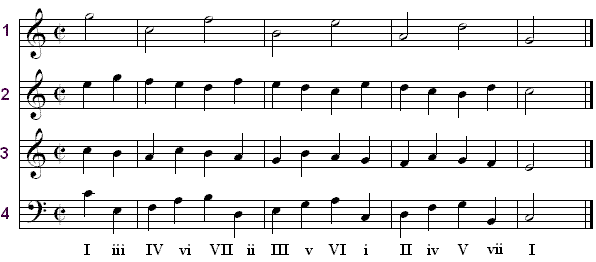
|
Exercises
The following exercises will insert the deceptive triad less frquently
than was the case in the example of this class (above),
and the first step will be to establish the VLLs
for the chord pattern of each exercise.
The Doubling and Voice-leading when the deceptive triad is added
will be found in the example on this page,
the displacement from the Real Triad to the deceptive triad,
using the fourth/fifth skip freely, and
the progression (caving in) from the deceptive triad to the next Real
Triad.
The Voice-leading between two Real Triads
will be found in the example inClass 10,
with two of VLLs 1, 2, 3 rising, and the third stationary.
Once the VLLs are established,
the rest will be similar to the exercises of the preceding classes.
Exercise 1
With theI-IV-(VII-ii)-(III-v)-VI-II-V-Ichord pattern ,
and the  melo-rhythm pattern, melo-rhythm pattern,
using the deceptive triad only twice,
produce the four VLLs,
with VLL 4 ready for the bass voice (C F BD EG A D G C).
In the soprano voice, a VLL which ends on the note C will be placed.
In the alto and tenor voices, the two remaining VLLs will be placed,
respecting problems of crossing.
HINT - the three top voices, in open position, will rise slightly,
while VLL 4, in the bass voice, although generally descending,
will end on the same note as the first.
Transposition to a more appropriate key may be required for vocal performance.
Exercise 2
With theI-IV-VII-III-(VI-i)-(II-iv)-(V-vii)-Ichord pattern ,
and the melo-rhythm pattern,
using the deceptive triad three times,
produce the four VLLs,
with VLL 4 ready for the bass voice (C F B E AC DF GB C).
In the soprano voice, a VLL which ends on the note C will be placed.
In the alto and tenor voices, the two remaining VLLs will be placed,
respecting problems of crossing.
HINT - the three top voices start in close position and end in open position,
one rising, one falling, one stable,
while VLL 4, in the bass voice, descends,
ending a full octave lower.
Transposition to a more appropriate key may be required for vocal performance.
Exercise 3
With the(I-iii)-IV-(VII-ii)-III-(VI-i)-II-(V-vii)-Ichord pattern ,
and the melo-rhythm pattern,
using the deceptive triad four times,
produce the four VLLs,
with VLL 4 ready for the bass voice (CE F BD E AC D GB C).
In the soprano voice, a VLL which ends on the note C will be placed.
In the alto and tenor voices, the two remaining VLLs will be placed,
respecting problems of crossing.
HINT - the three top voices start and end in open position,
all the voices falling,
while VLL 4, in the bass voice, although generally descending,
will end on the same note as the first.
Transposition to a more appropriate key may be required for vocal performance.
Performance remains the best form of correction.
|