|
|
|
Chordal and linear structures
In thegeneration of triads and scales, 3 diagrams were placed side by side -
1. in the center, the original series of fifths in the diatonic Window (7 notes)
which acts as generator for both structures (chordal and linear);
2. on the left, where theFRAMEs of fifths are “divided” by theMEDIANs,
we find the chordal structure of triads
(where all the notes are heard at the same time); and
3. on the right, the double circle of fifths, where the fifths are “multiplied” by
2,
we find the linear structure of the scale,
(where notes are heard one after the other).
With Jordan Triangles, it will be possible
1. to combine both structures (chordal and linear) in one diagram,
2. to extend the possibilities of linear structure “multiplication” from 2 fifths
to 3,
(possibly more) and
3. to observe the “birth” (borrowing) of theMOTRIX(sixth or seventh) more clearly.
Definition of the Jordan Triangle
Orbits 0 and 1
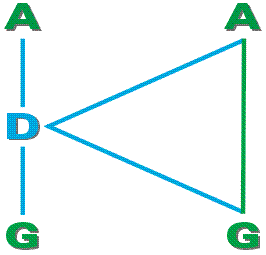
Starting from the central note D, acting as theCOMMON TONE,Orbit 0, and generating, with the interval of the perfect fifth, the notes G and A, produces
thePROPER TONEs,Orbit 1, of the 2FRAMEs of the swing D.
|
|
|
In the normal disposition of the Window,
the 3 notes of this swing are placed vertically,
in a column.
However, if the 2 extremities of the swing
(G and A,Orbit 1),
are placed to one side,
they may be joined by a vertical green line,
producing a “Jordan Triangle”.
|
|
Chordal and linear structural relationships
Both of these relationships are present in the triangle.
1 - The blue lines D-G and D-A represent
(a) not only the chordal relationship of the 2FRAMEs of the swing D
(the pivotalCOMMON TONEgives the swing its name),
(b) but also the linear Voice-leadings 0-1 and 1-0 (the Fundamental Bass).
2 - The green line G-A represents
(a) not only the chordal relationship between theCOMMON TONEand theMOTRIX,
(b) but also the basic Voice-leading 1-1
(between the two peripheralPROPER TONEs).
Assemblage of Jordan Triangles
Orbits 2 and 3
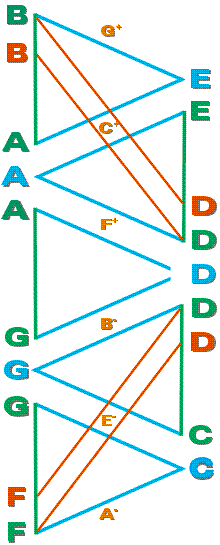
The 5 triangles of the Window (one for each swing) can be superimposed in a column
by zig-zagging the notes of the series of fifths (F, C, G, D, A, E, B).
The linear structure of the scale is found in the vertical green lines on each side
(C, D, E, on the right and F, G, A, B, on the left).
The triangles are separated from each other to clearly differentiateOrbit 0) andOrbit 1).
The sameFRAMEis indicated twice (with 2 parallel blue lines)
specifying the direction of the chord (the swing to which it belongs)
withOrbit 0andOrbit 1indicated accordingly.
Insertion of MEDIANS
in the middle of each (double) blue line
They correspond to the notes of the Window
but have their own specific tuning (+/-),
being generated by the natural major third (5/4).
|
|
|
The Jordan Diamonds
Any 2 adjacent triangles form a diamond,
composed of 2 adjacent swings,
with the common chord between them.
We will concentrate on the diamonds at the ends.
(The central swing D,
which unites the major and minor sections,
is, most of the time, only a one-way passage.)
The MOTRIX Diagonals
Let us start by examining the 2 red diagonals,
between F and D, in the bottom of the Window.
1. The note F isOrbit 1of theFRAMECF and
the note D isOrbit 1of theFRAMEGD.
2. These diagonals run past the note E-,
Orbit 2of theFRAMEs GC and CG.
3. These diagonals indicate the linear structures
F E- D and D E- F,
common to both swing G and swing C.
4. (a) in the swing G, F-E--D represents
the Orbit line 3-2-1, and
(b) in the swing C, D-E--F represents
the Orbit line 3-2-1.
5. TheOrbit 3F of theFRAMEGD
is borrowed from theOrbit 1F of theFRAMECF.
TheOrbit 3D of theFRAMECF
is borrowed from theOrbit 1D of theFRAMEGD.
One could even say that theOrbit 3F
is borrowed from the substitution 1(3)
and that theOrbit 3D
is also borrowed from the substitution 1(3).
6. There seems to be a strong symbiosis between the twoMOTRIX)s
which resolve to theMEDIANE- of the TONIC chords GC or CG.
7. TheMOTRIX, in these F E- D, D E- F diagonals,
seems to have strong linear heritage,
but one must not neglect the chordal relationship of 2 fifths (9/8)
between F and G (on the chord of G7) and
between D and C on the chord of F6.
Note that the chordal relationship is betweenOrbit 0andOrbit 3
and that the linear relationship is betweenOrbit 1andOrbit 1.
|
|
Where do MOTRICES come from?
Each chord surrounding the TONIC (DOMINANT and COUNTER)
borrows itsMOTRIXfrom the substitution of theMOTRIX1(3) of the other chord.
This becomes all the more evident when chromaticism is involved (like the D#--).
The same procedure ofMOTRIXborrowing will apply elsewhere in the Window
not only in the D-B diagonals, for theMOTRIXof Dm6and Em7
but also in the C-A diagonals, for theMOTRIXof C6and Dm7, and
in the G-E diagonals, for theMOTRIXof G6and Am7.
|
|
|
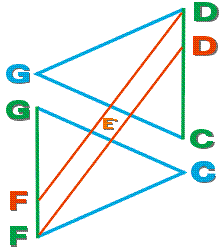
1. Comparing the triangle and the diamond
(a) In the triangle, we have the primary notes -
oneOrbit 0which is pivotal and
twoOrbit 1s which are peripheral.
(b) In the diamond, we have the secondary notes -
oneOrbit 2, in the center, which is generated and
twoOrbit 3s, at the ends, which are borrowed.
2. Comparing the 2 sets of diagonals
In the F-C-D-G diamond there are
the C E- G, G E- C diagonals which are chordal, and
the F E- D, D E- F diagonals which are linear.
Orbit 2(E-) belongs to the 4 diagonals,
with both linear and chordal structure.
|
|
It is interesting to observe Orbit 2 (E-) surrounded by a “court” of four Orbits 1
-
one of which (D or F) will be borrowed to become Orbit 3,
and another (G or C) will be chosen to be Orbit 0,
depending on the swing (C or G) involved at that moment.
The periphery of the Jordan Diamond
This is all the more evident when we examine the complete periphery of the diamond,
with the MEDIANS added, B- in theFRAMEGD and A- in theFRAMECF
(see the following illustration in The Four Metamorphoses).
(a) On the upper left side, delimited by the F E- DMOTRIXdiagonal,
we have the complete DOMINANT chord, D, B-, G, F. (G7).
(b) On the lower right side, delimited by the D E- FMOTRIXdiagonal,
we have the complete COUNTER chord, F, A-, C, D, (F6).
The orbits are inversed in perfect symmetry with
the TONIC triad, on the short diagonals, between its 2 neighboring tetrads.
The Four Metamorphoses
|
|

|
This seems to be the best way we have yet found
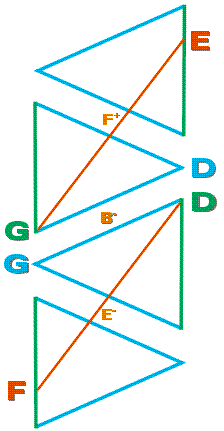
to illustrate Metamorphosis 3, (G7/ F6) -
Orbit 1andOrbit 3(D, F/ F, D) exchange notes,
Orbit 2of each chord (B- / A-) acts as a
non-chordal tone ofOrbit 0of the other chord (C / G).
The linear resolutions of these non-chordal tones
could be clearly perceived inMOTRIXdiagonals
which do not appear in this diagram -
(a) B- to C in the diagonal; A B- C, and
(b) A- to G in the diagonal; Bb A- G.
Metamorphosis 3 is the most “compact” of the four,
occupying only 2 Jordan triangles (1 diamond)
because both tetrads use the same diagonal.
|
|
|
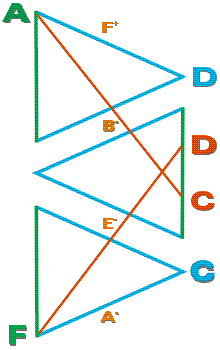
Metamorphosis 4 (F6/ Dm7)
is not as compact as Metamorphosis 3,
occupying 3 Jordan triangles.
Its chords use 2 sets ofMOTRIXdiagonals -
F E- D / D E- F, of which we show only
D E- F for the chord of F6(F, A-, C, D) and
A B- C / C B- A , of which we show only
C B- A for the chord of Dm7(A, F+, D, C).
Orbits 0 and 3 (C, D / D, C) exchange notes,
Orbits 1 and 2 (F, A- / A, F+) also exchange notes,
but change pitch in the process (F / F+, A- / A).
It is the “spread” over 3 triangles
that is responsible for this change of pitch,
a comma higher in the minor section of the Window.
|
|
|
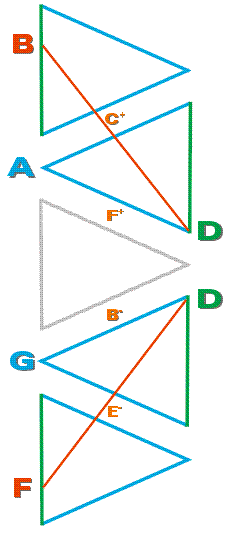
Metamorphosis 1 (G6/ G7) is even more spread than
Metamorphosis 4, occupying 4 Jordan triangles.
Its chords use 2 sets ofMOTRIXdiagonals -
G F+ E / E F+ G, of which we show only
E F+ G for the chord of G6(G, B-, D, E) and
D E- F / F E- D , of which we show only
F E- D for the chord of G7(D, B-, G, F).
As we are dealing with the same triad, G (major),
Orbits 0 and 1 (D, G / G, D)
will evidently exchange notes of theFRAME.
Being theMEDIANof the same triad, G (major),
Orbit 2(B-) evidently remains in the same voice.
Orbit 3remains in the same voice but changes note (E / F),
causing a considerable spread for the same triad.
|
|
|
Metamorphosis 2 (G7/ Dm6)
is even more spread than Metamorphosis 1,
occupying 5 Jordan triangles (the entire Window).
Its chords use 2 sets ofMOTRIXdiagonals -
D E- F / F E- D , of which we show only
F E- D for the chord of G7(D, B-, G, F), and
D C+ B / B C+ D, of which we show only
B C+ D for the chord of Dm6(D, F+, A, B)
Orbit 1 (D) belongs to both chords,
and remains in the same voice.
Orbits 2 and 3 (B-, F / F+, B)
exchange notes but change pitch (B- / B, F / F+).
Once again, it is this “spread” over 5 triangles
that is responsible for this change of pitch,
a comma higher in the minor section of the Window.
Orbit 0 remains in the same voice but changes note (G / A).
TheOrbit 0of each chord acts as a
non-chordal tone ofOrbit 0of the other chord.
The linear relationship of these non-chordal tones
could be clearly perceived in theirOrbit 1relationship (G-A)
which does not appear in this diagram.
|
|
The Complete Swing
In 1 triangle
We could very well have inserted theMEDIANs in the first illustration and produced a diagram of the swing in one single triangle,
but an important element of the swing would have been missing - theMOTRIXs.
In 3 triangles
In order to “borrow” theMOTRIXs from the appropriate diagonals (as we did in the second illustration), we must add
another triangle on each side of the triangle of the swing (as we did in the fifth
illustration but, this time, showing only the appropriate diagonal in each set.
|
|
|
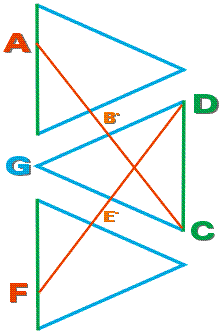
We have here the complete swing G,
which consists of the chords
- C6(C, E-, G, A), and
- G7(D, B-, G, F).
TheMOTRIXs are borrowed from the diagonals
A B- C / C B- A, of which we show only
A B- C for the chord of C6(C, E-, G, A), and
F E- D / D E- F, of which we show only
F E- D for the chord of G7(D, B-, G, F).
TheMOTRIXs F and A are symmetrically disposed
around theCOMMON TONEG,
by the chordal structure of the tone (9 / 8),
which was originally the linear structure
between thePROPER TONEs F, G and A, G.
Back toHome
|
