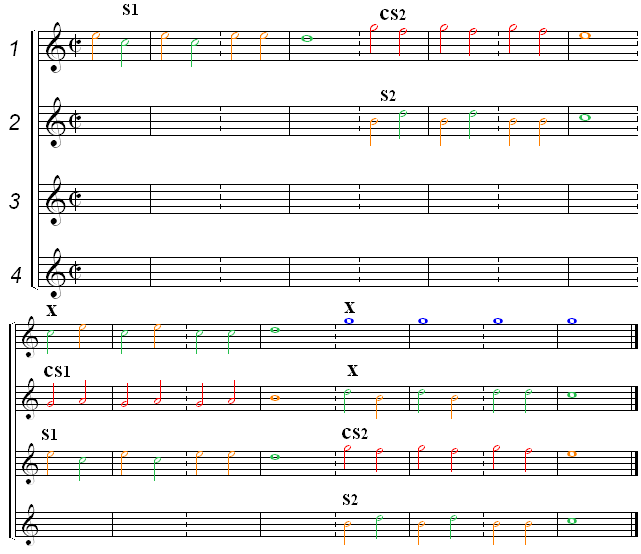
NOTE - In the Subject, we find the principal Orbit Line2-1and the accessory Orbit Line1-1. In the Counter-subject, we placed the3-2Orbit Line, alternating the0(3)substitution with3itself in order to produce a sonority of thirds/sixths with the lines of the
Subject. In the first X, constant1-2displacements to recuperate theMEDIANlost in the Subject. Not much choice for the second X, only Orbit Line0-0left.
Choral Disposition
For the strong cadential final AA, Line 1 must serve as theFundamentalBass, with Line 2, and its1-1line, in the Soprano, the static harmonic Primary Note lines exposed in the outer voices, Line 3, in the same direction as Line 1, in the Alto, and Line 4 in the Tenor, the kinetic polyphonic Secondary Note lines concealed in the inner voices.
To avoid the full close in the middle of the fugue (the AAAA), invert Soprano-Tenor
and Alto-Bass, exposing the the kinetic polyphonic Secondary Note lines in the outer voices,
and concealing the static harmonic Primary Note lines in the inner voices, entering the voices counter-clockwise ATBS. No need to transpose, the existing Key of C is fine.
The Divertimento
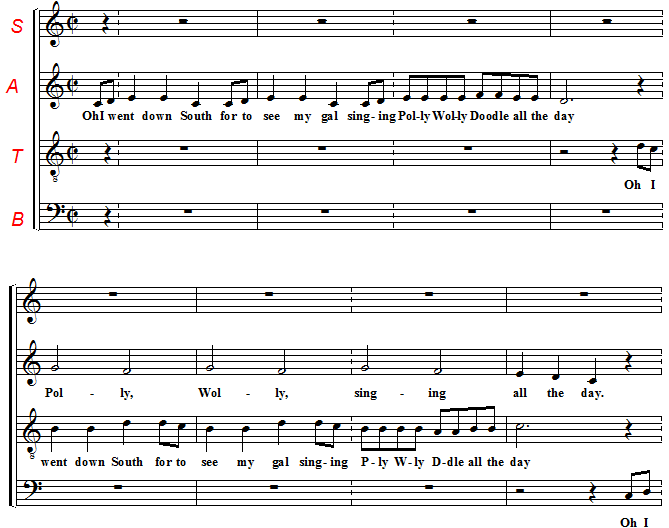
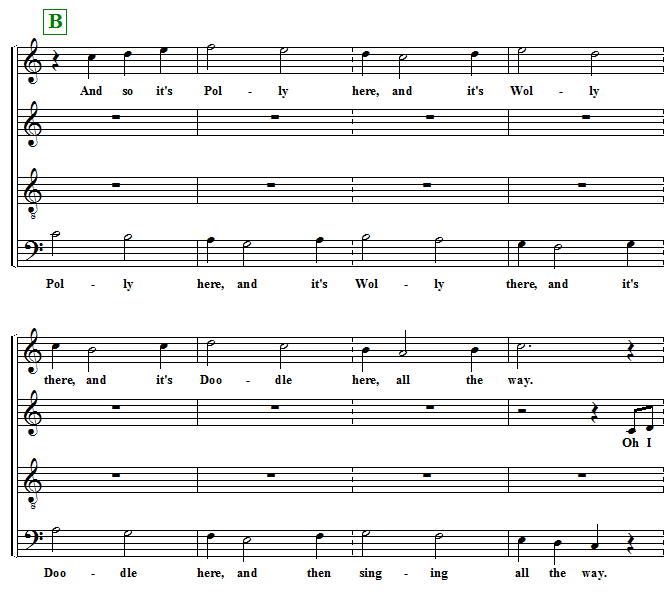
Only one Divertimento of length BB, 8 chords (8 bars), ending on the TONIC to accomodate the pick-up to the Subject. Chord Pattern71*7*4, a complete circle from TONIC to TONIC, in 2 Voices (Bass and Tenor), using the end of the Counter-subject and the end
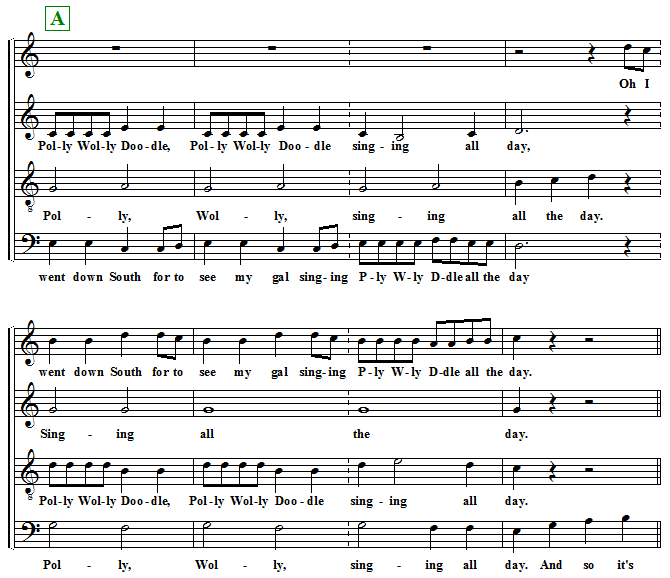
of the first X. See letter "B" of the complete fugue below.
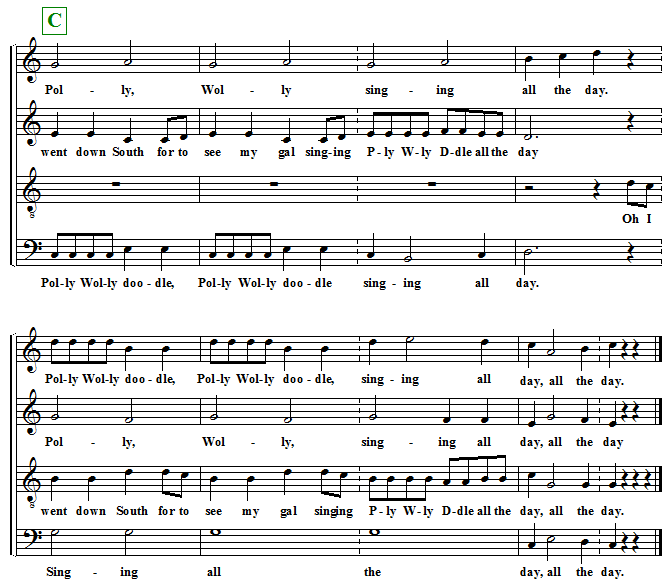
The Complete Fugue
For the ornaments, NOTE - in the Counter-subject, the substitutions for the sonorities with the Subject, and the rebound "all the day" at the end; in first X, subdivision of note-values, as well as the embroidery in the third bar; the Pick-up to the Divertimento in the Bass and Soprano Voices. Also NOTE the whim of a little coda.
Exercise
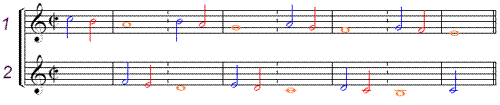
Write your own fugue In the 4 first classes, we composed our own Subject using a specific Orbit Line, which made life nice and easy for us, a good way to start. We followed 4 simple guide-lines : - respect the priority of the Orbit Lines, in order of tension,3-2,2-1,1-1, and0-0; - avoid using the 2 strongest lines at the same time,3-2and2-1; - avoid crossing the Performance Voices (and Orbit Lines); and - respect the range of the Performance Voices, by remaining in the center
of the range as much as possible. Now that we will be using the beginning of existing, preferably well-known, songs, respecting these 4 guide-lines will not always be possible, or even advisable, and we will learn how to "cheat" by circumventing some of these restrictions. To make things a little easier, we will offer you a list of songs with suggestions
for cheating, but you can very well use any other song if you prefer.
Keeping the same Specifics- FormAAAA BBAA, Chord Pattern for the AAAA,M34-34, if the Subject hasM3, andM5324-5324, if the Subject hasM53, and for the BB, a half circle if the Subject hasM3, and a full circle if the Subject hasM53, using the Orbit Line(s) imposed by the chosen Melody for the Subject, and the appropriate Orbit Line for the Counter-subject, taking care of the 2 Xs, making use of the Orbit Lines left over, and any available material as motif for the canon of the Divertimento, the Melo-rhythm, words, and time signature ( 2/2,6/8, 3/4, atLevel -1) of the chosen Melody, but freely choosing- the embroideries and Non-chordal Tones for the Counter-subject and the Xs. Check each Voice carefully(Soprano, Alto, Tenor, and Bass) from beginning to end, making sure that the melodic movements are easy and natural, and that the words are coherent. Correction is always in the performance.
Suggestions- Oh! When The Saints,S1=M53, Orbit Lines1-1, 2-1, This has already been done and works well. Happy Birthday,S1=M3, Orbit Line3-2. Try using Orbit Lines2-1and1-1in the Counter-subject, to get the best sonorities with the Subject. La Raspa,S1=M53, Orbit Line1-1, Try using Orbit Line2-1for the Counter-subject, instead of3-2which crosses the Subject. You might be tempted to try something new here. Crossings Red River Valley,S1=M53, Orbit Line2-1. The Pick-up of the Subject will inevitably cross the Counter-subject. Make the CS very different (especially note-values) so that the crossing
really shows, and alternate the entries between the Male and Female Voices. Clementine,S1=M53, Orbit Line2-1. A crossing here (on note 4). Quite similar toRed River Valley. Take the same precautions. Down In The Valley,S1=M3, Orbit Lines2-1and1-1. . A Pick-up crossing here. Take the same precautions as inRed River Valley. Rebounds Auld Lang Syne,S1=M3, Orbit Lines1-1and2-1. A Pick-up crossing here, but there is also a rebound on the Beat of the
Subject, which will be present even at the end of the fugue. Carnival Of Venice,S1=M3, Orbit Line2-1. A rebound on the Beat of the Subject here (this one aDouble Non-Chordal-Tone), but no Pick-up crossing. It is often a good idea to also place a rebound on the Beat of the
Counter-subject, in the form of a single Non-Chordal-Tone (for the best sonorities). Yankee Doodle,S1=M3, Orbit Lines1-1and2-1. Rebound on the Beat of the Subject with Non-Chordal-Tone suspensions, no
Pick-up. Tenant Chords Lovely May,S1=M3, Orbit Line2-1. A rebound on the Beat of the Subject with a double Non-Chordal-Tone, which may also be considered, at a smaller level, as a Tenant Chord, an ANTE-1 on the S1 (and CS1) and a COUNTER on the S2 (and CS2). Drink To Me Only With Thine Eyes,S1=M3, Orbit Line2-1. A melodic rebound on the Beat of the Subject, but also a harmonic Tenant
Chord on the Off-beat. AMetamorphosis 4occurs on this Tenant Chord (F6Dm7on the S1 and Dm7F6on the S2, in C). America, M3Deep In The Heart Of Texas, S1 = M53, Orbit Line 0-1,La Cucaracha, S1 = M53, Orbit Line 1-1, 2-1,Alley Cat, S1 = M53, Orbit Line 3-2,Rock-A-Bye Baby, S1 = M53, Orbit Line 3-2,
-->