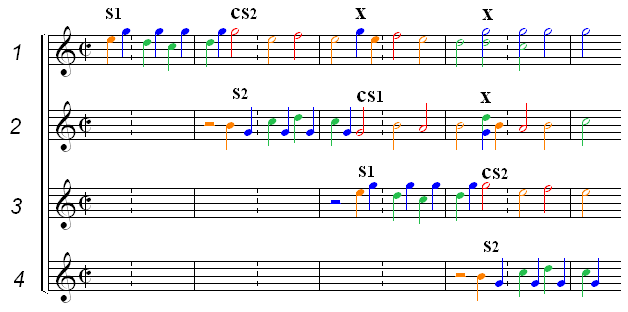
In this class, the Subject will use 2 Orbit Lines at the same time.
Specifics
FormAAAA BBAA- Chord PatternM33-44- Subject Orbit Lines2-1and0-0for the first cell,1-1and0-0for the second cell - Counter-subject Orbit Line, preferably3-2for both cells.
Another 16-bar fugue, with a chord at each, a half-bar at the beginning and a half-bar at the end.
The Expositions
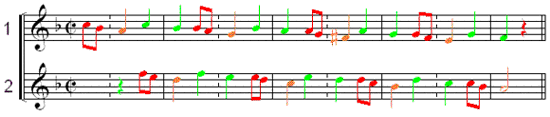
The Fugue-lines
NOTE - In the Counter-subject, to produce a sonority of thirds/sixths with the Subject, the choice of the0(3)substitution in the first cell and3itself in the second cell. At the beginning of the first X, a displacement to recuperate theMEDIANlost in the Subject, then the use of theMOTRIXon the Beat of the first cell to maintain movement, but not on the Beat of the second cell. The possible choices of the second X. The consecutive fifths (fourths) between the Counter-subject and the first X, despite the fact that one of these fifths is diminished, a little embroidery will advantageously camouflage this small weakness.
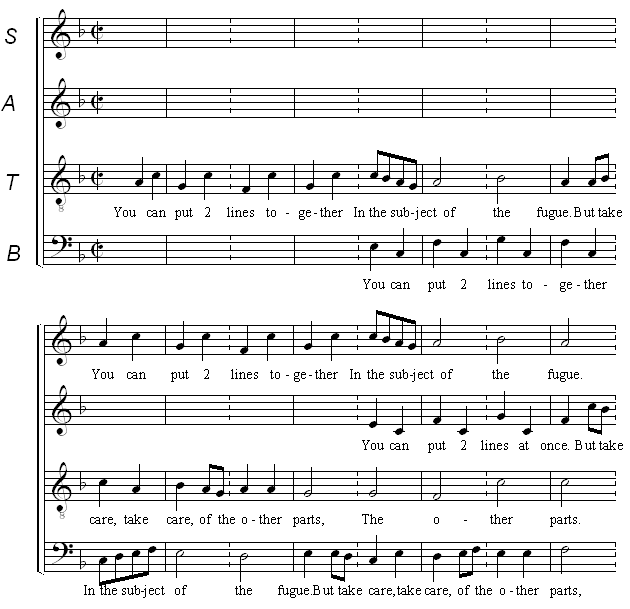
Choral Disposition
We have here, in Line 4, theFundamentalBass, combined with the1-1line, normally reserved for the Soprano. Line 1 should be used as Soprano, because Line 3 ends on theMEDIAN, and because it possesses the required static harmonic Primary Notes0-0-0-1 in contrary motion with theFB. Lines 2 and 3, with the kinetic polyphonic Secondary Note lines,3-2and2-1 will be concealed in the inner voices (T and A). Transposing this in F places it in a good vocal range. To avoid the full close in the middle of the fugue (the AAAA), invert Soprano-Tenor and Alto-Bass.
For the ornaments, see the complete fugue below. Note the substitution at the beginning of the Counter-subject for the sonorities
with the Subject, the pick-up with Passing Tone to the first X, as well as the embroidery to cover the consecutive fifths in the middle
of the first X.
The Divertimento
Only one Divertimento of length BB, 8 chords (4 bars), ending on the TONIC to accomodate the pick-up to the first X. Chord Pattern71*7*4, a complete circle from TONIC to TONIC, withDominantizedANTE-2. In 2 Voices, using the beginning of the first X, inverted.
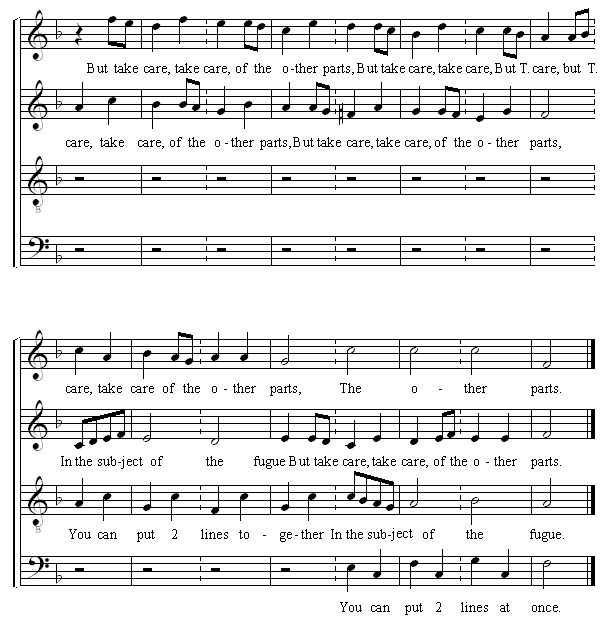
The Complete Fugue
Dispose the Expositions AAAA and AA. Insert the Divertimento (in the Soprano and Alto voices). Touch-ups - between the AAAA and the BB, the Alto drops its last note for the Pick-up to
the Divertimento, between the BB and the AA, inevitable repeats in the words of the Soprano.
Here again, silly words which describe the nature of the fugue : for the Subject : "You can put 2 lines together" for the Counter-subject : "In the subject of the fugue," for the first "X" : "But take care, take care, of the other parts," for the second "X" : "The other parts."
Exercise
Write your own fugue Keeping the same Specifics- FormAAAA BBAA, Chord PatternM33-44-33-44, for the AAAA with a full circle from DOMINANT to DOMINANT (or TONIC to TONIC) for the
BB, but freely choosing- any 2 lines (except3-2and2-1together) for the Subject (or Counter-subject) line, with the line not used (3-2or2-1) placed in the other motif, take care of the 2 "X"s, making use of the lines left over, and any available material as motif for the canon of the Divertimento, and freely changing- the Melo-rhythm time signature (6/8, 3/4 ... atLevel -1) the embroideries and Non-chordal Tones for all the motifs, the words, the mode (possibly using the Diatonic Minor Mode). Check each Voice carefully(Soprano, Alto, Tenor, and Bass) from beginning to end, making sure that the melodic movements are easy and natural, and that the words are coherent. Correction is always in the performance.