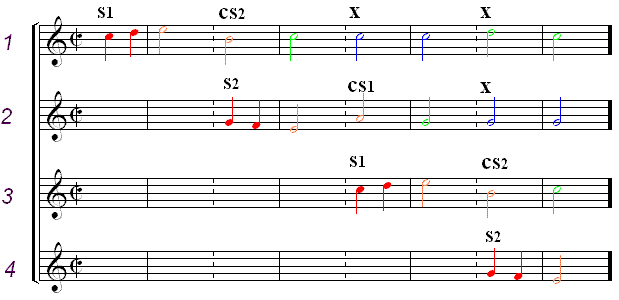
FormAAAA BBAA BBAA, a ternary form at the large level, in which the firstAAAAand the lastBBAAwill cadence strongly, but not the firstBBAA. Chord PatternM6-4- In the first five chapters, we had only TONIC and DOMINANT chords in our Expositions, with the S1 and S2 centered around theCOMMON TONE, degree 5 of the scale. We now have the COUNTER/TONIC progression answered by DOMINANT/TONIC, with the S1 and S2 centered around the the complete TONIC chord, degree
3 of the scale. Subject, the beginning ofFrère Jacques, with principal Orbit Line3-2and auxilary Orbit Line0-0. Counter-subject with principal Orbit Line2-1and auxilary Orbit Line1(3)-2. NOTE that both the Subject and the Counter-subject haveOrbit 2on the Beat, but the Subject has it on the firstand the Counter-subject on the second.
A 12-bar fugue (in 4/4 meter), with a half-bar at the beginning and a half-bar at
the end.
The Fugue Lines
Choral Disposition
Line 1, with the Fundamental Bass at the end, will be placed in the Bass Voice, Line 2, with the Primary Notes, the Common Tone, will be placed in the Soprano Voice, Lines 3 and 4, with the Secondary Notes, will be placed in the Alto and Tenor Voices.
Divertimenti
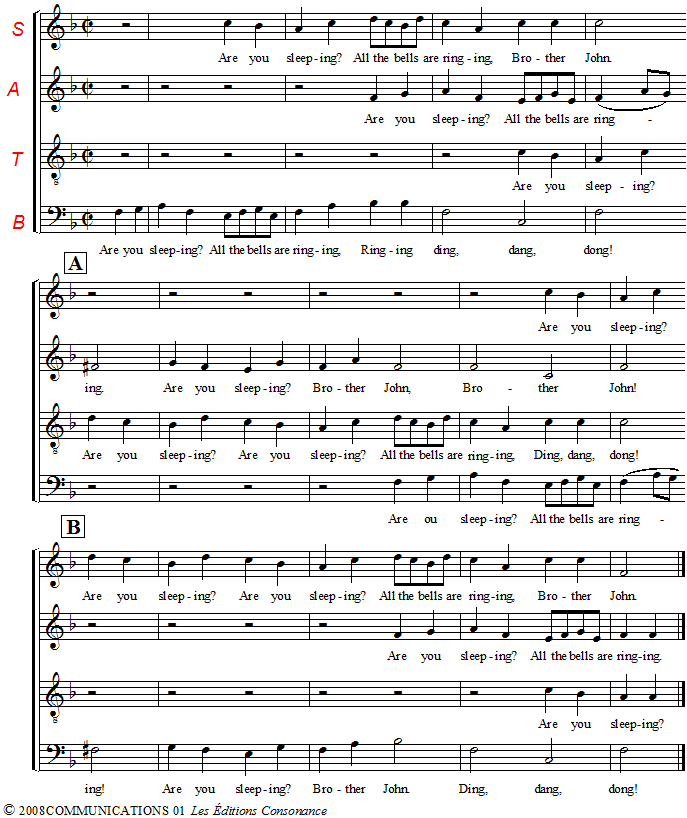
Since the S1 starts on a COUNTER chord, the Divertimenti must end on the TONIC, thus a half-circle starting on a Dominantized ANTE-2 (D7), using the S2, see the complete Fugue (below). The habitual inversion (T-S, A-B) will produce the second Divertimento.
The Complete Fugue
NOTE the words - The Subject uses the words of the first line of the song, while the Counter-subject uses the words of the third line, and the "X"s use the fourth line. NOTE the Pick-up into each Divertimento in the Alto and Bass voices with the notes A-G-F#. NOTE in the Soprano voice the notes C-C-C at the end of the AAAA, but the notes C-C-F at the end of the second AA at the end, to make a difference between the two strong cadences.
Exercise
Write your own fugue Keeping - the same formAAAA BBAA BBAA the same chord pattern, Exposition -M64- Divertimento -M7*4, but varying - the melody and the orbit lines of the subject and countersubject, the ornaments, the words, and the mode - choice ofMorw- the whole fugue in the same mode.
RESEARCH - Find melodies on theM56orM54patterns, or in themMode which could serve as subject for a fugue in the next chapter.