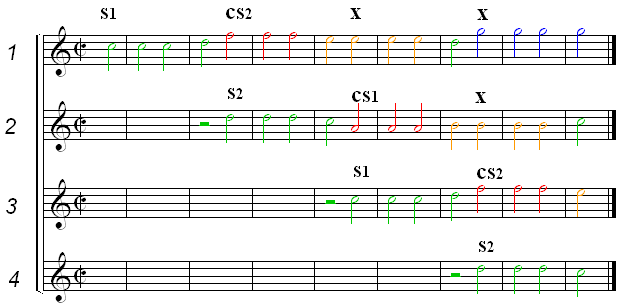
Another 16-bar fugue. However, there is a chord at eachinstead of eachas was previously the case. The fugue opens with a half-bar and closes with a half-bar.
The Expositions
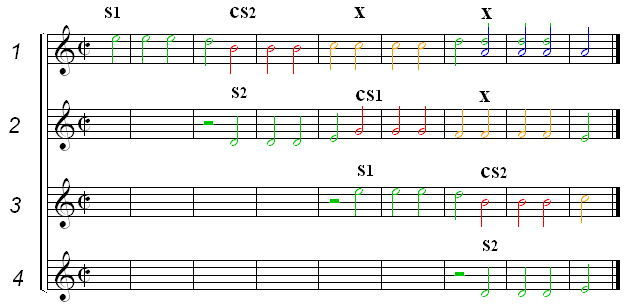
The Fugue-lines
Here eachOrbit 3(In CS2 and CS1) has NOT been replaced by0(3) 3 because the Sonorities between the Subject and the Counter-subject (in thirds) are better withOrbit 3itself, and it is quite simple to attack it directly from the precedingOrbit 1. NOTE that there is very little choice for the X fills. With a Subject1-1and a Counter-subject3-2, the first X should be2-1, and the0-0is left for the second X.
The Choral Dispositions
The last Exposition (AA)
The last Exposition, being a consequent, must come to a full close (cadence), Here we have only 1 possible disposition because Fugue-line 1 alone can offer
theFB.
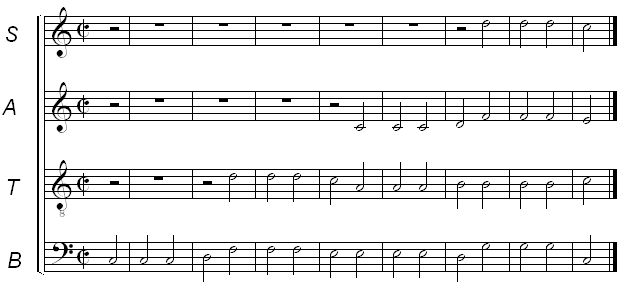
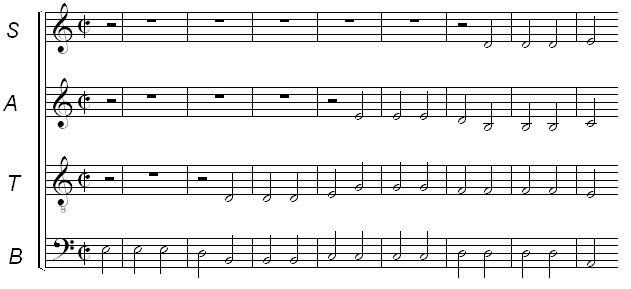
With Fugue-line 1 in the Bass Voice, ending on theFB(G-C), Fugue-line 4, with its1-1line, must be in the Soprano Voice, producing the appropriate cadence with the static Primary Note lines exposed in the outer voices (S and B), Fugue-line 3, in the same direction as Fugue-line 1, must be in the Alto Voice,
and Fugue-line 2 in the Tenor Voice, with the Secondary Note voices concealed in the inner voices. Leaving this in the Key of C gives us a good Choral Disposition. The first Exposition (AAAA) of this disposition will be seen later.
NOTE - Remember that only the second half of the last Exposition will be used, because it is only an AA, the first AA being replaced by the BB.
The first Exposition (AAAA)
Invert the high Voices (Soprano and Tenor) and the low Voices (Alto and Bass) to avoid the full close (cadence) in the first Exposition, an antecedent.
The outer voices, Soprano and Bass, now expose the Secondary Note resolutions2-1and3-2, and the Primary Notes resolutions1-1and0-0, are now concealed in the inner voices (A and T).
Ornaments
In this class, we will add unprepared Non-chordal Tones as melodic ornaments for the Subject and the Counter-subject. NOTE that it is often preferable to sharpen inferior Non-chordal Tones when we are dealing withflat notes(F# and C#). The end of the Counter-subject lends itself particularly well to this treatment
onOrbit 2, producing successful sonorities with the substitutionOrbit 1of the Subject. See thecompletefugue.
Once again, we offer simple, silly words to fit the Melo-rhythm, or possibly vice-versa, the Melo-rhythm fitting the words - for the Subject : "I just want to write a little fugue" for the Counter-subject : "but I ne-ver" for the first "X" : "seem to make it to" for the second "X" : "the very end."
The Divertimento
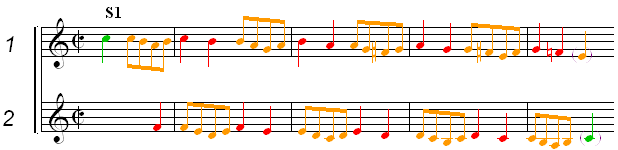
Only 1 Divertimento of length BB, composed of 8 chords, 4 cells of 2 chords each. We will use here a complete circle from DOMINANT to DOMINANT, with dominantized ANTE-1 in the fourth cell,
The Fugue-lines
The second half of the Subject (S1) as canon motif -
There is evidently a harmonic breath after the first cell (M4) and the rest is calculated back from the final M1.
2 voices, with lines0(3)-2and2-1, using the second half of the Subject as canon motif. The beginning of the Subject, stationary on the same note, and the end of the Counter-subject, which begins onOrbit 3itself, would not be as useful in a canon. Using S1 as motif, with the words "To write a little fugue" the canon starts in Fugue-line 1 with the pick-up on the TONICOrbit 1, followed byOrbit 2on the DOMINANT, with superior and inferior Non-chordal Tones, the notes CBAB/C, then passingOrbit 3B, and is answered in Fugue-line 2, also with the pick-up followed byOrbit 2, on the TONIC, with the same superior and inferior Non-chordal Tones, the notes FEDE/F, then passingOrbit 3E. At the end of the Divertimento, we see (in parentheses) the resolutions, which we will need to tie in the lines of this Divertimento with the next (and last) AA. Fugue-line 1 resolving toOrbit 2ties in with the first "X", and Fugue-line 2 resolving toOrbit 1ties in with CS1. NOTE that the canon motif used the line1-1in the S1 but must now use the line2-1in the canon. However, the melodic motif remains unchanged.
The Complete Fugue
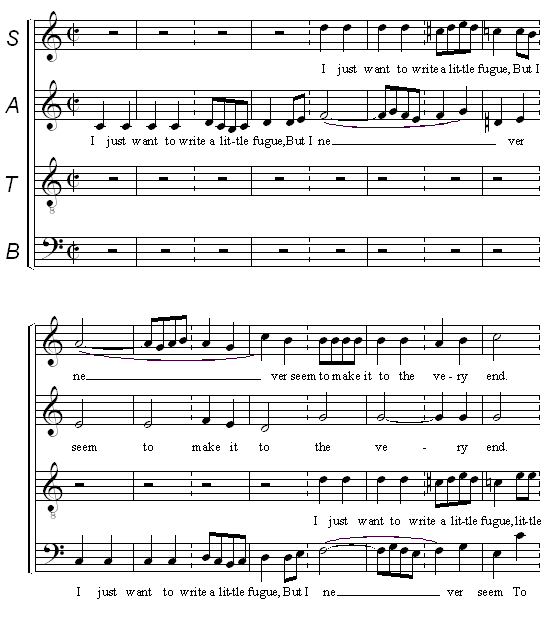
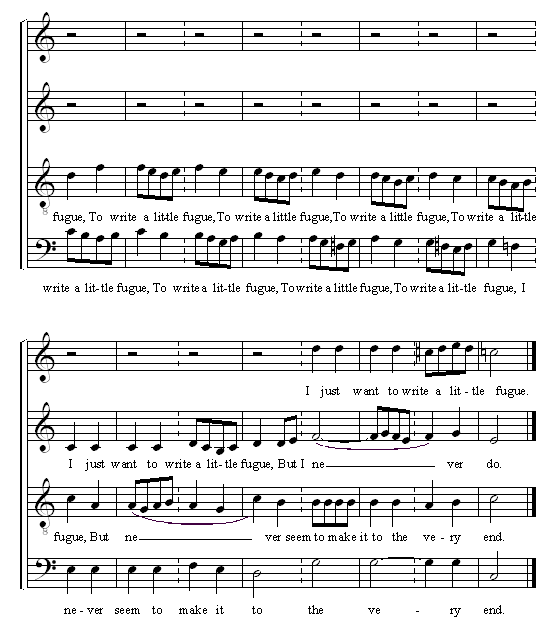
Place the Expositions, insert the BB Divertimento, have some voice tie in the AAAA with the BB, and adjust the words.
The first Exposition AAAA is disposed asthe second example, without the strong cadence. The last Exposition AA is disposed as the second half ofthe first example, with the strong cadence (the embroideries and unprepared Non-chordal Tones are added, of course). NOTE the inferior chromatic Non-chordal Tones (C# in the Soprano and D# in the
Alto) at the end of the first line. NOTE, in the Soprano Voice, the subdivision ins ands to place the words of the 2 "X"s into 1 "X" (for the words "seem to make it to the ve-ry end", at the end of the second
line). The 2 DivertimentoSubject lineshave been disposed in the Tenor and Bass Voices, replacing the 2 first entries of the AAAA with thestrong cadence, which tie in to the remaining AA, Divertimento Fugue-line 2 tying in to the CS1 in the Tenor Voice, and Divertimento Fugue-line 1 tying in to the 2 "X"s (with theFB) in the Bass Voice. NOTE how the Tenor Voice ties in the preceding AAAA Exposition to the following Divertimento BB, with the words "lit-tle fugue", at the same time as the S1 pick-up in the Bass Voice with the words "To write a lit-tle fugue", and that, also in the Tenor Voice, the CS1 after the Divertimento comes
alate, after the word "fugue" and even after the added word "But". NOTE, in the Bass Voice, the word "ne-ver" is borrowed from the Counter-subject fill in the 2 "X"s (in the last line). NOTE, in the Alto Voice, the word "do" at the very end, to close off the fugue.
Exercise
Write your own fugue Keeping the same Specifics- FormAAAA BBAA, Chord PatternM53-24-53-24, for the AAAA with a full circle from DOMINANT to DOMINANT for the BB, Subject line1-1, Counter-subject line3-2, first "X"2-1, and second "X"0-0, but freely choosing- from the Subject or the Counter-subject, the motif for the canon of the Divertimento, and freely changing- the Melo-rhythm time signature (6/8, 3/4 ... atLevel -1) the embroideries and Non-chordal Tones for both the Subject and the Counter-subject, the words (or possibly scat singing) for the Subject, the Counter-subject, and
the "X"s, the mode, using the Diatonic Minor Mode (see below). Check each Voice carefully(Soprano, Alto, Tenor, and Bass) from beginning to end, making sure that the melodic movements are easy and natural, and that the words are coherent. Correction is always in the performance.
RESEARCH - You might enjoy finding a melody which starts withM53, which uses Orbit Line3-2,2-1, or1-1, to act as S1 for your fugue.
Exposition Fugue-lines From a harmonic point of view, the second "X", in Line 1, should preferably be0-0A-A, but that would leave us without the possibility of producing theFB. In such a case, the second "X" can borrow the1-0Line D-A, even if that leaves the chord temporarily withoutOrbit 0A. To produce the final, strong cadence, Line 1 would thus be in the Bass Voice, with Lines 2 and 4 in the Tenor and Soprano Voices.
Exposition closing cadence A transposition to E minor, a fifth higher, would place this exposition in a good
vocal range. For the first Exposition, without a strong cadence, invert Soprano-Tenor and Alto-Bass, the Alto having preferably the original0-0Line, A-A, at the end. The Divertimento and the Assembly are the same as in major. Double-check everything. Good luck, and Enjoy !