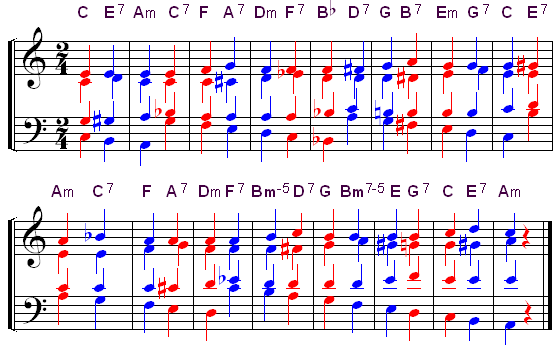
Interlaced Circles constantly jump, back and forth, between theDiatonic Majorand theChromatic Minorcircles, (the 2 flattening modes), using both Metamorphoses 1 and 4, one after the other, on the same chord. The whole process can become quite confusing half-way through when the major circle is using minor chords and the minor circle is
using major chords. We thought that the best way to always know which circle we were dealing
with was to color each circle according to its mode,majororminr, and sacrifice the Orbit colors. The example is written in short bars of 2/4, without any indication of larger levels which would depend on the circle chosen as the more important of the
two.
- The diatonicmajorcircle starts first, on the opening chord of C(6) with a substitution of Orbit 3 in the Bass. This is followed by a chord of E7/B, originally a chord of G7 which was submitted to aMetamorphosis 1transforming it into G6, then aMetamorphosis 4transforming it into Em7, finally toDominantizationwhich transforms it into E7. The chromaticminrcircle now starts at the second bar of 2/4, on the chord of Am(-6) with a substitution of Orbit 3 in the Bass. This is followed by a chord of C7/G, originally a chord of Em7 which was submitted to Metamorphoses 1 and 4, as well as dominantization, transforming it into C7, as was the case for the second chord in the first bar. This process will continue for the complete circles, theminrcircle finishing after themajorcircle. The second beat (chord) of each 2/4 bar, with its dominant shape and strength, operates a change of circle. At bar 8, we seem to start all over again but in the opposite circles. At bar 15 themajorcircle ends, and at bar 16 theminrcircle ends. In themajorcircle, the Buckle chord (Bm7-5), is placed - below the Window (Bb) when it is on the first beat, as a chord of rest,
and above the Window (B7) when it is on the second beat, as a chord of movement. In theminrcircle, the Buckle chord (Bm7-5), remainsconstantly diatonic, and the DOMINANT remains constantly major (E). Voice-leading C is always used from the first to the second beat within each
bar, and Voice-leading B is always used from the second beat of a bar to the first
beat of the next bar. These interlaced circles are seldom used complete, as we see them here, but far more frequently in fragments, often to change circle only once or twice.
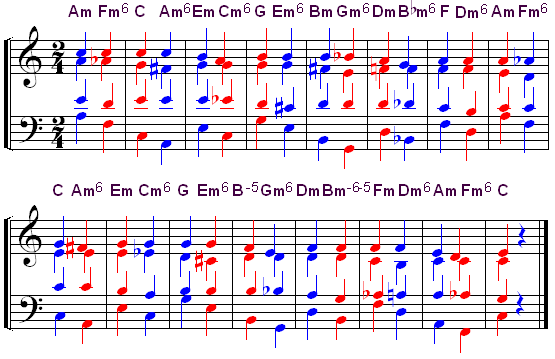
The inversus is also interesting with theminrcircle starting first, followed, at bar 2, by themajorcircle.
- The Bass voice is completely in root position, the "running bass" of the previous example not being possible. In theminrcircle, the Buckle chord (Bm-6-5), is placed - above the Window (Bm) when it is on the first beat, as a chord of rest,
and below the Window (Bbm6) when it is on the second beat, as a chord of movement. In themajorcircle, the Buckle chord (Bm-6-5), remains constantly diatonic, and the DOMINANT remains constantly minor (Fm), the exact harmonic inversion of the preceding example.

 r
r