Evaluation / Analysis / Intensive Care / Things-Return


All The Things You Are - Return

Participant Judges

Scores

The up-to-date average score
     of the Technical evaluation is2.5points, and
     of the Artistic evaluation is3.5points, for a
           Total score of 6 points.

Comments sent with the Scores

As for the evaluation itself, I had to wonder if a more irregular structure 22 2 12 should get more points in praise of its complexity or lose points for lack of integration and structure. Generally, I would tend to vote for integration, yet making a nice song with a weird structure can be seen as a feat too and should be rewarded as well, even if the feat is accomplished purely intuitively, possibly even more so. In the end, I cut it in the middle in some way and also considering different other factors, I came up with the following "scores": 2.5-3.5 = 6.0/10 (T-A = S/10) There is one thing that I could not consider as I did not have copy of the exact Lyrics for the song, is the impact and link between the music and the words. I will try to get a copy of the words and further this evaluation. I am especially curious about comparing 1st and 2nd mod. relationship quality with the lyrics. Which fits better the words, sad to pompous or more balanced ?

(From a letter presented below)

Staff Judges

Analysis - Comments

General
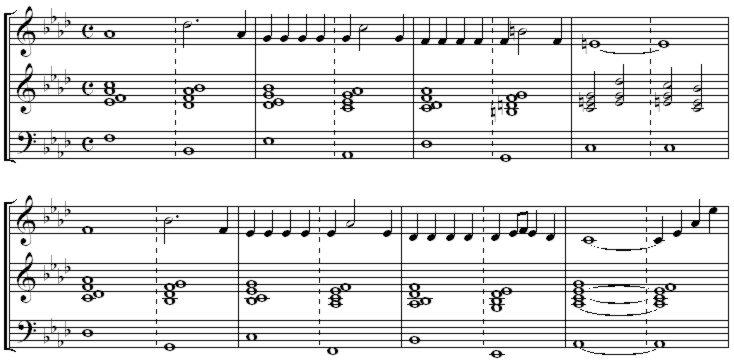
TheForm=AABA-Back to the music page.
Level 0for eachA=0 + 3
     with Bar-lines placed atLevel -2, 4 bars percell, 8 bars (2 cells) in eachA.
Level 0for eachB=3 + 6
     with Bar-lines also placed atLevel -2, 4 bars per cell, 8 bars (2 cells) in eachB.
The added cell in the lastAwill be considered the result ofablations,
          from a total of 16 cells, to the existing 9.
     (4)4 4 4, the large level ablation
          of the first 1/4 of the whole piece.
     ((2)2)22(2)2 22, the medium level ablation
          of the first 1/4 of the each half of the piece.
     (((1)1)2) (1)12((1)1)2(1)12, the small level ablation
          of the first 1/4 of the each quarter of the piece,
               producing the Fibonacci8(3-2-3)
     (((1)1)2)22((1)1)2(1)12
          but the small ablation of the second quarter of the piece was not made,
               producing the desired group of9 (2-2-2-3),add .5 point here.

Melo-rhythm
The firstAconsists of 2 cells,
      Whole note Half note.Quarter note/Quarter noteQuarter noteQuarter noteQuarter note Quarter noteHalf noteandQuarter note\Quarter noteQuarter noteQuarter noteQuarter note Quarter noteHalf noteQuarter note/Whole note_Whole note,
               with theBeatof Cell 1 similar to the Offbeat of Cell 2,
          drawing attention toLevel +1, a majestic effect,
                similarto that in bars 5-8 ofOver The Rainbow.
The secondAis quite similar,
     but with added movement (Quarter noteEight noteEight noteQuarter noteQuarter note) in bar 14,
          bothAs withmasculine rhymes, 2melohythmic entities.
The 2 cells of theBare identical with a 3-note pick-up,
      Quarter noteQuarter noteQuarter note\Quarter noteQuarter noteHalf note_Quarter noteQuarter noteQuarter noteQuarter note/Whole note_Quarter note,
          a masculine rhyme in each cell.
The 2 first cells of the lastAare also quite similar,
      Whole note Half note.Quarter note/Quarter noteQuarter noteQuarter noteQuarter note Quarter noteHalf noteandQuarter note\Whole note Half note.Quarter note/Quarter noteQuarter noteQuarter noteQuarter noteQuarter note Half note.,
          both rebounding (one withF+and one withF=), keeping the Melo-rhythm open,
     but the last cell closes majestically withQuarter note\Quarter noteQuarter noteQuarter noteQuarter note Half noteHalf note/Whole note_Whole note,add 1 point here.

Melo-harmony
The Melo-harmony is unusual, to say the least:
     (a) the first 28 bars are composed uniquely offlattening(descending)circle sequences;
     (b) the first 3 sections (AAB) end on major rather than minor chords,
          that could be called "Picardy thirds", had they been on a final tonic;
     (c) the result is an incessantsharpening,
          which makes the return after the Bridge awkward and painful.
The firstA"circles" from Fm(7) to C, which could be interpreted as
     fromIto adominantized Vin Fm, or
     fromVIto a dominantizedIIIin Ab.
The secondA, identical to the first,
     "circles" from Cm(7) to G, which could also be interpreted as
          being either in Cm or Eb.
TheB"circles" from Am(7) to E,
     which not only establishes the Key of G,
               more strongly than any other key in the piece so far,
          but leaves us on what seems like aVof A,
               making a reasonable return to Ab (or Fm) next to impossible,1 point lost here.
The lastAstarts exactly like the firstAonly for the first cell (bars 25-28),
     then abandons all "circle sequence" when it reaches theIVof Ab, the chord of Db,
               which should be a 6th chord (and not a 7th chord) in bars 29-30,
          returning to the chord ofI,
               which should be in second inversion (and not in root position, in bar 31,.5 point lost here),
          leading to the finalII-V-Icadence (in bars 33-36).

Melo-lines
This piece has a strong affinity for theMEDIAN(third) of each chord,
     jumping from one to the other at each change of chord (bar),
          thus using 2 Voice-leading Lines (Orbits 3-2) almost all the way through,
               occasionally having bothOrbit 2andOrbit 3in the same bar (2, 4, 6, 10, 12, 14, 26, 28),
                     add 2 points here.
     The situation is slightly different in theBridge, where there is a 3-note arpeggio Pick-up,
          followed by a descending Voice-leading line,
                    composed of Orbits 2-3-2, interrupted by a lowerCOMMON TONEline,
               which occurs twice.
     The end of the lastAis reminiscent of theB.

Review of Entities
This song has a very "classical feeling" which is mostly the result of its lack of entities.
     Neither the Melo-harmony nor the Melo-lines ever really "close",
          with only one tonic chord and oneOrbit 1at the very end.
     There does not seem to be any other song quite like it,
          but comparison with classical examples would be very tempting.

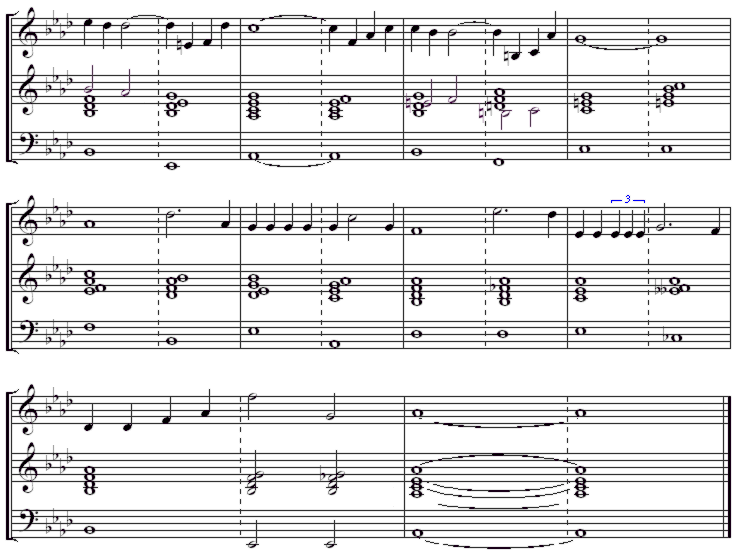
New look/sound

cathings04a cathings04b

This is what the suggestions would look and sound like.
     (a) The secondA, a diatonic second higher,
          cadences firmly in Ab and brings us "back home".
     (b) TheB, in the original key of Ab,
          ends on a chord of C which acts asVof Fm,
               tying in to the lastA, with the changes of Db6, Dbm6, and Ab/Eb.

Scores

In the technical evaluation -
     1.5 points were lost,5 - 1.5 = 3.5
In the artistic evaluation -
      3.5 points were added.
Total score = 7 points

Double Quality Control
The first Quality Control was our evaluation of the piece.
The second Quality Control is your evaluation of Analysis,
     did you find it convincing, valid, and fair?
           Let us know, we will print your comments.

Comments and Questions after reading this Results page

Here are my candid remarks concerningAll the Things You Are. The first gut-reaction of one who has much admired the song (while being uncomfortable and embarrassed by the harmonic crudeness of bars 23 – 24 – 25) was a refusal to admit the proposed melodic modifications, viz. (a) the large step interval across the barline between bars 10 – 11 (F – Eb), when the original has a small step (Eb – D) and (b) the notes Ab – G across the barline between bars 22 – 23 when one’s ear expects to hear Bb – A (corresponding to the original’s A – G#). In trying to explain these reactions I reasoned as follows: (a) in the original, the chord progressions of phrase A² are an exact transposition from phrase A¹, characterized by a rise of tension in proceeding gradually from descending minor to descending major (i.e.dominant type) chords and then to a Neapolitan 6th chord and its resolution at the distance of a diminished four-step (or diminished fifth). In the modified version the opposite occurs, viz. the phrase A² starts with the high tension of the resolution of the Neapolitan 6th to a chord with a flattened 5th and proceeds then most predictably down from the 3rd antecedent with diminishing excitement. Concurrently, the melody loses the relatively “loaded” small step across the bar-line between bars 10 – 11, being replaced by the diatonic motion F – Eb. We know from age-old experience in all the temporal arts that it is easy to “sell” rise of tension but a very delicate matter to make lowering of tension emotionally interesting. (b) in the four notes ending phrase B, the modified version imitates (and transposes) exactly the four notes across bars 18 – 19 but loses the added emotional tension of the wider skip (from B up to A) of the original. After which one is truly gratified to resolve the C7th chord to Fm7th. But, I am curious, why did you not put the Fb of bar 30 in the bass?

We will start from the end of your comments. In bar 30, the Fb was not put in the bass because (a) we wanted to stay as close as possible to the original (where the Db goes to Ab and not to the 64 chord), and (b) we felt that the rapport of the bass and the melody was preferable in contrary motion, even if it entailed the consecutive octaves between Db and Eb. An excellent question, each possibility having its respective merit. May we mention that you did not comment on the change of bass to have the 64 chord, nor on Kern's use of Dbmaj7 and Dbm7 (instead of Dd6 and Dbm6) in bars 29-30? Otherwise, we found your letter interesting and provoking, leading us to eventually realize that another solution was possible which would conserve the original version all the way to the offending bars 23-24-25, as well as conserving the progression from C7 to Fm7 with which you seem to have been "gratified". You will note that we kept the following changes from our first solution: (a) the first note of bar 20 is a tone higher, (b) bars 29 and 30 have a 6th (and not a 7th), and (c) bar 31 is a cadential 64 chord with the fifth in the bass. After having heard this second solution by clickingHERE, please let us know what you think of it.

Concerning the changes: (a) the F in bar 20 sounds fine and (b) the changes in bars 29, 30 and 31 were so convincing that it didn't even occur to me to comment. I mentioned the bass of bar 30 because that was the only spot where I perceived a choice. The audible version heard when clicking on HERE is Kern's original. I remain looking forward to the further changes you mention.

Listen more closely, "The audible version heard when clicking on HERE is" NOT Kern's original.Check bars 23, 24, 25.

Comments on the second variant of the corrected "All the Things You Are". Well, you have truly solved the Gordian knot. My ear is completely fooled. But as for "conserving the progression from C7 to Fm7", you must be kidding.

In bar 23, there is a chord of E followed by E7, and in bar 24, there is a bar of C#/E# followed by C#7, which progresses to F#m7 (the C7 to Fm7 progression a semi-tone higher). We are truly honored to have this second version considered a solution to the mythic Gordian knot, which is usually defined as "an extremely complicated knot which had to be severed with a sword". Many, many thanks for your generosity, pains, and perseverance. (These three letters were all evidently from the same person)

     I like your thing ! It is interesting, fascinating, and challenging. I would like to contribute my evaluation for "All the things you are". Although I spend a lot of time programming computers, I do enjoy music and played this song, years ago. It is today an unavoidable jazz standard and a very nice and original song with a beautiful melody.
     For this evaluation, I first started by listening to the original version that you have, providing an evaluation described below. After I got access to your 2 proposed improvements, I listened to all 3 carefully a few times each, trying to feel and penetrate their essence and a few things appeared to me:
          1. Undoubtedly, in both revised versions, the song is still what it is, but it has been truly improved, quite remarkable.
          2. The 2nd modified version is very close to the original but the 1st modified version offers a little bit more of a change.
          3. In fact, both the original and the 2nd mod. seem to go in a single direction from start to end, while the 1st mod. seems to have more balance.
          4. At first, being used to the original, I preferred the 2nd mod. as it creates an additional and interesting tension, while relieving some discomfort in the joints, if I may say.
          5. But the more I listened to the 2nd mod. (and the original), the more I noticed how, starting in a flat and minor (sad) mood, all along it lights up to the point of ending in a very sharp major and rather pompous mood (in comparison).
          6. But the 1st mod. is more subtle, it starts the same but breathing in and out, it cheers up more subtly, still with melancholy remaining, at the end.
          7. Looking at the scores, it seems that harmony is making a difference here as instead of constantly modulating to sharp keys, the 1st mod. seems better balanced.
          8. The more I listened the more obvious this became and my favorite is now the 1st mod. Listening to the original is already starting to feel a little strange ...
     I hope that you will offer more like this as these exercises offer not only improvements on masterpieces but also really help understand composition, Music, and its structure and beauty.

We are truly amazed at the pains you took to evaluate both the song and its suggested changes. We took the liberty of extracting the comments relating to your scores and placing them at the top of this page.
After reading your comments and evaluations, it struck us how clearly these two versions of change apply to our page "The 2 Faces Of Music", the first version being feminine (on the left of our table) and the second being masculine (on the right of our table), with all the attributes allotted to each class.

To compare with theoriginal song
To theAnalysis main menu
To theApplications main menu
Back toHome


Previous Top Next