It seems paradoxical, and possibly humiliating, for a scientific vision of music principles
to accept the fact that certain harmonic progressions refuse to invert and apparently
act as exceptions. It seemed high time that the culprit be identified and its role
clearly defined.
The role of the Fundamental Bass in Uninveribility
The concept of the Fundamental Bass was first presented by Jean-Philippe Rameau in his Traité de L'Harmonie (1722). The very first musical example (of theG7/Cprogression) is presented in 5 voices, the top 4 for the Orbit Lines and the bottom voice for the Fundamental Bass. Even with considerable hindsight, it would be difficult to evaluate which was the greater discovery, the Fundamental Bass or the use of 5 performance voices.
TheFundamentalBass, which consists ofthe root of each chord, is thus by definition uninvertible, contrary to the fourOrbit Lineswhich are invertible. In certain 4-voice chord progressions, one of the Orbit Lines
being missing, theFBplays a crucial role which permits this specific progression to take place but which
prevents its inversion.
As we see in the Primary Notes section of theVoice-leading Matrix, theFBis either Orbit line0-1(in flattening, descending, seventh progressions) or Orbit line1-0(in sharpening, ascending, sixth progressions). Orbit line1-0is an integral part ofVoice-leading A but Orbit line0-1does not appear in any of the Orbit line possibilities. This is where Uninvertibility is born and this is where we will find our explanations. The following list will constantly be enlarged and everyone is invited to send
in other examples.
The Blues Chord
To our knowledge, no academic harmony text-book has ever spoken of the Blues Chord. The German augmented sixth chord is composed of the same notes, but serves a completely different function. Jazz musicians use the chord often, but insist on labeling it a seventh rather than a sixth chord.
We first saw, and defined, theBlues Chord in Harmony/Transformations/Chromaticism/Diminution. We then saw it in greater detail, with new possibilities of usage, as one of theFavoritesin Harmony/Sonorities. It can also be found (and heard) as A1 in theClips.
The explanations in the Favorites are quite explicit - TheFBis what makes theF+6/Cprogression possible, the F in the bass resolving to C, the1-0Orbit Line. Had the F resolved to G, in the1-1Orbit Line, which is not present in the Blues chord, the F# would have been obligatory, to be compatible with the D#, in theDiminutiontransformation of the chord. TheFBin a flattening (descending) progression likeEm-7/Am- uses the0-1Orbit Line, preventing the inversion of the Blues chord.
The 1-1(10) Cluster
This1-1(10) cluster(Db,D,D#) is presented in Harmony/Sonorities/Favorites. Explanation of theListingcode can be found in Harmony/Sonorities/List.
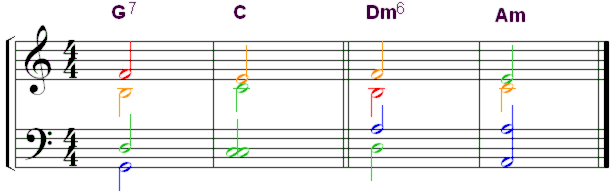
In this specific musical example, the version with the flattening (descending) progressionG7/Cis presented first, with all the fifths of the chords in the tenor voice, and the version with the sharpening (ascending) progressionDm6/Amis presented second, with all the roots of the chords in theFB.
The second example, in Diatonic Minor, is certainly the more fundamental and successful of the two. This did not seem so to us at the time, favoring the Diatonic Mode and starting with it, to eventually invert the result later. Once again, the1-0Orbit Line in theFBmakes this possible.
The Augmented Triad
The situation here,where discordance is avoided, is the opposite to that of the preceding example, where discordance was saught. The0-1Orbit Line in theFBwill be preferable, to avoid discordant conflict with the chromatic substitution in the1(3)-2Orbit Line, thus giving priority, for once, to the flattening, decending, seventh progressions.
The Diad
It is surprising that something as fundamental and usual as the DOMINANT/TONIC, G7/C cadence, should produce something as disappointing as an incomplete TONIC chord, which we called a "Diad" in Triad Harmony.
In the G7/C cadence, the0-1 FBis evidently, as usual, responsible for the problem. PossessingOrbit 0in the DOMINANT chord, it eliminates theOrbit 0-Orbit 0line (G-G), if the chord is to remain complete, and deprives the TONIC of itsOrbit 0(G). In the Dm6/Am cadence, the1-0 FBwill preserve the TONIC triad. PossessingOrbit 1in the DOMINANT chord, it maintains theOrbit 0-Orbit 0line (A-A), eliminating theOrbit 1-Orbit 1line (D-E) which is not essential, and the TONIC triad remains complete.