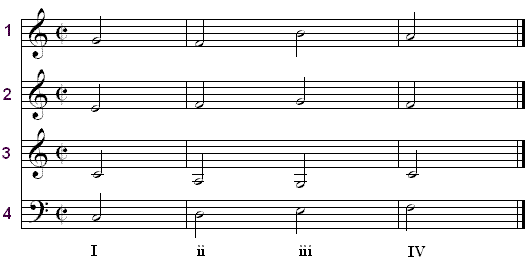
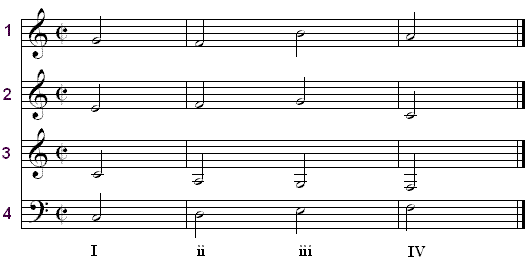
Doubling and Voice-leading Lines In this class, we will see theI-ii-iii-IVchord pattern, which also has three progressions by ascending second. Voice-leading and doubling will again depend on the nature of the triad - on a Real Triad, the Third has an obliged resolution, and the Root is doubled, on a deceptive triad, the root and fifth have obliged resolutions, caving in toward each other, and the third is doubled, There are here again two versions of theiii-IVcadencing progression, and they will be seen individually.
First version NOTE that VLL 1 and VLL 3 cross and should not be disposed in adjacent performance voices, but rather, in this case, in the soprano and tenor voices, which imposes the disposition of VLL 2 in the alto voice. NOTE that disposing VLL 3 in the soprano voice will produce a direct fifth.
Second version NOTE the different Voice-leading in theiii-IVcadencing progression, which affects VLL 2 and VLL 3. NOTE in VLL 2 that the GC as a downward fifth rather than an upward fourth removes all danger of a direct fifth.
Exercises
Exercise 1 With theI-ii-iii-IVchord pattern asaand theIV-I-V-Ichord pattern asc, and with line 4 in the bass voice (CDEF FCGC), any version of either pattern may be used. In the soprano voice, any VLL may be placed in the antecedent (a), and a VLL which ends on the note C will be placed in the consequent (c), for a strong cadence. With theaending onIVand thecstarting onIV, there is no problem of resolution between the two sections. In the alto and tenor voices, the remaining VLLs will be placed. Transposition may be required for vocal performance.
Exercise 2 With theI-ii-iii-IVchord pattern asaand theV-vi-vii-Ichord pattern asc, and with line 4 in the bass voice (CDEF GABC), any combination of the two preceding versions may be used. In the soprano voice, any VLL may be placed in the antecedent (a), and a VLL which ends on the note C will be placed in the consequent (c), for a strong cadence. HINT - choose the VLL for thecfirst, then the VLL for thea, which gives the correct Voice-leading for theIV-Vprogression. This exercise is tricky because theaand thectie in very tightly. In the alto and tenor voices, the remaining VLLs will be placed. HINT - start with SAT in close position with the tenor really far from the bass, and gradually the three higher voices will descend as the bass ascends, the four voices (SATB) ending in close position. Transposition to the key of G will be required for vocal performance.