The Structure and Functional Tuning of Diminished Sevenths
The enigma - Born, not made Diminished seventh chords have always been somewhat mysterious. They are evidently
tetrads, chromatic tetrads at that, in a world predominantly peopled by triads. It
is curious that the augmented triad is considered the chromatic version of a fundamental
major triad (usually I or V) but that the diminished seventh chord is considered a
separate entity, born chromatic, without any diatonic progenitor.
Traditional Definition They are traditionally defined as a superposition of 3 minor thirds. With equitempered
tuning, which we have been using so extensively for the last century and a half, the
remaining augmented second sounds exactly like the minor thirds, and the chord is
considered as a uniform mush without any inherent differences.
Common Usage This is the kind of usage usually proposed for diminished seventh chords, allowing
it to travel with impunity to any other chord, as if the listener had conveniently
forgotten where it came from.
Academic Directives 1. Each of the three fully diminished 7th chords may have 4 enharmonic spellings (C#o7 = A#o7 = Go7 = Eo7), and 4 possible roots.
2. The chord functions structurally as a leading tone with the root resolving up by 1/2 step. The possible resolution goals for C#o7 are then D, B, Ab and F.
3. All of the other 8 possible chromatic destinations are decorative (embellishing, linear, non-functional, etc.) as follows: A. Dim. 7th root contained in resolution chord (common-tone o7): goals of C#, Bb, G and E. B. Dim. 7th root resolves down by step, moving to C, A, Gb or Eb. The o7 chord is usually passing, often to another o7.
In other words, any of the 12 pitch-class roots may follow a diminished 7th, but only 4 are functional.
The solution 1. No enharmonic equivalence There seems to be no valid reason why enharmonic equivalence should be more acceptable in the case of diminished seventh chords than it would be anywhere else. The fact that this “uniform” sonority of minor thirds may seem, on the surface, to establish equivalence of meaning between the components of the chord is an insult to our capacities of perception and of memory. Our presentation will not include, or accept, any form of enharmonic equivalence and each enharmonic “spelling” will be considered individually.
2. All chords are functional The diminished seventh chord is always functional for the very simple reason that all chords are functional (including those considered “embellishing, linear, non-functional,
etc.”). This will enable us to maintain a clear vision (a) of the chord itself, where it is placed in the “Window”, and (b) of the nature and function of each component of the chord - the 2 Primary Notes, the0and the1(root and fifth), and - the 2 Secondary notes, the2(third) and the3(7th or 6th). How else can these chords be properly handled and resolved?
3.The diminished seventh look/sound No chord is “born” with a diminished-seventh look/sound, there being no such thing as a real bona-fide “diminished seventh chord”. Every diminished seventh chord is merely a look/sound, the result of a simple basic Tetrad being processed by a specific Transformation (usually chromaticism).
We will therefore start by looking at the 3 processes which produce this diminished-seventh
look/sound, always, of course, including the inversion for each process.
The 3 processes of producing the diminished seventh look/sound
1. Diminution
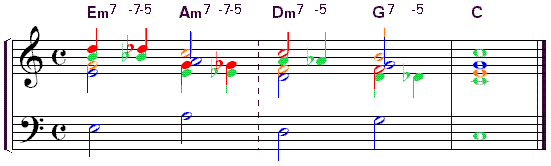
How does it work? The transformation of diminishing consists of chromatically altering two lines, the Orbit lines 3-2 and 1-1, moving in parallel thirds. This chromatic transformation always brings them closer to their resolutions.
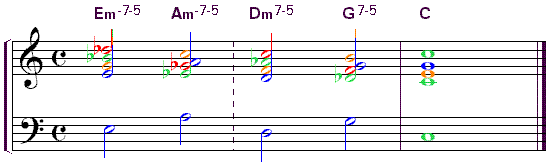
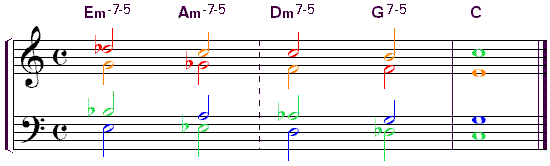
-In the Key of C major, in a half-circle with Voice-leading C, working down from the top of the Window, we have “diminished” - the ANTE-3 (Em7), - the ANTE-2 (Am7), - the ANTE-1 (Dm7), and - the DOMINANT (G7), which is followed by the TONIC (C). Only the ANTE-3 and ANTE-2, will have the fully diminished seventh look/sound. There is not enough room between C-B and F-E to chromaticize Orbit-3 on the other two chords. Notice that the diminished version of Em7 is called Em-7-5 , and that the diminished version of Am7 is called Am-7-5, so that we still know with what chord we are dealing and control its normal resolution and voice-leading.
-It is possible to have the diminished look/sound all by itself (only on the first
two) without the original, fundamental, diatonic version.
-It is also possible to eliminate the Fundamental Bass and get a real Broadway feeling.
The inversion with ascending (sharpening) 6th Tetrads Once again, we will chromatically alter the two same lines, the Orbit lines 3-2 and
1-1, moving in parallel thirds, bringing them closer to their resolutions, but this
time with sharps instead of flats.
-We now work up from the bottom of the Window, with - the COUNTER (Sub) DOMINANT (F6), and - the TONIC (C6), up to - the DOMINANT (G7). Both the COUNTER and the TONIC will have the diminished seventh look/sound, having enough room to chromaticizeOrbit 3on each chord (the notes D# and A#).
Notice that the diminished version of F6 is called F+6+1, not D#o7, and that the diminished version of C6 is called C+6+1, not A#o7, so that we still know with what chord we are dealing and expect its normal resolution and voice-leading.
Diminished look/sound all by itself
-This ascending, inverted version can also have the diminished look/sound all by itself, without the original diatonic version. The Fundamental Bass is often eliminated because because of the friction involved but it can very well be included.
2. Orbit 4
How does it work? If a chord has a strongMEDIAN, major if the progression is flattening (down) or minor if the progression is sharpening
(up), itsOrbit 0, when it procuresOrbit 3in Voice-leading A, can be chromaticized to bring it closer to its resolution. We
call this particular chromaticism "Orbit 4" because it has a very high degree of tension
and is clearly no longerOrbit 0. Since it resolves toOrbit 3, and resolution is always to the next lower degree of tension, it seems appropriate
to call it Orbit 4.
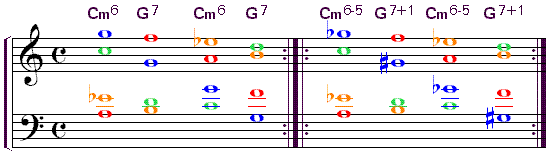
-In a TONIC-DOMINANT Swing with Voice-leading A, where the TONIC chord has been dominantized to Cm6, theOrbit 0of each chord, G, can be chromaticized to orbit 4, Gb and G#. We have here the diminished seventh look/sound on each chord: both 6th and 7th Tetrads.
Notice that the chord of Cm6 is indicated Cm6-5 (not Adim7) and that the chord of G7 is indicated G7+1 (not G#dim7 ).
Notice also that this process of Orbit 4 functions in a swing between the 2 same chords, and not in part of a circle as was the case for the process of Diminishing (1.).
Orbit 4 in clusters You will also find this process of Orbit 4 used for really violent clusters.
3. Non-chordal Tones
How do they work? To produce the diminished seventh look/sound, we must use the permanent chromatic
non-chordal tone ofOrbit 0on a dominant-shape chord, superior (above) if the chord is descending (7s-2) or inferior
(below) if the chord is ascending (m6p+4).
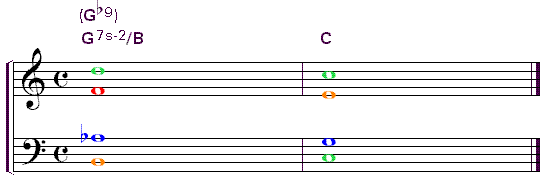
-This example is on the fundamental DOMINANT-TONIC progression in C. We have here a permanent superior chromatic non-chordal tone Ab ofOrbit 0G indicated G7s-2 (not Bdim7) and commonly called a minor 9th.
Here is our diminished seventh look/sound. As a matter of fact, this is probably the oldest use of this sound and the only one considered “functional” by most academic theoreticians.
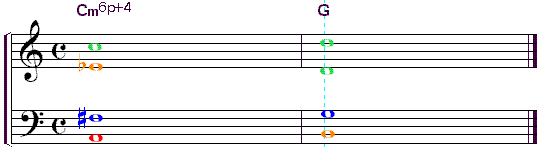
The inversion with an ascending (sharpening) m6th Tetrad
-We have here a permanent inferior chromatic non-chordal tone F# ofOrbit 0G indicated Cm6p+4 (not F#dim7) and often erroneously considered a D7-9.
The 6 possible sources of the same diminished seventh look/sound
Where can this look/sound come from? Knowing how each process works and what it produces, we can now place this question
in the form of equation solving within the framework of each of the 3 processes. Working
backward from the diminished seventh look/sound C#, E, G, Bb (abbreviated C#o7) should
not be too difficult. In each case, we will specify the functional tuning in Just
Intonation while we are a it.
1. From Diminution
Solving for X We know that the process of diminution transforms a m7 tetrad into a m-7-5 diminished seventh look/sound, and a 6 tetrad into a +6+1 diminished seventh look/sound. Solving for X in the equations Xm-7-5 = C#o7, we find X = C#, since C#m-7-5 =C#,E+,G+,Bb++(with the small minor third in the center). X+6+1 = C#o7, we find X = Eb, since Eb+6+1 =C#--,E-,G-,Bb(2 commas lower than the C#m-7-5).
Note the colors ofOrbit 0,Orbit 1,Orbit 2(3rd),Orbit 3(7th or 6th) Also note -Trunk Tuning(no indication),Short Branch Tuning(+/-),Long Branch Tuning(++/--)
With the process of Diminution, the C#o7 look/sound came from C#m7 and Eb6.
2. From Orbit 4
Solving for X We know that the process of Orbit 4 transforms a 7 tetrad (dominant 7th) into a 7+1 diminished seventh look/sound, and a m6 tetrad (minor 6th) into a m6-5 diminished seventh look/sound. Solving for X in the equations X7+1 = C#o7 we find X = C, since C7+1 =C#-,E-,G,Bb, (with the large minor third in the center). Xm6-5 = C#o7 we find X = E, since Em6-5 =C#,E,G+,Bb++, (1 comma higher than the C7+1).
With the process of Orbit 4, the C#o7 look/sound came from C7 and Em6.
3. From Non-chordal tones
Solving for X The process of permanent chromatic non-chordal tones ofOrbit 0transforms a 7 tetrad (dominant 7th) into a 7s-2 diminished seventh look/sound, and a m6 tetrad (minor 6th) into a m6p+4 diminished seventh look/sound. Solving for X in the equations X7s-2 = C#o7 we find X = A, since A7s-2 =C#-,E,G,Bb+, (with the small minor third in the center). Xm6p+4 = C#o7 we find X = G, since Gm6p+4 = C#-, E, G, Bb+, (the same tunig as A7s-2).
With the process of Non-chordal ones, the C#o7 look/sound came from A7 and Gm6.
In order of Chrominicism If we place these 6 sources in order of Chrominicism (in the series of fifths) we
have
Eb6 - C7 - Gm6 - A7 - Em6 - C#m7
which became
Eb+6+1 - C7+1 - Gm6p+4 - A7s-2 - Em6-5 - C#m-7-5
with the 2 sources subjected to the process of Diminution at the extremities, the 2 sources subjected to the process of Non-chordal Tones in the center, and the 2 sources subjected to the process of Orbit 4 in second and fifth place.
What about traveling? Actually the Diminished Seventh look/sound does not really help us to travel. That is the job of the metamorphoses.
Between the adjacent chords of our list of sources, we note the following metamorphoses: - between Eb6 and C7, we have a metamorphosis 4 - between C7 and Gm6, we have a metamorphosis 2 - between Gm6 and A7, we have a metamorphosis 3 - between A7 and Em6, we have a metamorphosis 2 - between Em6 and C#m7, we have a metamorphosis 4.
The farther we travel in this series, the less successful will be the resolution of the “diminished seventh chord”.
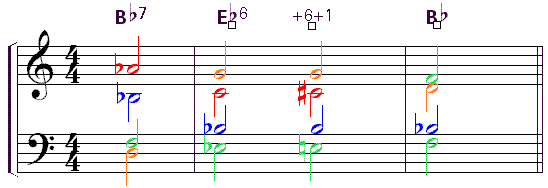
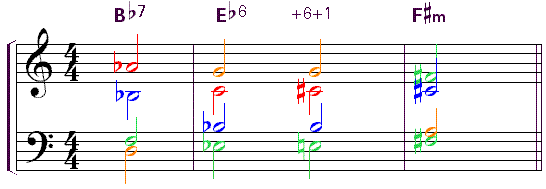
-We have here - Eb6 preceded by its DOMINANT Bb7, - followed by its “diminution” (+6+1), and - the return to Bb. No metamorphosis, no traveling, no surprises.
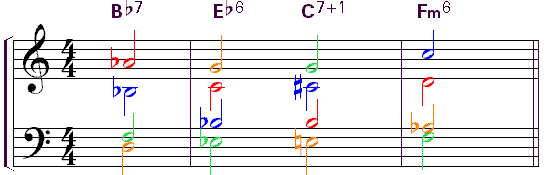
-We have here - Eb6 preceded by its DOMINANT Bb7, - followed by an open metamorphosis 4, dominantized and orbit 4 (C7+1), and - its resolution to Fm6. (which could be followed by G7 and Cm). The traveling is the result of metamorphosis 4, the “diminished seventh chord” was not even necessary, one could have passed
over it. The result was quite satisfactory.
-We will now go to the very end of our list of sources to see what result we have. Once again - Eb6 preceded by its DOMINANT Bb7, - there is no metamorphosis possible over such a distance, - we merely present the “diminished seventh chord” as it was originally, and - resolve it to F#m as if it were C#m7. If, according to academic theory, “diminished seventh chords” can travel anywhere, this should sound as well as the preceding examples. We leave each to his own evaluaton concerning the musical validity of this progression.