Rhythm Scales are usually performed in 1-, 2-, 3-, or 4-octave spans of 7 notes each, a particularly awkward and unmusical grouping, especially for beginners. It seemed advantageous to add : 1 note for 8-note grouping (1 octave + 1 tone) in Short Promenades ; 2 notes for 9-note grouping (1 octave + 2 tones) in Medium Promenades ; 2 notes for 16-note grouping (2 octaves + 2 tones) in Long Promenades ; 3 notes for 24-note grouping (3 octaves + 3 tones) in Extra Long Promenades.
Harmony Nor does the usual rhythmic grouping of scales imply any harmonic movement, only stagnation on the TONIC chord. The addition of a note or two will automatically imply harmonic movement, which can be included in the scale exercises, making them far more interesting and musically valid.
An introduction to scales and chords (triads) 1. The scales are first passed from one hand to the other, and back. 2. Then chords are added in the part of the free hand. 3. Finally, the scales are played in octaves with both hands, and the harmony written for another performer (as a duet).
Short Promenades
Rhythm With an 8-note grouping, these short promenades are completely binary, the simplest for beginners.
Harmony However, they are not the simplest as far as the harmonies, or the fingerings, are
concerned, being symmetrical only when they are chromatic, but not symmetrical when they are
diatonic. It might be preferable to start with the medium promenades, even if they are slightly more complex rhythmically.
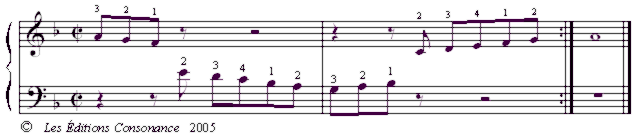
Short Promenade 1a
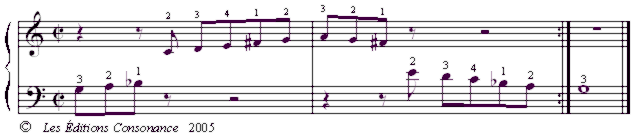
We are here in the Keys of G minor and D major, twochromatic modes, whose TONIC chords act as DOMINANT to the other mode, in D major on the way up and in G minor on the way down. The keys were chosen for their symmetry around middle D, and the accidentals, Bb and C#, are written in the text, rather than in a key signature. Instead of having a scale composed of ditone and tritone, as is the case in diatonic
scales, this chromatic mode scale (with only 2 semi-tones) is composed of a whole-tone (G-A) and a tetratone (Bb-C-D-E-F#).
The thumb (finger 1) is placed on the extremities of the tetratone, the notes Bb and F# (in row b). The first 2 notes (G and A) are in row e, notes 4, 5, 6 (C, D, E), in row d, note
8 back in row e.
Vocentro Staff The first noteRicorresponds to G.
Short Promenade 2a
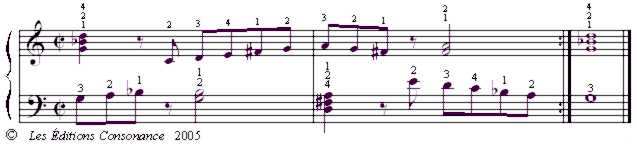
This is where chords are added in the part of the idle hand. The triad chord in the right hand, at the beginning, should only be played on
repeats, when it is preceded by the diad chord.
The diad chords are fingered b1,e2 and the triad chords a1,d2,d4 imposing a change of row for fingers 1 and 2, The scales are fingered as they were in Short Promenade 1a.
Short Promenade 3a
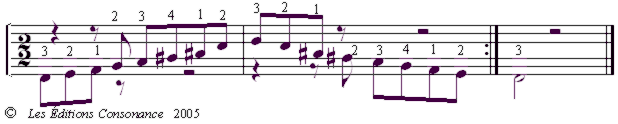
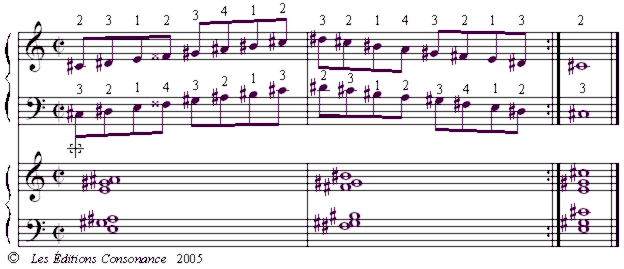
We are here in the Keys of C# minor and G# major, chosen for their symmetry around middle D. This is where both hands play the scale in octaves, with another player playing the chords as an accompaniment.
In the scales, the thumb (1) has passed under finger 4 in Short Promenades 1a and
2a, but here fingers 3 and 4 will pass over the thumb. The triad chords in the accompaniment can be played by either hand or by both hands. The choice of fingerings are numerous and enjoyable. 1. All the notes involved are in the same row (b, d, f). 2. The thumb (1) may or may not participate. How about 123 for one chord and 124 (134) for the other (on b and d)? or 234 (245) for one chord and 235 for the other (on b or d)? 134 for one chord and 235 for the other keeps the same finger (3) on theCOMMON TONE(the note G#).
Short Promenade 1b
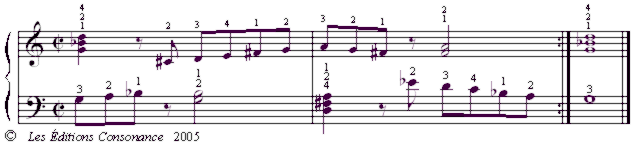
This is very much the same as Short Promenade 1a, in the adjacent Chromatic Modes of Gm and D, but with chromaticNon-chordal Tones, thep+4(C#) on the way up, and thes-2(Eb) on the way down. This chromatic scale has 3 semi-tones, the third semi-tone imposing the presence of an augmented tone, Bb-C# on the way up, and F#-Eb on the way down.
These chromatic Non-chordal Tones (C# and Eb) complicate the fingering a little, forcing finger 2 to play them farther (higher, in row e), to which it will
later return. The augmented tone is conveniently placed between the 2 hands. Thinking about it is more difficult than actually playing it.
Short Promenade 2b
This is where we see that these short promenades are musically more complex than the Medium Promenades, and should possibly be played later.
No real fingering problems here. The scale is the same as in Short Promenade 1b, and the chords are the same as in Short Promenade 2a.
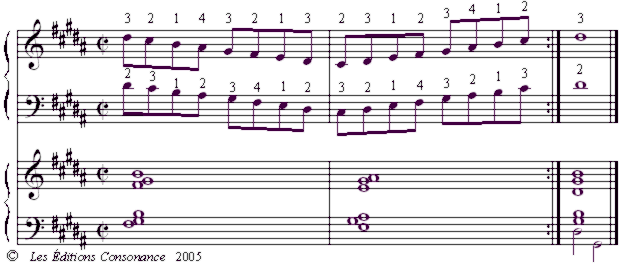
Short Promenade 3b
This is a combination of the scale of Short Promenades 1b and 2b, in both hands, and the chords of Short Promenade 3a. Once again in the Keys of C# minor and G# major (as was 3a).
There is, however, an added fingering difficulty for the augmented tone in the scale, that of passing finger 4, in row c, over the thumb (1), on the way up in the left hand (E-Fx), and on the way down in the right
hand (B#-A), while the other hand has finger 2 in row e. Fingering the chords has been seen in Short Promenade 3a.
Short Promenade 1c
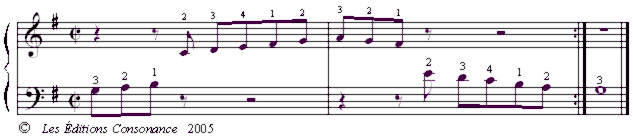
This Short Promenade is on a Swing in the Diatonic Major Mode, with the TONIC chord on the way up, and the DOMINANT chord on the way down. There is no perfect symmetry here. The arbitrary key of G major was chosen to have middle D asCOMMON TONEof the swing.
The scale passes from the left to the right hand and back as in Short Promenades 1a and 1b, with the same fingerings, but on different rows : left hand - GAB with c32a1, right hand - CDEF# with d234b1, GAGF# with e232b1, left hand - EDCB with d234a1, AG with c23.
Short Promenade 2c
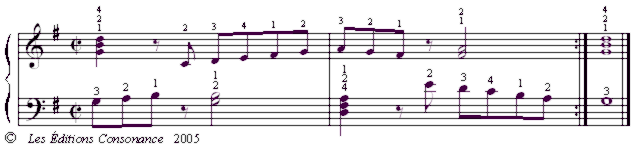
The same scale as in Promenade 1c but with added chords.
The chords are fingered using the thumb (1) in both of them, left hand - a1c2, a1d24 right hand - b1e2, c1e2d4, but other, perfectly good, fingerings are also possible.
Short Promenade 3c
Like Short Promenade 2c, this is a combination of Short Promenade 1c and Short Promenade 3a. The arbitrary key of C# major was chosen to have the note G# asCOMMON TONEof the swing, with the G# octave symmetrically disposed around middle D.
The chords can be fingered in several ways,as in 3a and 3b, but the E# is now in rows a, c, e, and G#, A#, F#, B#, in rows b, d, f.
Short Promenade 1d
This Short Promenade is on a Swing in the Diatonic Minor Mode, with the TONIC chord on the way down, and the DOMINANT chord on the way up. There is no perfect symmetry here. The arbitrary key of D minor was chosen to have the middle D asCOMMON TONEof the swing.
The scale passes from the right to the left hand and back the only Promenade in this direction. right hand - AGF with c32a1, left hand - EDCBb with d234b1, AGABb with e232b1, right hand - CDEF with d234a1, GA with c23. It is perfectly symmetrical to Short Promenade 1c.
Short Promenade 2d
The same scale as in Promenade 1d but with added chords.
The chords are fingered using the thumb (1) in both of them, right hand - a1c2, a1d24 left hand - b1e2, c1e2d4, but other, perfectly good, fingerings are also possible.
Short Promenade 3d
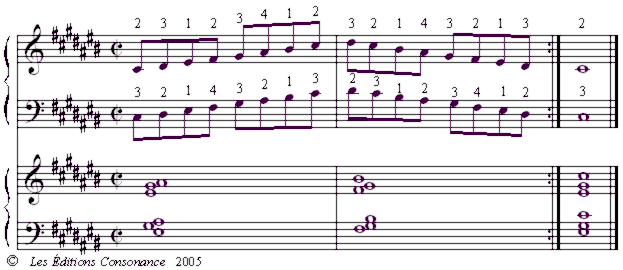
Both hands play the scale, first descending, then ascending, with the chords in a second part. The arbitrary key of G# minor was chosen to have the note G# asCOMMON TONEof the swing, with the G# octave symmetrically disposed around middle D.
Here again, the chord fingering possibilities are numerous, the B is in rows a, c, e, and F#, G#, A#, E, in rows b, d, f.