Rhythm These long promenades have a 16-note grouping, with four binary levels (in 2/2), cover a span of 2 octaves and 2 tones, and are quite accessible to beginners, possibly before the short promenades.
Harmony They are a little more complex than the medium promenades, as far as the harmonies, and the fingerings, are concerned, with room for more chords. Instead of immediately playing the DOMINANT of the relative mode, they pass through both the ANTE-1 and the DOMINANT.
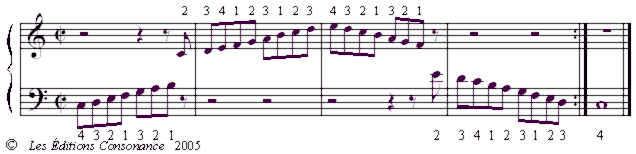
Long Promenade 1
As usual, we start with both hands alternating, first ascending, then descending, this time in the key of C (on account of the extended range), to be centered around middle D.
The fingerings are quite similar to those of the medium promenades - LH - 4321 321, RH - 2341 231, 234321, LH - 2341 231, 23(4), with the thumbs (1) always in row a, and 3 fingers in row d, 2 fingers in row e, all the way, in each hand.
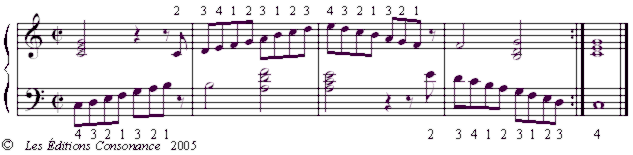
Long Promenade 2
After the first TONIC chord in the right hand (only played on the repeat), we have, in the left hand, the chord of G (only the note B), the chord of Dm (complete in second inversion), the chord of Am (complete in root position), and in the right hand, the chord of Dm (only the note F), the chord of G (complete in first inversion), the chord of C (complete in root position).
The scale fingerings are the same as in the preceding promenade. The chord fingerings are the same in both hands - the ANTE-1 chord, (only B or F) with c4, the DOMINANT chord, with a1d2c5, the TONIC chord, with b1d2c4.
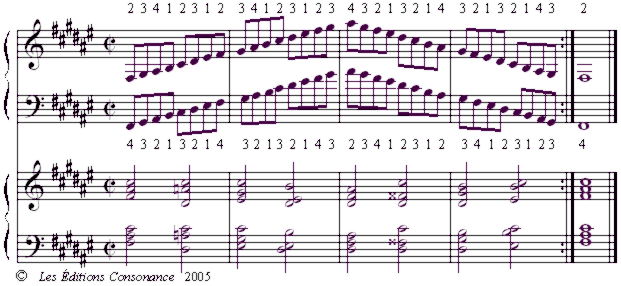
Long Promenade 3
Now the scale is played in octaves by one player, while the chords are played by another.
Scale fingerings : thumbs (1) always at the same time, in row a, on B and E#, fingers of both hands in row d (for 3 fingers), in row c (for 2 fingers),
all the way through. Chord fingerings : RH - b1d3c5, a1c3c5 / a1d2c5, a1c2c5 / a1d2d4, a1c2c5 / a1d2c4, a1c4c5 (b1d3c5) LH - a1d2c4, a1c2c5 / a1d2c4, a1c4c5 / b1d3c5, a1c3c5 / a1d2c5, a1c2c5 (a1d2d4).