Before attacking specific examples, let us briefly recap the principal forms of Functional
Tuning in Just Intonation, with the habitual color of our chord components. (seeHarmony Basic Materialsand theUSE OF COLOR)
Trunk Tuning Trunk Tuning(Pythagorean), using uniquely the interval of the perfect fifth, generates the two notes of theFRAMEof each chord, commonly called the root and the fifth, which we call theCOMMON TONEand thePROPER TONE depending on the role which they play in the chord progression. As its name implies, theCOMMON TONEis common to both chords, and thePROPER TONEis specific to each chord. These two notes are also called the Primary Notes of the chord. The two other notes of each complete Tetrad (4-note chord), the third, which we call theMEDIAN, placed in the middle of theFRAME, and the seventh or sixth, which we call theMOTRIX, the source of movement, placed outside theFRAME, borrow their notes from these generated Primary Notes. TheMEDIANand theMOTRIXare also called the Secondary Notes.
Trunk Tuningis proper to Melody which seems to prefer it, if not use it exclusively.
Short Branch Tuning Short Branch Tuning(natural) preserves theTrunk Tuningof itsFRAMEs (theCOMMON TONEand thePROPER TONE) but generates theMEDIANof the chord with a new interval, the major third. The Branch major third being slightly smaller than the Trunk major third, majorMEDIANs, being flatter, will be indicated "-" and minorMEDIANs, being sharper, will be indicated "+" always, of course, usingTrunk Tuningas a point of reference. MostMOTRIXs (sevenths and sixths) remain borrowed fromTrunk Tuning.
Long Branch Tuning InLong Branch Tuning, the major third is used twice, thus generating the augmented fifth. Long Branch Tuningwill be indicated "--" or "++" because it is even farther away fromTrunk Tuning.
For further details, see the DIAGRAMS ofTrunk Tuning,Short Branch Tuning, andLong Branch Tuning.
1. With the TONIC-DOMINANT Swing
NB - the notes will be colored according to their tuning and not their chordal function. ThePROPER TONEwill be colored asTrunk Tuning, and theMOTRIXwill also be colored asTrunk Tuning.
In the TONIC-DOMINANT Swing (in C major) we will have the following tuning. On the TONIC chord (C6) - TheCOMMON TONE= G ThePROPER TONE= C TheMEDIAN= E- (generated from the C) TheMOTRIX=A (borrowed from theFRAMED-A) and not A- (from theFRAMEF-C) as might be surmised from the Zarlino scale.
On the DOMINANT chord (G7) - TheCOMMON TONE= G (by definition, the same note) ThePROPER TONE= D (by definition, a different note) TheMEDIAN= B- (generated from the G) TheMOTRIX= F (borrowed from the FRAME F-C)
Fifths Out Of Tune Notice that - between the notes of theFRAME(primary notes) we have a perfect fifth which is in tune; but between theMEDIANandMOTRIX(secondary notes) we have, on the TONICchord (C6), a perfect fifth which is not in tune (too small, A to E-)
and on the DOMINANTchord (G7), a diminished fifth which is not in tune (too large, B-
to F).
On the DOMINANT chord (G7), this "out-of-tuneness" is not evident because theShort Branch Tuning(natural) diminished fifth is not as complex as theTrunk Tuning(Pythagorean) diminished fifth. But in the case of the TONIC chord (C6) the "out-of-tuneness" is much more evident and can be illustrated on certain instruments.
The non-fretted string instruments (violin, viola, cello, bass) are the most useful for this purpose of Just Intonation demonstration. The change of finger position on the strings can be easily seen and felt by the performer as these subtle changes of pitch take place.
Let's try something - -On the violin, with open strings carefully tuned in Trunk Tuning (perfect fifths), play the chord (G, E-, C) You will automatically tune theMEDIANE-, probably without even noticing. Now, add the open E (tuned E and not E-) and listen to the difference! A similar demonstration can be made by trying to play the chord (C, G, A, E-) in tune
- No matter what you do with the C and the G, the only 2 notes that can be controlled, the result will never sound well because the open string is incapable of playing the E- required by theMEDIAN.
The same kind of demonstration can be made for minor chords. -The very last chord of a piece called "L'abeille" by François Schubert (not to be confused with the better-known Franz) has the TONIC E minor chord disposed - No matter how you place the poor first finger which must play the E and B, the chord never sounds in tune! And for good reason -The two open strings are incompatible! The open G will always sound G and not G+ as the minorMEDIANshould. Alternate solutions for this chord could easily be found - which can be played in tune.
One could even establish as a general rule - Beware of MEDIANS on open strings! More will be said of this later.
2. With the three major chords, TONIC, DOMINANT, and COUNTER
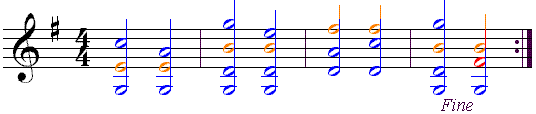
-Something a little more elaborate: 8 chords in the key of G The last chord is used only when one repeats the passage. Don't forget to play the F#-- a coma lower than the F#- (tuned with the open D).
Notice that - Short Branch Tuning(MEDIANs) andLong Branch Tuning(major sevenths) are never on open strings. On the fourth chord, we have 3 open strings and that, in this case, the open G and E are not incompatible the way they were on the E minor chord we saw previously.
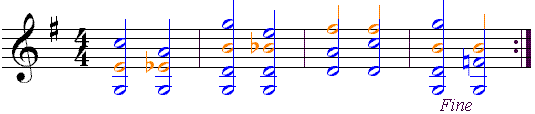
-Let's repeat these chords with a little chromaticism (dominantization) - An amazing thing happens here - The lower (by a semi-tone), chromatic Eb+ seems to have been foreseen by the lower (by a coma), diatonic E-, and the lower (by a semi-tone), chromatic Bb+ seems to have been foreseen by the lower (by a coma), diatonic B-. NOTE that on the very last (repeat) chord, theMOTRIX, F, is now inTrunk Tuning.
3. With the Half-circle (Em7, Am7, Dm7, G7, C)
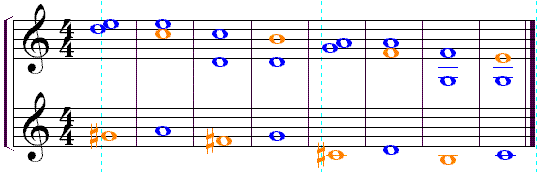
-You might wish to play the following double-stops several times each to hear them
well -
Notice that -The second finger will be displaced twice - from the C+ to the C and from the F+ to the F, (fromMEDIANtoMOTRIX- see Voice-Leading C) an excellent opportunity to see and feel the size of a coma.
To hear the harmony better, some one else could play the second line - but, please,not on a piano.
NOTE that the odd-numbered chords have beenDominantized.
4. More Elaborate Chromaticism
(To come)
5. Non-Chordal Tones
(To come)
6. Examples From The Repertoire
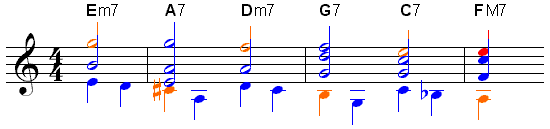
BACH, Fugue in C major, Bars 57-60, from the Sonata III for unaccompanied violin -On the Em7 chord (III - ANTE-3), the minorMEDIANis G+, theMOTRIX, D, is inTrunk Tuning, perfectly suited to the open string. On the A7 chord (VI - ANTE-2), the majorMEDIANis C#-, theMOTRIX, G, is inTrunk Tuning, lower than the preceding G+, theFRAMEnote A (inTrunk Tuning) is perfectly suited to the open string . On the Dm7 chord (II - ANTE-1), the minorMEDIANis F+, theMOTRIX, C, is inLong Branch Tuning, theFRAMEnotes, D and A (inTrunk Tuning), are perfectly suited to the open strings. On the G7 chord (V - DOMINANT), the majorMEDIANis B-, theMOTRIX, F, is inTrunk Tuning, lower than the preceding F+, theFRAMEnote G (inTrunk Tuning) is perfectly suited to the open string . On the C7 chord (I - TONIC), the majorMEDIANis E-, unsuited to the open string, as we well know. The only "solution" to this is to tune the other members of the chord a
coma higher. (C+, G+ and Bb+ rather than C, G and Bb) On the F+7 chord (IV - COUNTER-DOMINANT), theMOTRIXis E--, lower still, which means that theFRAMEnotes, F and C should be tuned two comas higher (F++ and C++) and theMEDIAN, A-, should be tuned A+.
Certainly not an easy task for the violinist who still has to figure out where (and
how) to bring the pitch back down for the coming open strings.
7. The Max Planck Enigma
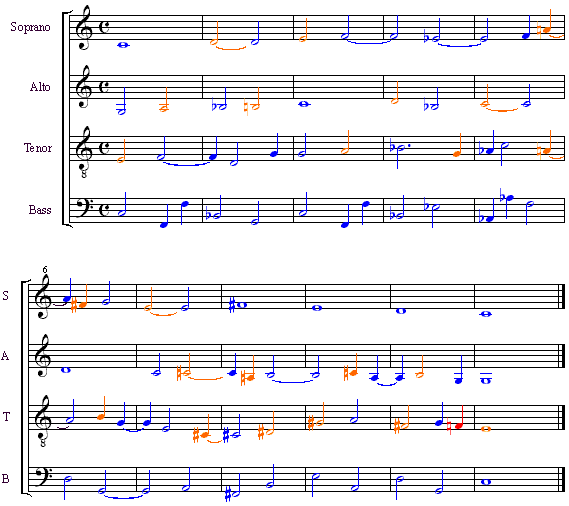
The following text accompanies the musical example. Composed in 1893 by Max Planck, physicist and Nobel Prize winner in 1918 (Quantum
and Energy Theory). This composition proves, when sung a capella, that the singers
will finish more than half a tone lower. This is due to the fact that the singers
use the pure diatonic scale, the thirds sung 1/64th lower than the tempered scale.
-This "composition" is composed exclusively of major triads (1/2 note each). In general, there is a Metamorphosis 1 on each triad (10 times), producing sections of a descending circle. However, in 5 places (Bar 2, Bar 5, Bar 5 to Bar 6, Bar 7, Bar 7 to Bar 8), there is an open Metamorphosis 4, where theMEDIAN(of the first "chord") which becomes thePROPER TONE(of the second "chord") is sustained in the same voice (with a tie or a whole note), giving the deceptive impression of a common tone.
Now, theMEDIANis inShort Branch Tuning(-), and thePROPER TONEis inTrunk Tuning, which means a good signer would raise the note a coma while signing it, and not
remain at the same pitch as Planck surmises. This would, of course, prevent the pitch
from descending.
If the pitch were kept the same on these presumed "common tones", it would drop a coma at each Metamorphosis 4, eventually 5 comas (a little over a
semi-tone).
Click here to hear the Planck version of Just Intonation for his Enigma (ending a semi-tone lower).
Click here to hear the Functional Tuning version of Just Intonation for Planck’s Enigma (ending at the same pitch)
Since Planck proposed this Enigma to show the necessity of using equi-tempered tuning to perform this kind of music, we thought you might also enjoy hearing it in this version.
It is difficult to foresee how effective the a capella performance of this composition
would be: It is not well written and would hardly get a passing grade in Harmony 101,
and Planck’s suggestion of performing it Molto Lento and pp, hardly helps to keep
it up to pitch.
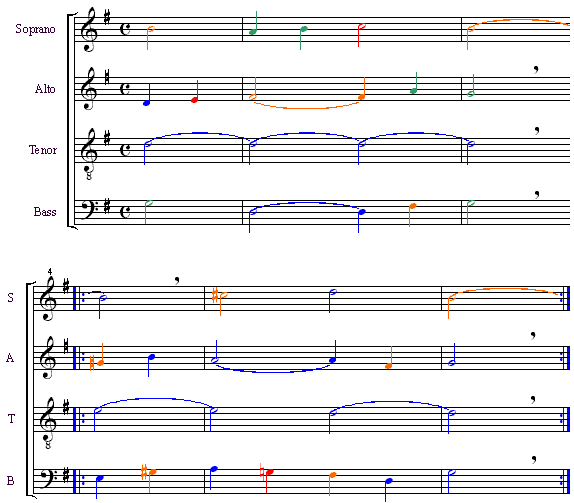
However the same result could be achieved by far simpler and more musical means.In the following example, after the intro of the first line, which serves to establish
the key of G major, we have the same conditions: only major triads; one Metamorphosis 4 (between the end of the first line and the beginning
of the second) with the pertinent pseudo-common-tone in the Soprano, and two Metamorphoses 1 (during the complete bar of the second line), which bring us back to the TONIC chord.
-All we must do is sing the repeated section 5 times and, according to Planck, the pitch should drop by at least a semi-tone. We have on numerous occasions sung the repeated section 20 times, without any appreciable drop in pitch. Singing this Moderato (possibly in 2/2, cut time) and mf, would certainly be more comfortable.
NB - At the beginning of the second line, if the Sopranos hold their B long enough
(not too long a breath), they will actually feel the note "rise" a coma from the previous
B-. They have really very little choice. The three other voices are pushing them up.
You may wish to hear the Functional Tuning versionfor this example but we stronly suggest that you sing it and really get the feel of the “comma rise”.