The traditional 3-part fugue presents the Subject only 3 times in the opening Exposition.
What will be our position if we wish to respect both the Rhythmical and Harmonic structures
which underlie these fugues ? We have, so far, looked at several options which we
will outline here. We could make the ablation in the original quaternary exposition,
thus producing a ternary exposition, or we could maintain the original quaternary
exposition but reduce its "girth" (to three parts) without altering its length.
New Voices Whatever option we might choose, the performance Choral Voices must be redefined and
renamed - what we will call the "SA Voice" will combine both Soprano and Alto range, what we will call the "AT Voice" will combine both Alto and Tenor range, and what we will call the "TB Voice" will combine both Tenor and Bass range.
In most cases, it will be preferable to write the 4 Fugue-lines first, placing them in the 4 performance Choral voices (Soprano, Alto, Tenor, Bass), and then transform it into a 3-part fugue, with the 3 performance Choral voices (SA, AT, TB).
Expositions
The original In the 4-part fugue, the opening AAAA Exposition had this Form, completely square with - 4 sections in length (of 1 or 2 cells each), and 4 lines in "girth".
Line 1
Line 1
S1
S1
CS2
CS2
X
X
X
X
Line 2
Line 2
--
--
S2
S2
CS1
CS1
X
X
Line 3
Line 3
--
--
--
--
S1
S1
CS2
CS2
Line 4
Line 4
--
--
--
--
--
--
S2
S2
Note thatthe four entries use S1, S2, S1, S2, and thatthere are 2 "X"s in Line 1, 1 "X" in Line 2.
Option 1 If we perform therhythmic ablationand present the Subject only3 timesin the opening Exposition, by the ablation of the first quarter inpick-up grouping removing the first column (in time) and Fugue-line 1 (in parts), we will still have a square Form, with - 3 sections in length (AAA), and 3 lines in "girth".
Line 2
Line 2
S2
S2
CS1
CS1
X
X
Line 3
Line 3
--
--
S1
S1
CS2
CS2
Line 4
Line 4
--
--
--
--
S2
S2
Note thatwe have kept Lines 2, 3, and 4, thatthe three entries use S2, S1, S2, and thatthere is only 1 "X", in Line 2.
Option 2 If we donotperform the rhythmic ablation and still present the Subject4 timesin the opening Exposition, we no longer have a square Form, rather rectangular, with - 4 sections in length (AAAA), but only 3 lines in "girth".
Line 1.4
Line 1.4
S1
S1
CS2
CS2
X
X
S2
S2
Line 2
Line 2
--
--
S2
S2
CS1
CS1
X
X
Line 3
Line 3
--
--
--
--
S1
S1
CS2
CS2
Note thatwe have condensed Lines 1 and 4 into Line 1.4 (1 at the beginning, 4 at the end), keeping Lines 2 and 3, thatthe 4 entries still use S1, S2, S1, S2, and thatthere is 1 "X", in Line 1.4, before the S2, as well as another in Line 2, at the end.
Option 3 If we donotperform the rhythmic ablation and present the Subject only3 timesin the opening Exposition, we still have a rectangular Form, with - 4 sections in length (AABA), but only 3 lines in "girth".
Line 1
Line 1
S1
S1
CS2
CS2
B
B
X
X
Line 2.3
Line 2.3
--
--
S2
S2
B
B
CS2
CS2
Line 4
Line 4
--
--
--
--
--
--
S2
S2
Note thatwe have replaced the third A by a B Divertimento, giving the opening Exposition an AABA Form, thatwe have condensed Lines 2 and 3 into Line 2.3 (2 at the beginning, 3 at the end), keeping Lines 1 and 4, thatthe 3 entries use S1, S2, S2, and thatthere is only 1 "X", in Line 1, at the end.
This is quite similar to the classical first Exposition, with the exception of the
third entry where we have S2 instead of the traditionnal S1. It will not be easy to
decide what role the Divertimenti will play in the subsequent Expositions. Should
they be disposed BBAA (the way they were in the 4-part Fugue), or BBBA to maintain
the B in the third place (as it was in the opening AABA Exposition) ? More on this
a little later ...
Divertimenti
The divertimenti were previously all BB, the antecedent of a BBAA combination. If we make theRhythmic ablation, each Divertimento will become B, half the original size, the antecedent of a BAA combination. If we donotmake the Rhythmic ablation, each Divertimento may remain BB, the antecedent of a BBAA combination, or each Divertimento may become BBB, the antecedent of a BBBA combination.
Let's examine each option more closely.
Option 1
With the Rhythmic ablationreducing the Quaternary structure to a Ternary structure, we end up with a first Exposition of AAA and subsequent sections of BAA
- The AAA (S2, S1, S2) could work with certain Chord Patterns, especially those that start and end on the TONIC and could be considered in the TONIC throughout, with a TONIC, DOMINANT, TONIC structure for the S2, S1, S2. However, the Divertimenti, cut down to half size, do not have much chance of producing the variety which a fugue so sorely
needs, the Expositions being all quite similar. At least for the present, we do not really see what could be accomplished with this
option - Maybe later ...
Option 2
Without the Rhythmic ablation, the Quaternary structure is maintained, and we end up with a first Exposition of AAAA, with the same ternary Voice presenting the first S1 and the last S2
(Line 1.4), and subsequent sections of BBAA, as in the quaternary structure. The AAAA (S1, S2, S1, S2) works as well as before, on condition that we avoid entry dispositions in which- the original Lines 1 and 4 are in the extreme Choral voices (Soprano
and Bass) where the same ternary Voice (SA or TB) cannot handle both the first S1 and the last S2. Occasionally, when Line 1 is in the Bass Voice and Line 4 in the Tenor Voice, the Bass voice, unwilling to sacrifice theFBat the end, cannot incorporate Line 4 of the Tenor Voice. This does not mean the disposition does not work, as we will later see. The Divertimenti operate as well as before, but would evidently be impossible in 4-parts. The CS1 in the AA at the end obviously belongs to Line 2, as was the case for theDisposition 1 in F in Class 1. Any 4-part fugue could be transformed into a 3-part fugue, if it respects these 2
restrictions, including the simple fugues of the very first classes. Certainly the most convenient option, with which the beginner could start.
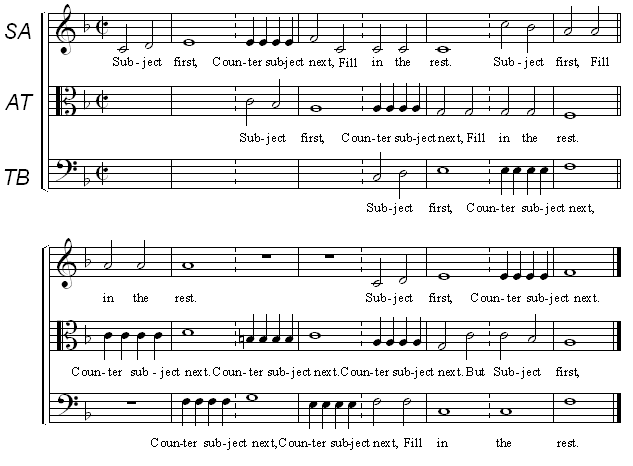
3-part fugue in F - Version 1 with a Counter-subject canon
Here is the Option 2 version of theoriginal4-part fugue In the first system (bars 1-8) - the SA Voice uses the Alto for bars 1-6 and the Soprano for bars 7-8, Fugue-lines 1 and 4 condensed into 1 Voice, the AT Voice uses the Tenor for the whole line, Fugue-line 2, the TB Voice uses the Bass for the whole line, Fugue-line 3. In the second system (bars 9-16), we have aFundamentalBass problem - the TB Voice uses the Bass for the whole line, because it cannot abandon theFB to take the Tenor S2 and condense Fugue-lines 1 and 4 into the
TB Voice, the AT Voice must use the Tenor S2 at the end, because the S2 would not cadence properly in the SA Voice, the SA Voice uses the Alto for the whole line, Fugue-line 3, and Bars 9-14 of the Soprano, Fugue-line 2, must be placed, an octave lower, in the AT Voice. a little tricky, but not impossible. We end up by condensing Fugues-lines 2 and 4 in the AT Voice.
Option 3
Without the Rhythmic ablation, the Quaternary structure is maintained, and we end up with a first Exposition of AABA, and subsequent sections of either BBAA or BBBA, as was previously exposed.
- The AABA (S1, S2, S2) could work quite well, especially with harmonies that would respect - the TONIC / DOMINANT, DOMINANT /TONIC of the AA (S1, S2), the beginning of the half-circle, ANTE-2 (probably dominantized) /
ANTE-1 for the B, as well as the DOMINANT /TONIC for the last A (S2), the Chord PatternM34 7s4. on condition that we avoid entry dispositions in which- the original Lines 2 and 3 are in the extreme Choral voices (Soprano
and Bass) where the same ternary Voice (SA or TB) cannot handle both the
first S2 and the last CS2. The Divertimenti could operate very well with the original quaternary BBAA combination, but it would certainly be very tempting to use the BBBA conbination, which would not only perpetuate the presence of a B in the third place, but also give us all this additional Divertimento space to create diversity. An excellent Chord Pattern would be the complete circle. Here again, Divertimenti would evidently be impossible in 4-parts. An extremely attractive option, with a classical opening AABA and the productive BBBAs
which follow.
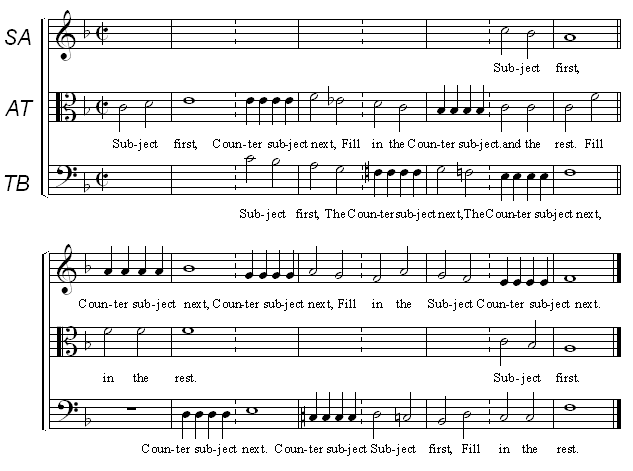
3-part fugue in F - Version 1 with a Counter-subject canon
Here is the Option 3 version of theoriginal4-part fugue
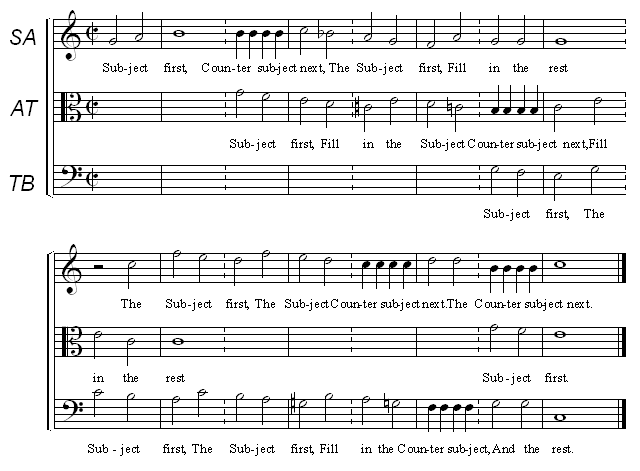
3-part fugue in C - Version 2 with a Subject canon
Here is the Option 3 version of theoriginal4-part fugue