|
Disposition of the 4 Strong Modes
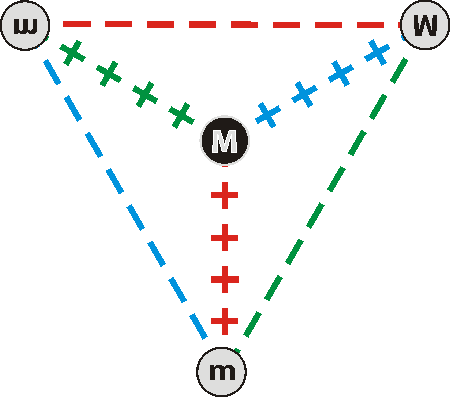
The best disposition seems that of the Platonic regular tetrahedron,
an equilateral triangular-based pyramid, seen from above,
with the Flattening Diatonic Major (+++, indicatedM) centrally placed at the apex,
and with the three other modes (+--), placed at the base around it,
the Sharpening Diatonic Minor (indicatedw) top-left,
the Sharpening Chromatic Major (indicatedW) top-right,
the Flattening Chromatic Minor (indicatedm) below.
Disposition of the Parameters
TheWindow Parameteris placed on the ridges :
between the twoDiatonic Modeswith its+line, and
between the twoChromatic Modeswith its-line ;
TheMode Parameteris placed on the ridges :
between the twoMajor Modeswith its+line, and
between the twoMinor Modeswith its-line ;
TheDirection Parameteris placed on the ridges :
between the twoFlattening Modeswith its+line, and
between the twoSharpening Modeswith its-line .
Choice of Transformation
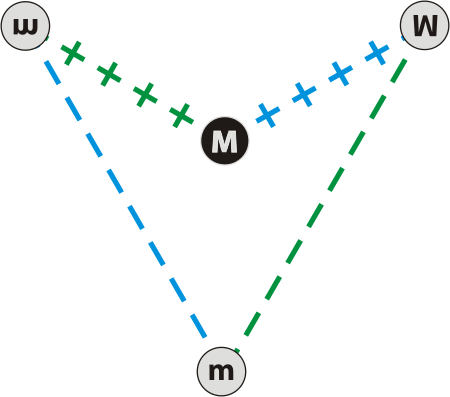
The only way to transform the Primary+++Mode into the three other Secondary+--Modes,
is that of symmetrical inversion, with a choice of two possible levels of
inversion.
1. The large, global, tonal, level of the complete Window, theFull-inversion,
along the+ridge of theWindow Parameter,
, transforms the Flattening Diatonic Major (C) into the Sharpening Diatonic
Minor (Am),
with the note correspondents D-D, G-A, C-E, F-B.
2. The small, nucleus, modal, level of a half-window, theHalf-inversion,
along the+ridge of theMode Parameter,
, transforms the Flattening Diatonic Major (C) into the Sharpening Chromatic
Major (C),
with the note correspondents E-E, D-F, C-G, B-A(b), A-B(b).
NOTE the flats in parentheses (b),
which only apply to the TONIC/DOMINANT Swing of the Chromatic Mode
(Fm6/C7),
and not to the TONIC/COUNTER Swing (G7/C6).
3. The application of both inversions (full and half in either order,+
-, or+
-)
transforms the Flattening Diatonic Major (C) into the Flattening Chromatic
Minor (Am),
which would have been unreliable with any kind of direct parallel transformation,
especially if one relied on scales, instead of swings and circles.
Observations and Conclusions
Metamorphoses
There is a striking similarity between this Inversion Generation and Metamorphoses
4 and 1 -
1.Metamorphosis 4changes a chord ofC6
into a chord ofAm7
,
changing both the Mode (from major to minor)
and the direction (from sharpening to flattening);
theFull-inversiongenerates the Diatonic Minor Mode from the original Diatonic Major Mode,
bringing about a TONIC chord ofAm7
from a TONIC chord ofC6
,
thus producing a change of Mode (from major to minor)
and a change of Direction of the mode (from flattening to sharpening),
but leaving the Window unchanged (still Diatonic).
2.Metamorphosis 1changes a chord ofC6
into a chord ofC7
,
changing both the Window (from Diatonic to Chromatic)
and the direction (from sharpening to flattening);
theHalf-inversiongenerates the Chromatic Major Mode from the original Diatonic Major Mode,
bringing about a TONIC chord ofC7
from a TONIC chord ofC6
,
thus producing a change of Window (from Diatonic to Chromatic)
and a change of Direction of the mode (from flattening to sharpening),
but leaving the Mode unchanged (still Major).
Direction
In this process of mode generation,
theFull-inversionchanges theMode(from Major to Minor)
theHalf-inversionchanges theWindow(from Diatonic to Chromatic)
both inversions change the Direction.
The parameter ofDirectionis thus a product, a result of the other parameters,
and not a generative parameter like the two others (ModeandWindow).
Its 2 ridges (++++and- - - -) DO NOT appear in the generation diagram.
There seems to be no basic, generative relationship between modes of the same
direction -
The Diatonic Minor Mode and the Chromatic Major Mode are in the same direction
merely because they are each a generation away from the original Diatonic
Major.
The Diatonic Major Mode and the Chromatic Minor Mode are in the same direction
merely because the latter is two generations away from the original
Diatonic Major.
It is high time to dismiss the myth of the Chromatic Minor being a parallel form of
the Diatonic Major.
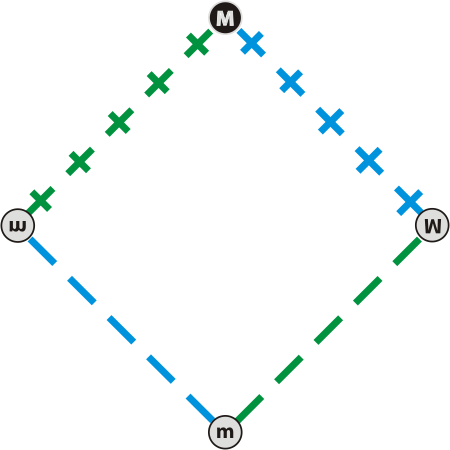
Alternative Disposition of the Four Strong Modes
1. The Diatonic Major Mode
2. The Diatonic Minor Mode
3. The Chromatic Major Mode
4. The Chromatic Minor Mode
5. Adjacent Chromatic Modes
6. A melodic Example
|
