The up-to-date average score of the Technical evaluation is3.2points, and of the Artistic evaluation is2.4points, for a Total score of 5.6 points.
Comments sent with the Scores
None yet
Staff Judges
Analysis - Comments
General - the French National Anthem The words and music are by Claude-Joseph Rouget de Lisle, 1792. The problems here are numerous because we are dealing with a recitativo, rather than
a song, which seems improvised and formless, without anysymmetryor well disposedentities, each melodic motif (usually of 4 bars but two of them only 2 bars) appearing
only once. One point removed here. Establishing any kind of order would require complete reorganization of valid key elements and removal of the rest. Back to the original music page (Bar-lines atLevel 0are indicated "/", and atLevel -1are indicated "\".)
Melo-rhythm To simplify matters, allspreadsof. will be treated as evenin this analysis. Bars 1-4 (2-cells) consist of\/.' \/.,KF KM, with aFeminine Rhymein bar 2 and a masculine rhyme in bar 4. Bars 5-8 (2-cells) consist of\/' \/.,KF KM, again, with a Feminine Rhyme in bar 6 and a masculine rhyme in bar
8. Two acceptable melo-rhythms which have little to do with each other. Bars 9-10 consist of\/.,KM, and are completely apart from the other 4-bar groupings, disturbing the entire large level rhythmic organization. Bars 11-18,\/' \/.' \./.' \./, produce a sequence of rhymesKF KM KM KF, which are current in French verse, but musically unacceptable. Bars 19-28,\_/.' \_/.' \. /'\/. \_/., KM KM MM KM KM, are the Chorus of the piece, evidently irregular, with 2 extra bars (25-26) which should preferably be removed. There are 3 melo-rhythmic entities here - bars 1-4, bars 5-8, and the Chorus, bar 19 to the end.
Melo-harmony There are relatively few secondary chords (indicated in parentheses) in the Melo-harmony
of this piece, mostly in the Off-beat of the first cells, in bars 1 and 3, and in the Chorus
at the end. In bars 1-4, we findI (V) / I \ (IV) V / I, basicallyI / I \ V / I, a normal complete harmonic entity. In bars 5-8, we findI / V \ V / I, the most basic chord pattern of all, also a complete harmonic entity. In bars 9-12, we findI / V \ V / Iagain, but this time in complete conflict with the words and melo-rhythm which start a new 4-bar (even 8-bar) group starting at bar 11. Remove 1 point. In bars 13-18, we find(I7) \ IV (IV-3) / V \ I-3 / V \ I-3 / V , three consecutive cadences toV, with theI7being aVofIV, theIV-3being aII-5, and theI-3being adominantizedIVofV. There is no question of having modulated to the key of G minor. In the Chorus, bars 19-28, we findI / V \ I / V \ I (V) / I \ II / V (IV) \ (V64) V7 / I, in which removal of bars 25-26 would leaveI / V \ I / V \ I (V) / I (IV) \ (V64) V7 / I. There are 3 melo-harmonic entities here - bars 1-4, bars 5-8, and the Chorus, bar 19 to the end.
Melo-lines From one section to the next, there is constant change in the nature of the melodic
motifs - in bars 1-4, 9-12, 19-22, we find numerous skips and arpegio patterns, including
bugle calls; in bars 5-8, 13-18, 23-25, we find more lyrical passages, almost entirely by
conjunct motion. There are only 2 melo-line entities here, bars 1-4, and the Chorus, bar 19 to the
end, both of which end on degree 1 on the scale. These 2 sections are particularly dramatic and effective.Add 1 point here.
Review of Entities Bars 1-4 and the Chorus, from bar 19 to the end, are complete bonafide entities in
the 3 categories, and bars 5-8 are recuperable material, an entity in melo-rhythm and melo-harmony, but not in melo-lines. However, bars 1-4, being acomplete bonafide entity, are aconsequent and bars 5-8, not a complete entity, are anantecedent, the opposite of their present position,a half-point removed here.. Since both sections 1-4 and 5-8 need to be repeated because there is insufficient
symmetry, we might have here the key to our reconstruction.
Reconstruction
Since it seems preferable to maintain the order of the 2 first sections, some decisions
are inevitable. Note that, in each of the three 8-bar sections, a canon is possible,
offering considerable added interest.
Bars 1-4 become 1-8 Create anantecedent for the first section by changing the melo-line in bar 4 to end on degree 3 instead of on degree
1. The original bars 1-4 become theconsequent. The canon is at a 2-bar distance.
Bars 5-8 become 9-16 Create aconsequent for the second section by transposing the first 2 bars a third higher and the last 2 bars a third
lower. The slight change of melo-rhythm at the beginning of thisconsequent helps to eliminate the triteness of the parallel lines in the canon. The original bars 5-8 become theantecedent. The canon is at a 4-bar distance.
The original anthem is composed of 28 bars and we already have 16. With a chorus of
8 bars, we would end up with 3 equal sections of 8 bars each, 24 bars in all. Removal
of the original bars 25-26, as suggested in the melo-rhythm, would produce the desired
length.
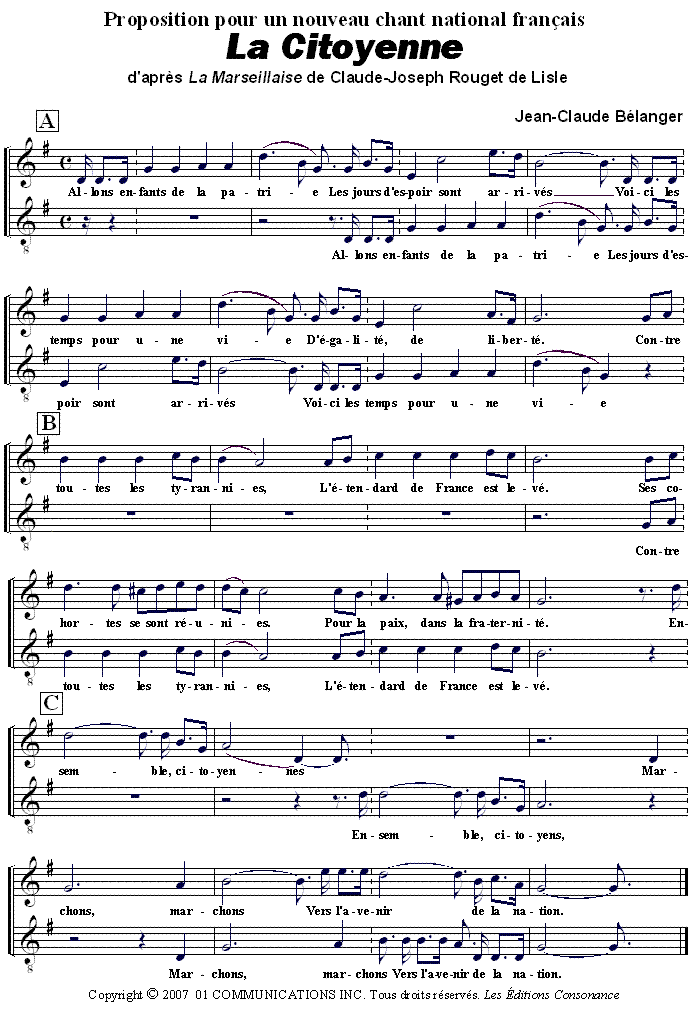
The Chorus, bar 19 to the end In the second bar of the Chorus, aFeminine Rhyme, to accomodate the word "citoyène", would produce theLanger Hingeof the 4-bar entity, a gift which only the French language could offer. Starting at the fifth bar, the canon is at a 1-bar distance, then, in the penultimate bar, at a half-bar distance.
This is what the reconstruction would look and sound like
Scores
In the technical evaluation - 2.5 points were lost,5 - 2.5 = 2.5 In the artistic evaluation - 1 point was added. Total score = 3.5 points
Double Quality Control The first Quality Control was our evaluation of the piece. The second Quality Control is your evaluation of Analysis, did you find it convincing, valid, and fair? Let us know, we will print your comments.
Comments and Questions after reading this Results page

 .
. 


 '\
'\